

How do Nylon and Rilsan powder coatings impact maintenance schedules and overall lifecycle costs for metal components in industrial settings?
Nylon and Rilsan powder coatings can extend maintenance intervals by providing durable resistance to abrasion, impact, chemicals and corrosion, helping metal components remain serviceable for longer. Although initial coating costs may be higher than simpler finishes, reduced recoating, repairs, replacement and associated downtime can lower total lifecycle costs when the coating is matched to the operating environment.
Nylon and Rilsan powder coatings affect lifecycle cost mainly by changing how a component is maintained, inspected and eventually refurbished. Rather than assessing the coating only by its application price, an industrial buyer should consider the full sequence of preparation, installation, inspection, repair, recoating and replacement over the component’s intended service life.
Maintenance planning. A coated component should still be included in a planned inspection regime, but the inspection focus may change. Instead of scheduling maintenance around predictable breakdown or finish failure, teams can assess the coating for local damage, loss of adhesion, exposed substrate, contamination and wear. This supports condition-based maintenance, where work is arranged according to the component’s actual condition rather than an assumed replacement date.
The practical effect is often a simpler maintenance schedule. Routine checks can be combined with existing equipment inspections, while recoating or refurbishment is considered only when the coating has deteriorated sufficiently to affect protection or function. This is particularly relevant for components that are difficult to remove, located within production equipment, or connected to other assemblies where access creates additional labour.
Where lifecycle costs arise. The cost of an industrial finish is not limited to the coating operation. A realistic assessment should include:
- Removal, handling and transport of the component for treatment;
- Surface preparation and any masking or stripping required;
- Production time lost while the component is unavailable;
- Inspection, cleaning and minor repair during service;
- Future recoating or replacement of the component;
- Costs associated with damage to adjacent parts or contamination caused by coating failure; and
- Engineering, fitting and commissioning work after refurbishment.
A coating that remains sound and functional for longer can reduce the frequency with which these activities are triggered. The financial benefit therefore comes from avoiding repeated maintenance events and the secondary costs attached to them, rather than from the coating material alone.
Impact on production downtime. Maintenance can be expensive even when the component itself is relatively low in value. Removing a worn part may require equipment to be isolated, guards or adjoining components to be dismantled, and production to be paused. In other cases, a replacement part may need to be fabricated or sourced before work can be completed. A finish selected for the operating conditions can help reduce the likelihood that coating deterioration becomes the reason for an unplanned intervention.
This should not be interpreted as a reason to extend maintenance intervals without evidence. Operating temperature, contact pressure, impact, chemical exposure, moisture, cleaning methods and the geometry of the part all influence coating performance. Maintenance records should therefore be used to confirm whether the selected coating is performing as expected in its actual environment.
Nylon compared with Rilsan. Nylon is a family of coating materials with properties that vary by formulation. Rilsan is a nylon 11 powder coating, so the comparison should be made between the specific coating grades and the service conditions rather than between two generic labels. The relevant questions include whether the part needs resistance to repeated contact, sliding or abrasion; whether it encounters oils, chemicals or moisture; how much impact it receives; and whether the coating must provide electrical insulation or a particular surface feel.
The better choice is the coating that addresses the dominant failure mechanism. Selecting a finish with properties that are unnecessary for the application can add cost without improving the maintenance outcome, while selecting one that is unsuitable may lead to earlier repair or replacement. Technical information for the chosen system should be reviewed alongside the component’s design, substrate, preparation method and intended use.
Application quality and lifecycle performance. Even a suitable powder coating can give poor economic results if the substrate is inadequately prepared or the coating is applied inconsistently. Areas such as edges, recesses, threaded features, welds and joints need particular attention because they can be more vulnerable to incomplete coverage or mechanical damage. Coating thickness, curing and handling also need to be controlled in accordance with the selected system’s requirements.
Design and maintenance teams should agree in advance how the finished part will be inspected and what condition will trigger intervention. Useful records include the coating specification, preparation requirements, application date, operating environment, inspection findings and any repairs carried out. These records make it easier to identify recurring damage and determine whether the issue relates to service conditions, component design, handling or coating selection.
For a B2B lifecycle-cost review, the most reliable approach is to compare complete maintenance scenarios rather than isolated coating prices. Assess the likely inspection workload, access requirements, downtime, refurbishment route and replacement consequences for each coating option. A specialist powder-coating assessment can then help match Nylon or Rilsan to the component’s operating conditions and establish practical preparation and application requirements before production parts are treated.
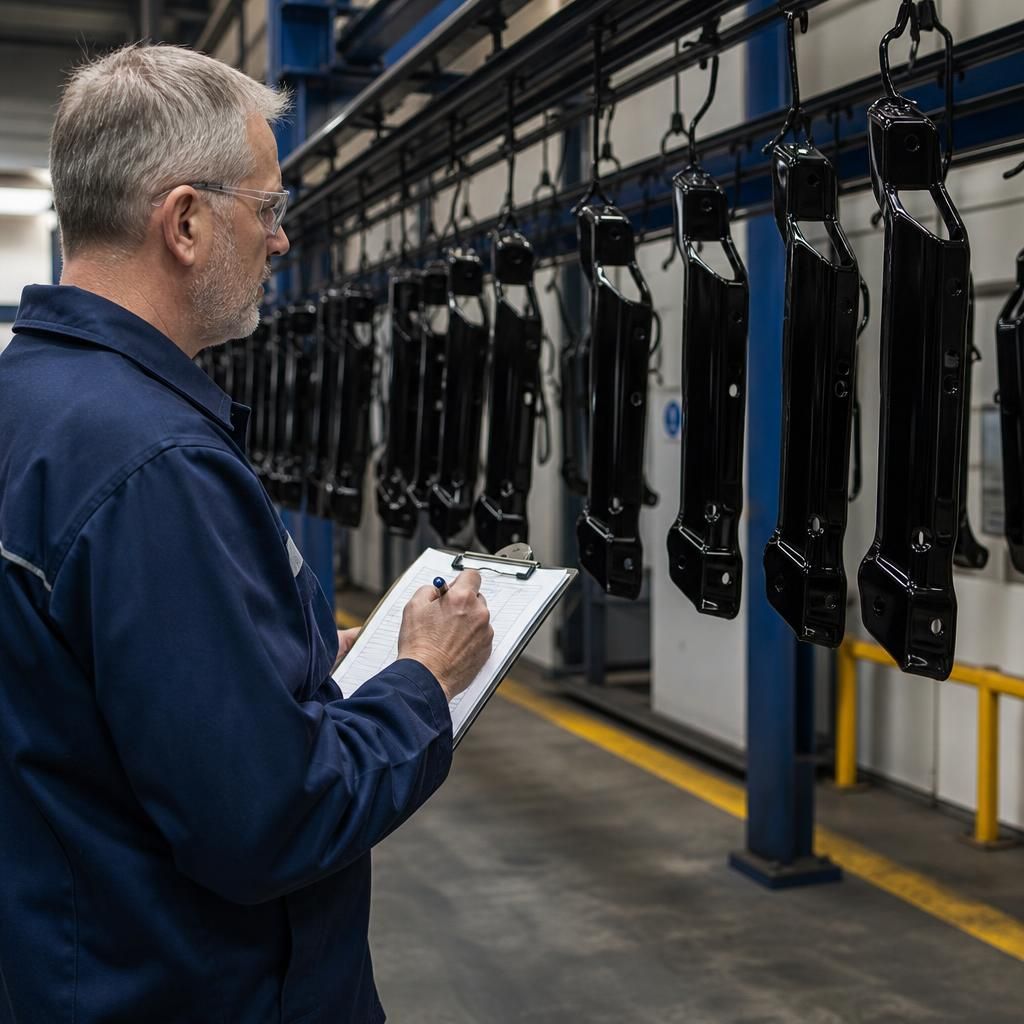
A meaningful lifecycle-cost comparison must assess Nylon and Rilsan coating options over the same component service period, rather than comparing their initial treatment prices alone. The assessment should use consistent assumptions for expected inspection, repair, recoating, removal and replacement requirements. This prevents a higher upfront cost from being judged in isolation or a lower-cost finish from appearing more economical simply because later maintenance has been excluded.
For each option, record the events that could create expenditure and identify which are certain, likely or dependent on operating conditions. This produces a clearer cost profile for procurement and engineering teams, while also showing where better coating performance would have the greatest financial effect. The result is not a guaranteed saving figure, but a reasoned basis for selecting a finish that supports the component’s intended service life.