

What are the benefits of using nylon coatings over other types of metal coatings?
Nylon coatings provide a tough, resilient finish for metal components, combining strong resistance to impact, abrasion, corrosion and many chemicals with a smooth, low-friction surface. Compared with harder but more brittle finishes, nylon can offer greater flexibility and noise reduction, making it suitable for parts exposed to repeated contact or movement.
Nylon coatings are thermoplastic powder coatings that form a continuous polymer layer when heated. Their main advantage over many harder or more rigid metal finishes is that they add a functional, non-metallic surface to the component rather than simply providing a thin protective film. This makes nylon suitable where insulation, cushioning, surface protection, low friction or a substantial coating build are important.
Key benefits compared with other metal coatings include:
- Electrical insulation: Nylon is non-conductive, so it can help isolate a metal component from electrical contact. This can be useful for brackets, housings, guides and other parts where the coating must act as a barrier between the substrate and adjacent components. The required insulation performance depends on the nylon grade, coating thickness, moisture exposure and the design of the finished part.
- A protective, cushioned interface: Unlike a purely metallic finish, nylon provides a polymer surface between contacting parts. This can protect mating components from direct metal-to-metal contact and help prevent marking of softer surfaces. It is particularly useful for guides, supports, rollers, hooks and handling equipment where the coating forms part of the interface.
- Substantial film build: Nylon can be applied as a relatively substantial coating where the specification requires more than a very thin decorative or corrosion-control layer. This allows it to cover minor surface irregularities and provide a defined protective barrier, although the permitted thickness must still account for clearances, threads, holes and moving fits.
- Good coverage of complex components: When the application process and part geometry are properly controlled, nylon can coat awkward profiles, edges and recessed areas more effectively than some conventional finishing methods. Component design, earthing, access for the powder and pre-treatment remain important; no coating process automatically guarantees coverage in deep recesses or shielded sections.
- No liquid solvent carrier: As a powder coating, nylon does not rely on the evaporation of a liquid solvent to form the finished film. This can simplify handling and reduce solvent-related concerns compared with solvent-borne paints. The curing and application stages still require controlled industrial equipment, and the overall environmental impact depends on the preparation, heating and finishing system used.
- Potential for process recovery: Thermoplastic nylon melts and solidifies rather than undergoing the irreversible chemical cure associated with thermoset coatings. In suitable controlled processes, this characteristic can allow certain overspray or coating-process waste to be managed differently from thermoset powder. It does not mean that every applied component can be stripped and recoated without preparation or loss of performance.
Nylon is not automatically the best choice for every metal component. Its service temperature, moisture absorption, chemical compatibility, required thickness and dimensional tolerances should be checked against the operating environment. A harder coating may be preferable where maximum scratch resistance, high-temperature stability or a very thin finish is the priority, while another powder system may be better suited to prolonged exterior exposure or a specific chemical condition.
The comparison should therefore consider the job that the coating must perform, not just its appearance. The substrate, preparation method, part geometry, mating clearances, electrical requirements and expected contact conditions all influence the result. For manufacturers and fabricators, supplying these details before coating helps determine whether nylon offers a practical advantage over paint, plating or another powder coating system.
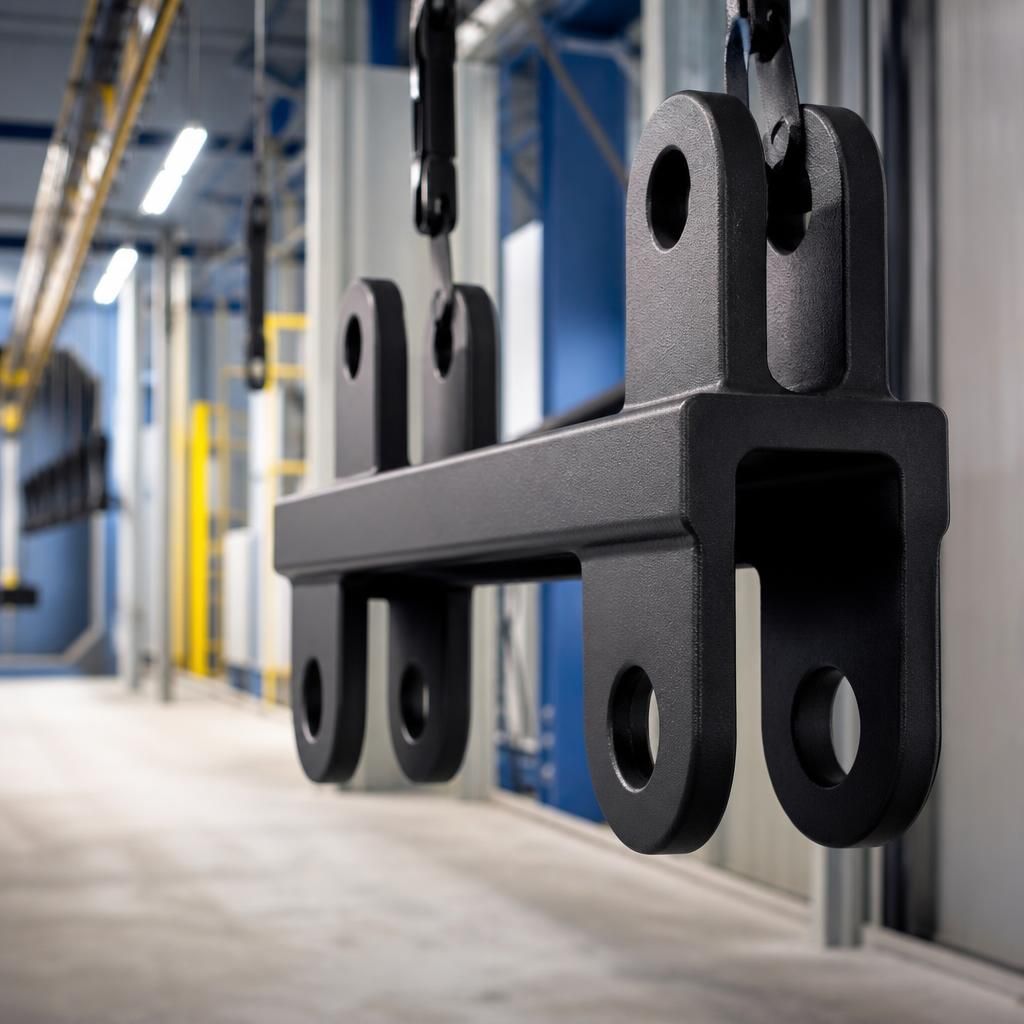
A key advantage of nylon is that the coating can form part of a component’s working interface, rather than serving only as a finish. On guides, supports, hooks and handling equipment, the polymer layer can provide a consistent contact surface between the coated part and adjacent materials. This may reduce the need for separate protective pads or liners, provided the coating thickness and wear requirements are suitable for the assembly.
That functional role is an important distinction when comparing nylon with paint, plating or a conventional hard powder coating. The correct choice depends on whether the component needs a durable contact surface as well as protection for the underlying metal. Designers should check the expected load, movement, mating material and permissible wear before specifying nylon for this purpose.
Discuss nylon coating options for your metal components
Discuss your component’s operating conditions, dimensional requirements and intended use with our powder coating specialists to assess whether nylon is the appropriate finish. Contact Powder-coatings.co.uk for practical guidance on specifying a suitable nylon coating.