

Are there specific nylon coating types best suited for protecting against chemical exposure in industrial environments?
Nylon 11 and nylon 12 coatings are commonly considered for industrial components exposed to chemicals because they offer strong resistance to many oils, fuels, solvents and cleaning agents. The most suitable grade depends on the specific chemical, concentration, temperature, exposure duration and whether contact is intermittent or continuous, so compatibility should be checked against the coating supplier’s technical data before selection.
The most suitable nylon coating for chemical exposure is determined by the chemical service conditions, but nylon 6/12, nylon 11 and nylon 12 are generally the main coating families considered for industrial metal components. Nylon 6/12 can offer a useful balance of chemical resistance, lower moisture uptake and dimensional stability, while nylon 11 and nylon 12 are selected in many applications requiring a durable barrier against oils, fuels, salts and process fluids. The precise grade and formulation should be confirmed against chemical-compatibility data rather than chosen by polymer name alone.
Nylon 6/12 for balanced chemical service
Nylon 6/12 is often considered where a component needs resistance to moisture and a broad range of industrial fluids without the relatively high water absorption associated with some other polyamide types. Lower moisture uptake can help the coating retain more consistent dimensions and mechanical properties in humid environments or where components are repeatedly washed.
It can be appropriate for housings, brackets, handles, guards and fabricated parts exposed to oils, dilute alkaline cleaners and general process contamination. Its suitability still depends on the exact formulation, because plasticisers, impact modifiers, pigments and other additives can alter chemical behaviour. It should not automatically be assumed to resist concentrated acids, aggressive oxidising agents or strongly polar solvents.
Nylon 11 where toughness and barrier performance are important
Nylon 11 is commonly considered for components that combine chemical contact with impact, abrasion or flexing. Its comparatively low moisture absorption helps limit changes in mechanical behaviour in damp conditions, while the coating can provide a tough protective layer over metal surfaces. This makes it relevant to pipework components, industrial handling equipment and parts exposed to repeated contact with oils, fuels or saline contamination.
For chemical service, the important distinction is between an unmodified grade and a formulation designed for a particular operating environment. A grade modified for flexibility may behave differently from a harder, wear-focused grade when exposed to solvents or elevated temperatures. The technical data should therefore be checked for both chemical compatibility and retention of mechanical performance.
Nylon 12 for dimensional stability and fluid contact
Nylon 12 is frequently assessed where lower water absorption, dimensional stability and resistance to many hydrocarbons are important. It can be a practical option for components that must maintain a consistent fit or surface condition while exposed to oils, fuels, hydraulic fluids or cleaning regimes.
Nylon 12 is not universally resistant to every chemical. Some solvents can cause swelling or softening, particularly at raised temperatures or during prolonged immersion. A coating that performs well with occasional splashes may not be suitable for continuous immersion, pressurised contact or repeated chemical cycling. Those conditions need to be treated as separate service cases.
How chemical groups affect the choice
- Oils, fuels and hydrocarbons: nylon grades are often considered for these environments, but the fuel composition, additives and temperature can affect permeation and softening.
- Alkaline cleaners: many nylon formulations tolerate mild or dilute alkaline solutions, although concentration, contact time and wash temperature remain important.
- Acids: acids require closer scrutiny. Dilute, cool and intermittent exposure may have a different result from concentrated or heated acid contact, which can attack polyamide chemistry more aggressively.
- Solvents: aromatic, chlorinated, ketone and other strong solvents should be assessed individually. The possibility of swelling, loss of hardness, cracking or adhesion failure should be considered.
- Oxidising chemicals: strong oxidisers can be unsuitable for nylon coatings, even where the same coating performs well against oils or salts.
- Water and humidity: absorbed moisture can change the stiffness, dimensions and impact behaviour of polyamide coatings. A lower-moisture-uptake grade may be preferable where tolerances are critical.
Formulation features can matter as much as the base nylon
Two coatings described as the same nylon type may not have identical chemical performance. Pigments, fillers, stabilisers and modifiers influence permeability, hardness, flexibility and resistance to cracking. A filled or reinforced formulation may improve wear performance but may not provide the same flexibility as an unfilled coating. Similarly, a coating designed for impact resistance may have different solvent behaviour from a harder formulation intended for abrasion resistance.
Coating thickness and continuity also affect protection. Pinholes, thin areas, sharp-edge thinning and poor adhesion can allow the chemical to reach the metal beneath the coating. A chemically suitable polymer cannot compensate for inadequate coverage or contamination at the metal interface. Application controls should therefore include attention to preparation, edge coverage, cure and inspection as well as the nominal coating type.
How to verify a proposed grade
- List every chemical that may contact the component, including cleaning agents, process residues and maintenance fluids.
- Record the concentration, temperature, pressure, exposure frequency and whether contact is by splash, wiping, immersion or vapour.
- Request compatibility information for the exact nylon powder or coating formulation, not just for the general nylon family.
- Check the effect of exposure on adhesion, swelling, hardness, flexibility, colour and surface appearance, rather than looking only for visible corrosion.
- Where the service is critical, carry out representative immersion or cyclic exposure testing using coated production material and the intended preparation and thickness.
For a metal component exposed to a mixed industrial environment, the best nylon type is therefore the one whose tested formulation matches the complete service profile. A coating specialist can help compare the available grade, finish and application requirements, but the final selection should be supported by the coating manufacturer’s technical data and, where necessary, project-specific compatibility testing.
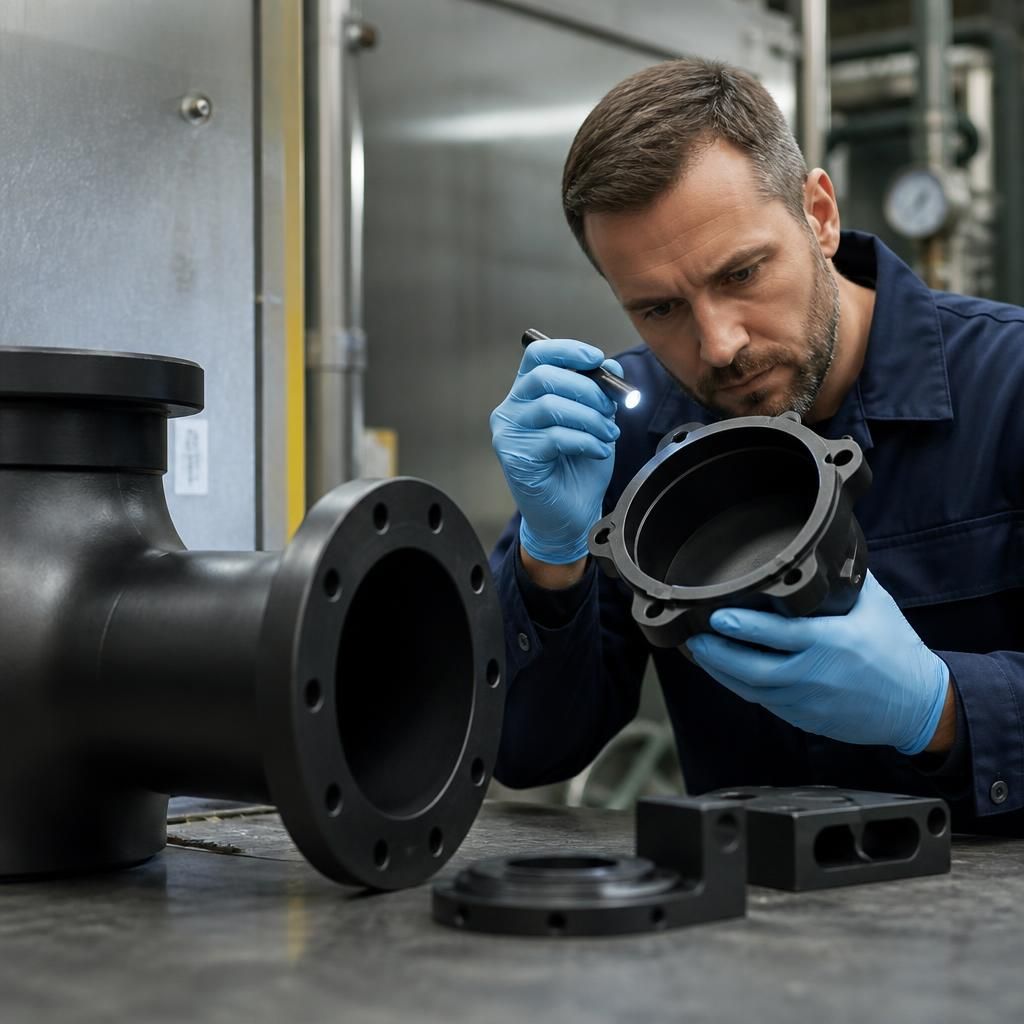
For chemical exposure, the vulnerable point is often the component’s geometry rather than the nylon grade alone. Crevices, lap joints, recesses, weld irregularities and sharp transitions can retain liquids or vapours, increasing the time that the coating and underlying metal remain exposed. A suitable nylon formulation may therefore provide limited protection if chemicals can collect at poorly coated or difficult-to-reach areas.
Where possible, parts should allow drainage and consistent coating access, with attention given to radiused edges, seams, threaded areas and close-fitting interfaces. Masking or dimensional allowances may be needed where coating thickness could affect assembly. Chemical-service evaluations should include these features, not just a flat test panel, so that the selected nylon coating is assessed under conditions that reflect the finished component.
Discuss your chemical exposure requirements
Discuss the component’s chemical service conditions with our powder coating team, including the substances involved, exposure pattern and performance requirements. We can help identify the information needed to assess a suitable nylon coating formulation and finish.