

What specific steps do you take to ensure that the curing process contributes to both the durability and aesthetic appeal of nylon-coated components?
We ensure nylon-coated components are properly prepared before curing, then control the oven temperature, heat exposure and loading arrangement so the coating forms a uniform, well-bonded finish. Each batch is checked for coverage, smoothness, colour consistency and surface defects, helping confirm both the coating’s durability and its aesthetic quality.
Durable, attractive nylon-coated components depend on a controlled cure cycle rather than heat alone. The process is managed so the nylon coating reaches the required melt and bonding condition, remains thermally stable throughout the component, and is handled correctly afterwards to preserve its appearance.
- Confirm the cure requirement for the coating system. The required temperature profile and dwell period are established from the coating specification and the component’s material, thickness and geometry. Nylon systems can respond differently to heat, so a cycle suitable for one product or part should not be applied automatically to another.
- Use calibrated temperature-monitoring equipment. Oven controls indicate the set conditions, but the component itself must reach the necessary metal temperature for the appropriate period. Temperature-monitoring equipment is used to verify the relationship between oven conditions and the part, helping identify cold spots, excessive heat or an unsuitable dwell time.
- Account for thermal mass and geometry. Thick sections, enclosed areas, folded metal and assemblies with different material thicknesses absorb heat at different rates. Cure planning therefore considers the slowest-heating areas rather than relying only on the surface temperature of an easily heated section. This reduces the risk of a coating being under-cured in one area and overexposed in another.
- Protect the finish during the transition out of the oven. Once the cure is complete, components are removed and supported in a way that avoids contact marks, distortion and damage while the coating is still vulnerable. Parts are allowed to cool sufficiently before packing, stacking or further handling, and contact points are selected to minimise visible impressions.
- Control racking and masking details. Hanging points, hooks and masking materials are chosen according to the part’s shape and the areas that must remain free from coating. This helps prevent shadowed regions, unwanted build-up around contact points and damage caused by removing masking after the coating has fused.
- Keep batch records linked to the components. Recording the coating system, cure recipe, oven conditions and any relevant observations provides traceability for repeat work. It also makes it possible to compare results between batches and investigate a change in gloss, colour, adhesion or surface texture without relying on memory.
- Assess the coating beyond appearance alone. A visually smooth finish is not sufficient evidence of a sound cure. Where the specification requires it, the finished coating can be assessed for adhesion, film integrity and resistance to handling or service conditions. These checks help distinguish a genuinely durable finish from one that merely appears acceptable immediately after curing.
- Separate incompatible work where necessary. Different nylon products, colours or coating requirements may need distinct process settings or handling arrangements. Keeping these requirements clearly identified helps prevent the wrong cure cycle being applied and reduces avoidable variation in colour, gloss and texture.
These controls are particularly important for components that will be exposed to abrasion, impact, moisture or repeated handling. By matching the cure cycle to the coating and part, verifying the heat received by the component, and protecting the finish after curing, the process supports both long-term coating performance and a consistent visual result.
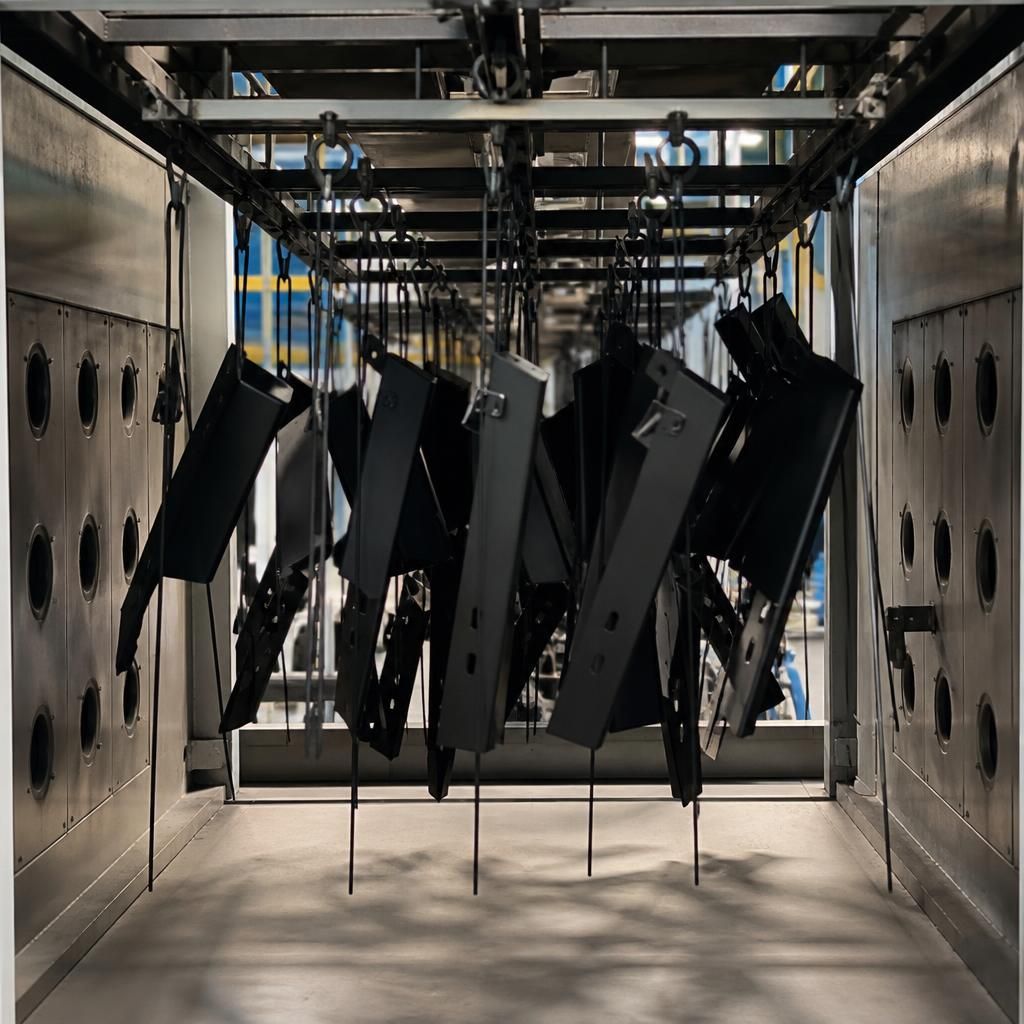
Oven cleanliness and consistent airflow are important parts of curing nylon-coated components because airborne contamination or uneven heat distribution can affect both coating performance and appearance.
Before a batch enters the oven, the chamber and relevant airflow components are checked for dust, residue and loose material that could settle on the coating. Air circulation is also kept consistent so heat reaches the batch evenly without creating areas more vulnerable to surface variation. This helps reduce defects such as specks, blemishes, dull patches and inconsistent texture, while supporting a continuous coating film with the integrity needed for handling and service.
Discuss Your Nylon Coating Curing Requirements
Discuss your nylon coating curing requirements with our team, including component geometry, coating specification and intended service conditions. This allows the appropriate curing and inspection considerations to be reviewed before production planning.