

How does your batch production process manage variability in component sizes and shapes while ensuring consistent coating quality?
We manage variation in component size and shape by assessing each batch, grouping compatible parts, and selecting suitable racking and application settings to promote even powder coverage. Consistent coating quality is then supported through controlled curing and inspection of the finished components for coverage, finish and defects.
Our batch powder coating process manages variation by controlling the factors that affect each component individually, while keeping the preparation, coating and curing requirements consistent across the batch. Size, geometry, metal thickness, surface condition and the required finish are considered before production so that differences between parts do not result in avoidable variation in coverage, film build or appearance.
Pre-production assessment establishes how each component should be handled. Drawings, specifications and any masking requirements are reviewed to identify areas that must remain free from coating, critical tolerances, threaded sections, mating faces and surfaces that will be visible in service. Components with deep recesses, narrow channels, sharp edges or large flat faces may need different preparation or application treatment from simpler parts, even when they form part of the same order.
Surface preparation is particularly important when component shapes vary. Oil, dirt, corrosion, weld residue and other contaminants can affect adhesion and create defects regardless of the part’s size. The preparation stage is therefore matched to the substrate and condition of the metal. Welds, edges and enclosed areas receive attention because they can retain contamination or cause coating build-up if they are not properly prepared.
Masking and contact points are planned to protect functional areas without creating unnecessary bare spots. Plugs, caps or other suitable masking methods can be used where required, while contact points are positioned so that the component can be electrically connected during application. This is important for consistent powder transfer, particularly on complex shapes, recesses and sections where access is restricted.
Powder application is assessed against the geometry of the part rather than relying on one setting for every item. Edges, corners, internal faces and recessed areas can attract or reject powder differently from broad external surfaces. Application technique is adjusted to achieve the specified film build without masking detail, closing small openings or producing excessive deposits on edges. Where a batch contains substantially different designs, the production plan can separate the handling of those designs while retaining the same documented quality requirements.
Heat response is also considered. A thin bracket and a heavy fabricated component may not reach the required metal temperature at the same rate, even if they are processed in the same oven. Components are therefore positioned and processed with their thermal characteristics in mind, and curing is judged by the conditions experienced by the metal rather than by oven air temperature alone. This reduces the risk of under-cured coating on heavier parts or unnecessary heat exposure on smaller ones.
For complex, unfamiliar or particularly variable batches, a representative component can be used to confirm the proposed preparation, application and curing approach before the full run proceeds. This provides an opportunity to identify problems such as difficult access, excessive build-up, inadequate coverage or masking interference at an early stage, when the process can be adjusted without affecting the wider batch.
Quality records help maintain consistency from the first component to the last. They can include the coating specification, powder identification, preparation requirements, masking details, process observations and any agreed acceptance criteria. Finished parts are assessed at relevant surfaces rather than only at the easiest area to inspect. Checks may include:
- visual uniformity of colour, texture and gloss;
- coverage of edges, recesses and less accessible faces;
- film build at defined inspection points;
- cleanliness and condition of masked or functional areas;
- signs of pinholes, craters, bubbles, runs or inclusions; and
- damage caused during unloading, handling or packing.
Handling is treated as part of quality control because a consistent coating can still be marked after curing if components touch, are stacked incorrectly or are moved before they have cooled sufficiently. Suitable separation and careful packing help protect the finish while allowing parts of different shapes to be managed safely.
This approach means component variability is managed through specification review, preparation, geometry-aware application, thermal control, documented checks and appropriate handling. The result is a repeatable batch process that accommodates different sizes and shapes without assuming that every component will behave in exactly the same way.
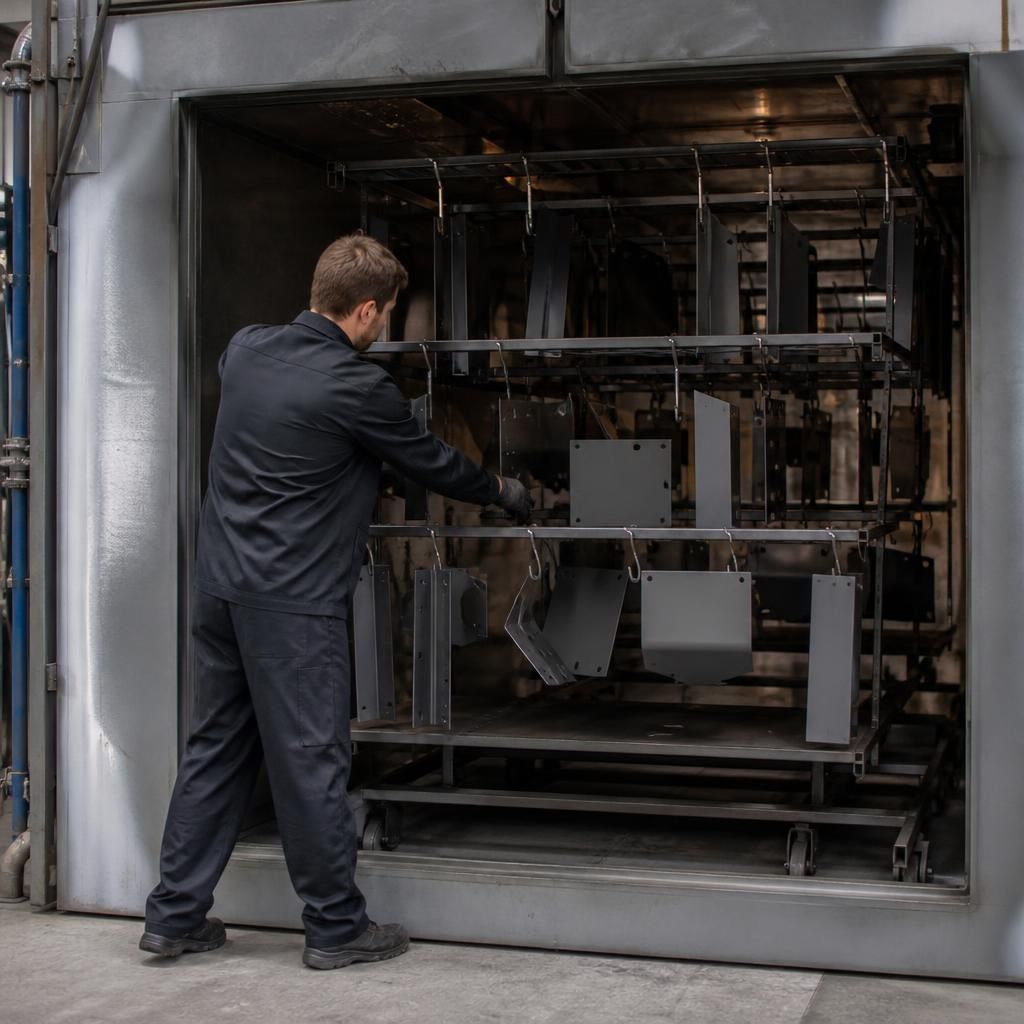
Oven loading is a further control point when a batch contains components with different profiles. Parts are arranged so that larger or more enclosed sections do not shield smaller items from the circulating heat. Adequate separation also helps limit contact between components and allows heated air to reach faces that might otherwise cure more slowly.
The loading pattern should remain consistent for comparable batches, particularly where the same component designs are processed repeatedly. If the arrangement changes substantially, the curing approach may need to be reassessed because the combined load can alter heat flow and the rate at which individual parts reach the required metal temperature.
Discuss your variable component batch requirements
Discuss your variable component batch requirements with our team and provide the relevant drawings, dimensions, quantities and finish specifications. We can review the production considerations for your parts and outline a suitable batch powder coating approach.