

What steps are essential for preparing aluminium surfaces for nylon powder coating?
Essential aluminium preparation for nylon powder coating involves inspecting the surface, removing oil, grease, dirt and existing corrosion, then applying a suitable pre-treatment to promote adhesion. The component should be thoroughly rinsed and dried, with threaded areas and other sections requiring protection masked before coating.
Preparing aluminium for nylon powder coating is primarily about controlling the aluminium oxide layer, creating a suitable surface profile and selecting a pre-treatment compatible with both the alloy and the nylon system. Aluminium forms an oxide film naturally, and that film can vary in thickness and chemistry; unless it is properly conditioned, the coating may bond inconsistently even when the component appears visually sound.
Identify the aluminium substrate first. Different alloys, castings, extrusions and fabricated parts can respond differently to mechanical and chemical preparation. The coating specification should therefore record the alloy where it is known, the manufacturing method, any heat-affected areas and whether the component includes welds, repairs or dissimilar metals. Cast aluminium deserves particular attention because pores can retain process residues and release gas during heating, creating pinholes or blisters in the nylon film.
Establish a controlled surface profile. Where the component design and specification permit it, a light abrasive treatment can provide a uniform key for the coating. Abrasive selection is important: ferrous media can embed particles in aluminium and create later staining or corrosion points. Non-ferrous media and controlled air pressure are generally preferable, with the treatment adjusted to avoid rounding precision edges, altering dimensions or distorting thin sections. The objective is a consistent, active surface rather than an aggressively rough finish.
Deal with the aluminium oxide layer deliberately. A suitable deoxidising or etching stage can remove unstable surface oxides and expose a more uniform substrate for subsequent treatment. This stage must be controlled carefully. Excessive attack can enlarge pits, emphasise casting marks and reduce dimensional accuracy, while insufficient treatment can leave areas with different reactivity. The chosen chemistry should be suitable for the particular aluminium alloy and compatible with the nylon powder coating system.
Use a conversion or adhesion-promoting pre-treatment where specified. Aluminium is often treated with a conversion coating or another approved adhesion-promoting system before powder application. Its purpose is to stabilise the surface and provide a chemically receptive interface between the metal and the nylon. The process specification should define the chemistry, contact conditions and acceptable appearance, as well as whether the treatment is intended primarily for adhesion, corrosion protection or both. A product designed for steel should not automatically be assumed to be suitable for aluminium.
Control component design and fabrication details. Preparation cannot compensate fully for features that interfere with coating formation. Sharp internal corners, narrow gaps, overlapping joints and inaccessible recesses can produce uneven coverage. Weld spatter, smeared machining marks and burrs can remain visible through a thermoplastic coating or create local weaknesses, so these should be addressed during fabrication. Vent holes may be necessary in hollow or enclosed sections to allow air and vapour to escape during the coating cycle; their position and size must be agreed against the component’s functional requirements.
Prevent recontamination after treatment. Once the aluminium has been conditioned, it should be handled in a way that does not introduce fingerprints, workshop dust, silicone, cutting-fluid residue or particles from unsuitable tools. Contact points and racks should be clean and selected to avoid damaging the prepared surface. The interval and environmental conditions between pre-treatment and coating should be defined in the process instructions, because a freshly activated aluminium surface can change if left exposed or handled poorly.
Allow for nylon’s application characteristics. Nylon powders are commonly applied as a thermoplastic coating, and the final film is formed by heating the powder until it flows and bonds. The substrate must therefore tolerate the specified thermal cycle without releasing trapped air, moisture or volatile residues. Components with porous castings, bonded inserts, sealed cavities or heavy welds may need a preliminary review or trial cycle before production. Parts should also be arranged so that the powder reaches all required faces and does not collect excessively in recesses.
Define inspection points before coating. A practical preparation specification should include:
- the permitted aluminium alloy and condition of the substrate;
- the required surface profile and the approved abrasive or chemical method;
- the acceptable appearance after deoxidising or conversion treatment;
- requirements for edges, welds, recesses, threaded features and hollow sections;
- handling controls between pre-treatment and powder application; and
- the checks used to confirm coating coverage, adhesion and finish after curing.
For unfamiliar alloys, repaired components or critical production batches, representative test pieces are useful. They allow the coating system to be assessed on the same aluminium, fabrication method and surface treatment as the finished parts. Adhesion testing, visual inspection and checks for pinholes, cratering, blistering or uneven coverage can then identify preparation problems before the full batch is processed.
In practice, the most reliable approach is a documented aluminium-specific sequence rather than a generic metal preparation routine. Substrate identification, controlled oxide treatment, compatible conversion chemistry, suitable surface profiling, careful handling and verification should all be considered together. This is particularly important where nylon is being used for protective, wear-resistant or electrically insulating purposes, because a defect at the metal-to-coating interface can affect the performance of the complete component.
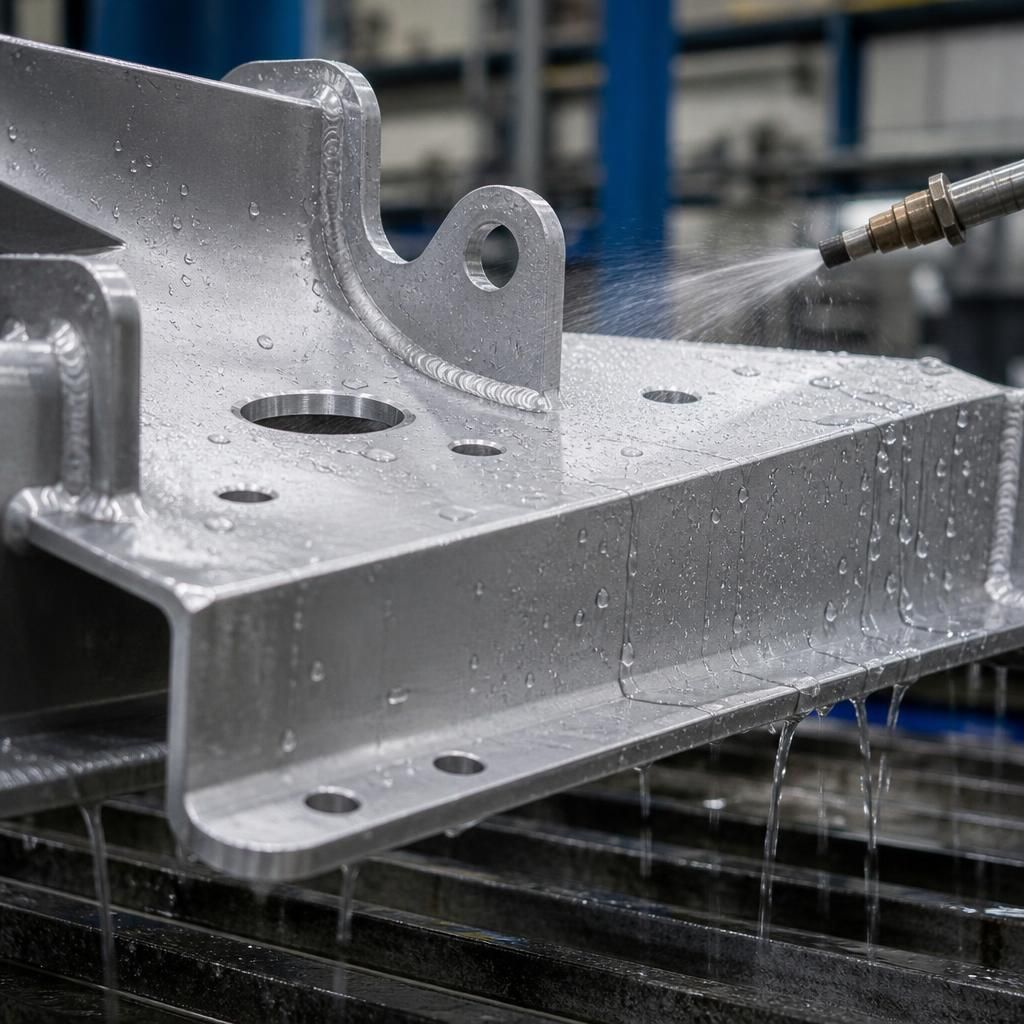
A useful final check for prepared aluminium is to confirm that the surface drains and wets evenly after rinsing. On components with blind holes, channels, flanges or raised sections, the part should be positioned so that treatment solution cannot collect in pockets or run back over cleaned areas. Residual chemistry or rinse water can interfere with the nylon interface and may later contribute to blistering or uneven coverage during heating.
Before the component moves to coating, inspect difficult-to-reach areas as well as the main faces. A continuous water film across the aluminium generally indicates that surface contamination has been removed, whereas isolated breaks or beading suggest residual oil, handling contamination or an incomplete preparation stage. This simple observation is particularly useful for complex fabricated parts where a visual inspection alone may not reveal inconsistent wetting.
Discuss Your Aluminium Preparation Requirements
Discuss your aluminium components, alloy details and nylon coating requirements with the powder-coating team to establish a suitable preparation specification. Providing drawings or representative parts can help identify any design features that need consideration before processing.