

How does your oven powder coating system ensure even distribution and curing of nylon coatings on metal surfaces?
An oven powder coating system helps achieve even nylon coverage by applying the powder consistently and maintaining controlled oven temperature and airflow around the metal component. Correctly matched curing conditions allow the nylon to melt, flow and bond uniformly across the surface, including edges and more complex profiles.
Even nylon coating on metal depends on controlling the part’s temperature, the time it remains at that temperature and the way components are positioned in the oven. Nylon is a thermoplastic powder, so it must reach its specified melt range before it can flow into a continuous film. The oven system therefore provides a controlled thermal cycle rather than relying only on the air temperature shown on the control panel.
Before a batch is processed, the coating requirements are assessed against the component’s material, thickness, geometry and expected use. Thick sections and heavy fabrications absorb heat more slowly than thin brackets or small parts. If every item is given the same nominal dwell time without considering this difference, lighter components may be overheated while heavier areas have not reached the temperature needed for complete flow. The cycle is therefore set around the temperature of the metal itself, not simply the temperature of the oven air.
Key controls for a consistent nylon coating cycle include:
- Oven temperature control: Sensors and control equipment regulate the heat supplied to the chamber so that the process remains within the required operating range.
- Air circulation: Recirculated air reduces stagnant or excessively hot areas and helps expose the surfaces of the load to similar thermal conditions.
- Load spacing: Components are arranged to prevent one part from shielding another or restricting the movement of heated air around recessed surfaces.
- Thermal monitoring: Where the component design requires it, temperature checks help establish when the metal has reached the correct point for nylon to melt and flow.
- Controlled dwell: The part remains in the heated zone for enough time to develop a continuous film without applying unnecessary heat that could affect the substrate or finish.
Component positioning is particularly important for large, deep or irregularly shaped items. Parts should be supported so that coated faces are not pressed against racks or other components while the powder is softening. Contact points are kept to the minimum needed for safe handling, with their location considered during preparation and inspection. Open spacing also helps reduce differences between exposed faces, enclosed sections and areas close to the oven floor or walls.
The transition from powder to finished nylon film occurs in stages. Heat first raises the temperature of the metal, after which the powder softens, melts and flows together. The coating must remain sufficiently fluid to close small gaps between particles and cover the intended profile. Once the component is removed and allowed to cool under suitable handling conditions, the thermoplastic film solidifies. Insufficient heat can leave a rough, porous or incompletely coalesced surface; excessive or uneven heat can affect appearance, dimensional detail or the condition of the substrate.
Oven performance is checked as part of process control rather than assumed from a single display reading. Temperature readings at different locations can identify variation within the chamber, while checks on representative parts show how quickly different sections of a load heat through. Results are considered alongside visual inspection for continuous coverage, consistent texture, missed areas, blistering, pinholes or other signs of poor powder flow. If a defect is localised, the review may include the rack position, part orientation, contact point and surrounding load, as well as the coating application.
Good results also depend on keeping the oven suitable for nylon work. The chamber and circulation system should be kept free from contamination that could settle on the softened coating. The control system, sensors and airflow arrangements require routine checking so that drift or restricted circulation does not gradually create differences between batches. For repeat work, recording the component type, loading arrangement and validated thermal cycle makes the process more reproducible when the same or similar metal parts return for coating.
In practical terms, an oven powder coating system ensures even nylon distribution and curing by combining a suitable powder layer with controlled heat transfer, correct load arrangement, monitored metal temperature and a verified dwell cycle. These controls are especially important where a batch contains different section thicknesses or complex profiles, because they address the causes of uneven flow rather than attempting to correct them after the coating has solidified.
Even curing depends on applying a reasonably consistent powder layer before the component enters the oven. Nylon is fused by heat rather than chemically cured, so areas with excessive powder may flow differently from thin or lightly covered areas. The oven can melt and consolidate the coating, but it cannot compensate for metal that was missed during application or for a deposit that is unsuitable for the component’s required finish.
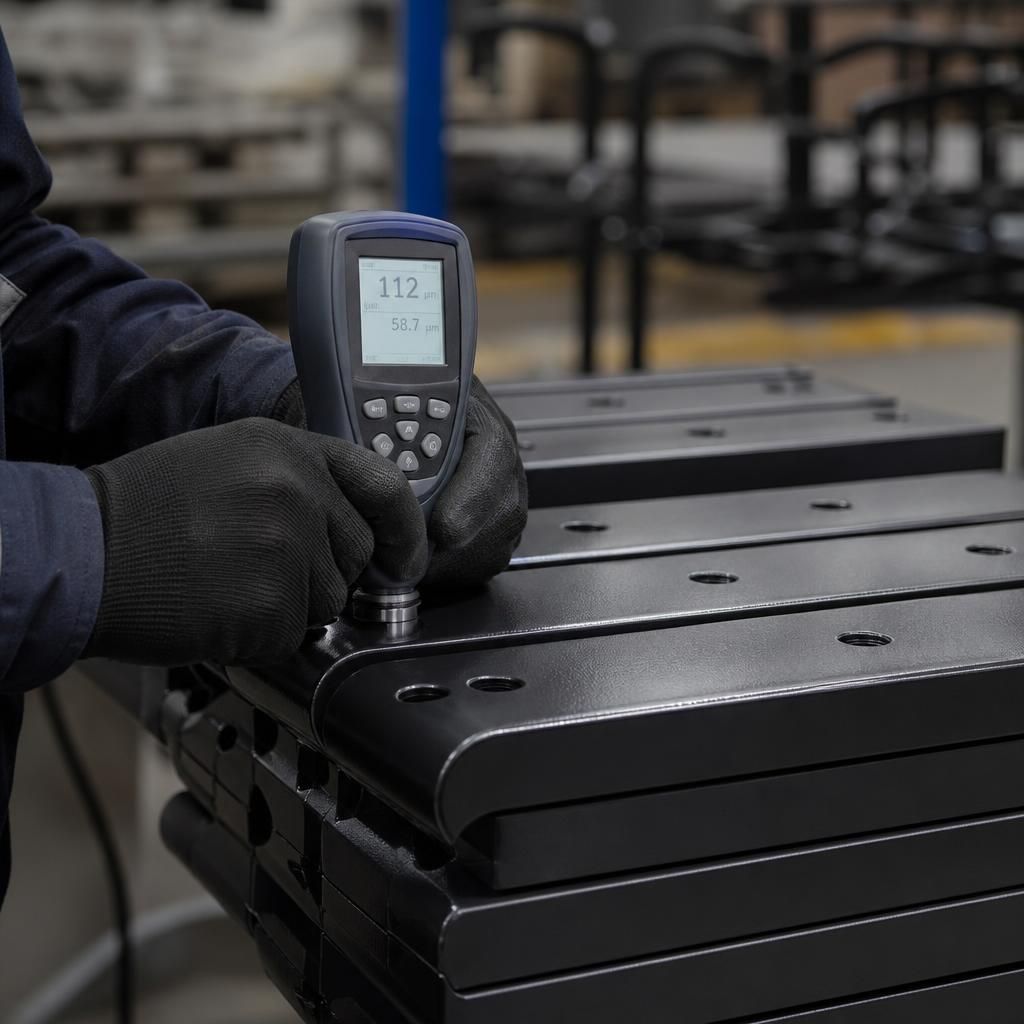
Coating thickness checks after processing help distinguish an application issue from an oven-cycle issue. Measurements should be considered alongside inspection of edges, recesses, welds and other areas where powder coverage can vary. If thickness is inconsistent across a component, the review can focus on powder application, access to the surface and the way the part was presented for coating before changing the thermal process.