

What specific pre-treatment processes should be followed to ensure optimal adhesion and durability in industrial powder coating?
Effective industrial powder coating pre-treatment normally involves thorough inspection, degreasing to remove oils and contaminants, suitable abrasive blasting or chemical conversion treatment, controlled rinsing and complete drying before powder application. The process should be selected for the substrate and service conditions so the surface is clean, suitably profiled and free from residues that could weaken adhesion or accelerate corrosion.
Optimal pre-treatment is a controlled, substrate-specific preparation process that creates a chemically compatible and mechanically stable surface for the powder film. It must account for the metal, fabrication method, intended service environment, coating system and any risks such as porosity, weld contamination or galvanic interaction between dissimilar metals.
Start with the substrate and service specification. Mild steel, aluminium, galvanised steel, stainless steel and cast components do not respond identically to pre-treatment. The required level of corrosion protection may also differ between an indoor fabricated part and a component exposed to moisture, road salt, industrial chemicals or outdoor weathering. The pre-treatment specification should therefore be agreed before production, including the required coating system, appearance, edge coverage, masking areas, testing requirements and acceptable rework procedure.
Prepare fabricated details, not just the broad metal surface. Weld spatter, slag, sharp burrs, laser oxide, embedded abrasives and cutting residues can create local adhesion defects. Weld seams should be continuous and free from porous deposits where possible. Sharp external edges should be removed or suitably rounded because powder films tend to become thinner over edges, leaving them more vulnerable to damage and corrosion. Crevices, overlaps and unsealed joints need particular attention: they can retain treatment residues or moisture and later cause blistering or corrosion beneath the coating.
Hollow fabrications should include suitable drain and vent holes. These allow trapped solutions, rinse water and air to escape during processing and curing. Without adequate drainage, liquid can remain inside joints or boxed sections, while trapped air and moisture may contribute to defects during heating. Components should also be designed so that all surfaces requiring protection can be reached by the preparation equipment.
Match the conversion treatment to the metal. On ferrous substrates, the conversion stage must be compatible with the chosen powder system and the level of corrosion resistance required. Aluminium requires a treatment that protects its naturally reactive surface without creating an unsuitable residue. Galvanised steel needs careful control because aggressive preparation can damage the zinc layer, while insufficient preparation may leave passivation treatments or contaminants that interfere with bonding. Stainless steel and other less reactive alloys may require a different approach again, particularly where a sound mechanical key is needed.
Where a component contains more than one metal, the preparation method must avoid damaging one substrate while treating another. Dissimilar-metal assemblies also need consideration of corrosion at interfaces. In some cases, separating the components for preparation and coating gives more reliable coverage than processing a partially assembled item.
Control process chemistry rather than relying on appearance alone. Treatment concentration, pH, temperature, contact time and solution condition all affect the resulting surface. A bath that is too weak or too short in contact may leave inadequate conversion, whereas excessive treatment can create an unsuitable surface or increase residue. Rinse stages must prevent carry-over between chemicals, and water quality should be suitable for the specified process. Records of bath checks and corrective actions help identify drift before it produces a large batch of defective parts.
Clean handling after preparation is equally important. Operators should avoid touching prepared faces with bare hands and should use clean handling equipment that will not transfer oil, silicone, dust or metal particles. Components should be protected from workshop contamination while they are being moved, stored or loaded for coating. If a prepared surface becomes visibly contaminated, oxidised or marked, it should be assessed and reprocessed rather than coated over.
Address castings and porous materials separately. Cast iron, aluminium castings and other porous components can retain oil, moisture or process residues below the apparent surface. Heating before coating may release these contaminants, producing pinholes, craters or bubbling in the powder film. A suitable pre-bake or outgassing control procedure may be needed, together with a powder system selected for the component. The part should be allowed to stabilise after this treatment and checked for any contamination that has migrated to the surface.
Castings also need inspection for moulding sand, graphite, inclusions and surface porosity. Blasting or cleaning may expose defects that were not previously visible. Filling or sealing may be appropriate for certain non-structural imperfections, but the material used must be compatible with the powder system and curing temperature.
Protect areas that must remain uncoated. Accurate masking of threads, bearing seats, electrical contact points, machined faces and locating surfaces should be planned before treatment. Plugs, caps and masking materials need to withstand the preparation and curing stages without shedding fibres, releasing contaminants or allowing treatment fluid to collect at the masked edge. Masking should create a clean, defined boundary while still allowing adequate preparation of the adjacent coating area.
Manage oxidation and the interval before coating. Prepared steel can begin to oxidise if exposed to unsuitable humidity or contamination before powder application. The process specification should define how prepared parts are stored and how any delay is assessed. Visible flash rust, staining or handling marks should not be concealed beneath powder; the affected area needs evaluation and, where necessary, renewed preparation.
Final preparation should be verified using methods appropriate to the specification. Visual checks can identify residues, missed areas, sharp edges and drainage problems, while surface tests may assess cleanliness or the presence of a suitable conversion layer. After coating and curing, adhesion testing, film-thickness checks and corrosion testing can be used as part of a broader quality plan. These tests do not replace correct preparation, but they help confirm that the selected process is producing repeatable results.
For industrial work, the most reliable approach is to document the complete preparation route for each substrate and component type, including chemical controls, handling rules, masking details, outgassing measures and acceptance criteria. This prevents a generic treatment being applied to unsuitable metal and makes it easier to trace whether a later defect originated in fabrication, pre-treatment, powder application or curing.
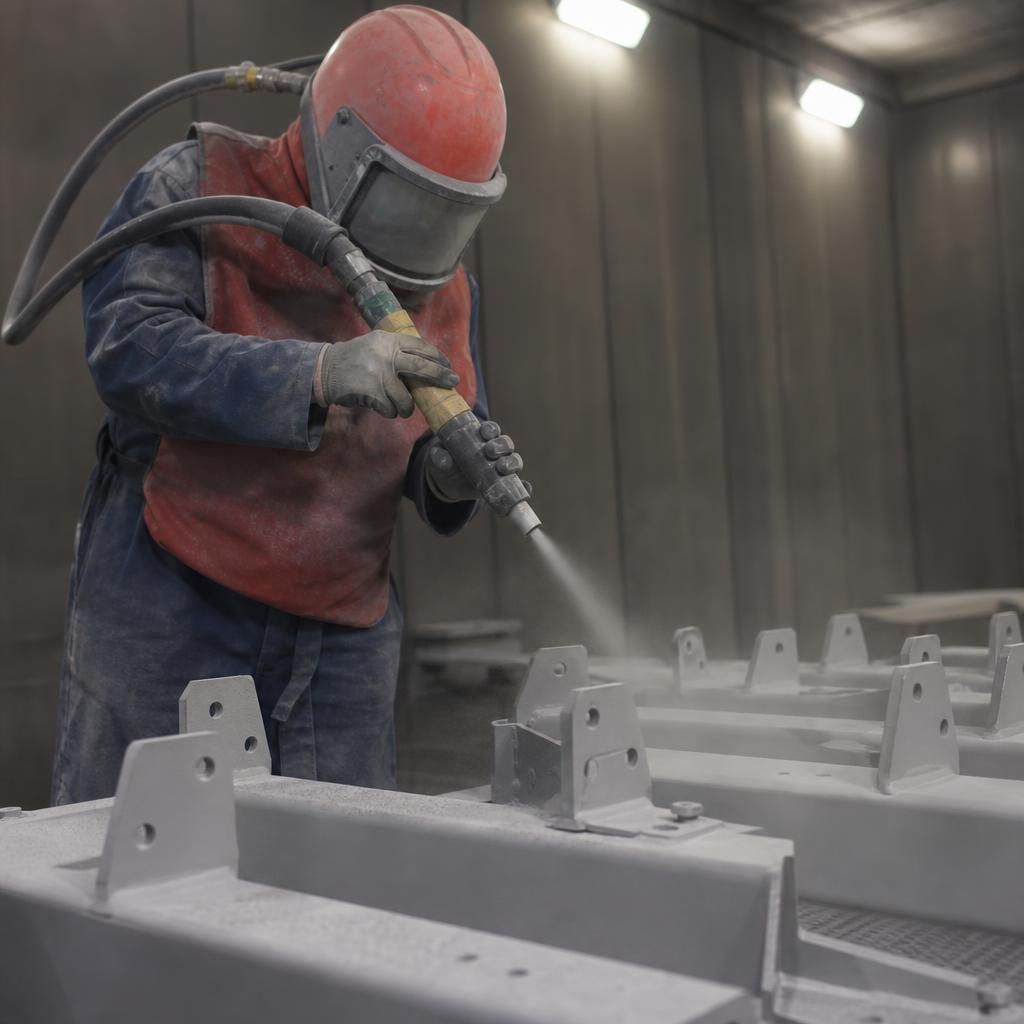
Abrasive blasting should create a consistent, suitable surface profile rather than simply make the metal look clean. The blasting media, nozzle pressure, working distance and angle must be selected for the substrate and component geometry. Excessive blasting can distort thin sections, erode edges or embed abrasive particles, while insufficient blasting may leave mill scale, oxidation or a profile too shallow for reliable mechanical keying.
After blasting, inspect representative areas for uniform texture, missed contamination and media damage. Pay particular attention to welds, corners, recesses and edges, where the blast pattern can be uneven. The prepared surface should then proceed directly into the controlled coating route, with its condition and preparation method recorded as part of the job specification.
Discuss Your Industrial Powder Coating Pre-Treatment Requirements
Discuss your component’s substrate, service environment and required coating specification with the powder-coating.co.uk team to establish a suitable pre-treatment route. Providing details of fabrication, contamination risks, masking requirements and inspection criteria will help define the preparation process before coating begins.