

What factors determine the choice of powder coating materials for different industrial applications?
The choice of powder coating material depends on the component’s substrate, operating environment, required corrosion and chemical resistance, mechanical demands, finish, film thickness and curing limitations. Industrial applications may therefore require different resin chemistries and formulations to balance durability, appearance, performance and cost.
Powder coating material selection is primarily a specification exercise: the coating must be matched to the way the component will be used, the type of failure it must resist and the finish required by the end user. This means choosing an appropriate resin family and formulation rather than treating all powder coatings as interchangeable.
The resin chemistry is the main starting point. Different chemistries provide different balances of flexibility, surface appearance, weathering performance and resistance to particular substances:
- Epoxy powders are commonly selected where adhesion and resistance to chemicals or moisture are important, particularly on components that are not exposed to prolonged direct sunlight.
- Polyester powders are generally preferred for external components because they offer better resistance to ultraviolet exposure and weathering than standard epoxy systems.
- Epoxy-polyester hybrids combine characteristics from both resin types and are often considered for indoor equipment, general fabrication and applications requiring a balance between appearance and functional protection.
- Polyurethane and acrylic systems may be specified where a smooth decorative finish, particular surface appearance or specialised resistance profile is needed.
- Nylon powders are used where the coating needs to tolerate abrasion, impact, friction or contact with aggressive substances. They can be relevant to industrial parts that require a more robust functional surface than a conventional decorative coating provides.
The resin is only one part of the material choice. The formulation may include pigments, additives, flow modifiers and agents that alter gloss, texture, flexibility, slip, electrical behaviour or resistance to specific chemicals. Two powders with a similar colour and nominal resin type can therefore perform differently in service. The technical data sheet and the intended application should be considered together rather than selecting material by colour alone.
The expected failure mode is a particularly useful selection test. A component exposed to rubbing or repeated contact may need an abrasion-resistant formulation. A part that is bent, clipped or assembled after coating may require greater flexibility to reduce cracking. Where edges, fasteners or moving interfaces are involved, the coating specification should also consider chipping, impact and the risk of damage during assembly. For electrical enclosures or components, insulation and conductivity requirements may rule out otherwise suitable decorative powders.
Appearance requirements can also influence the material. Gloss level, texture, colour stability, levelling and visual uniformity are controlled by the powder formulation and the application conditions. Fine textures can help disguise minor surface variation, while smooth finishes make substrate preparation and handling marks more visible. Metallic and special-effect finishes may require tighter control of application and reclaim practices to maintain consistency between batches.
Industrial applications often involve more than one exposure at the same time. For example, a fabricated part may encounter moisture, cleaning chemicals, abrasion and outdoor light rather than a single isolated hazard. In such cases, the most suitable powder is the one that provides a workable overall balance. A resin offering excellent resistance to one substance may be unsuitable if it becomes brittle, loses appearance or performs poorly under another part of the service conditions.
Hygiene, contamination control and cleaning methods can narrow the choice further. Equipment used in food, pharmaceutical or high-cleanliness environments may need a coating with a surface that can be cleaned repeatedly without excessive marking or degradation. The specification should identify the cleaning agents, temperatures and contact frequency involved; generic statements such as “chemical resistant” are not sufficient because resistance varies between formulations and substances.
Part geometry and assembly also affect material suitability. Recesses, enclosed sections, sharp transitions and closely fitted mating surfaces can influence how consistently the powder is deposited and how much coating can be retained. A material may be technically suitable but impractical if the finished film interferes with tolerances, threads, hinges, electrical contacts or press-fit areas. Masking, allowance for mating surfaces and any post-coating machining should be agreed before the powder is selected.
For components exposed to the outside environment, the specification should distinguish between basic weather resistance and long-term retention of colour and gloss. For internal components, those properties may be less important than adhesion, chemical resistance or resistance to handling. This distinction prevents an unnecessarily specialised external-grade material being chosen for an indoor application, while also avoiding an indoor formulation on parts that will face sustained weathering.
Selection should be confirmed against relevant technical evidence. Useful information includes recommended uses, resistance tables, flexibility and impact data, gloss retention, colour stability, storage requirements and any limitations on application. Where the operating conditions are unusual, a representative test piece or trial batch can assess appearance, adhesion and functional performance on the actual component. Testing is especially valuable when the part will contact solvents, detergents, fuels, oils or other substances not covered clearly by the supplier’s general documentation.
In practice, the coating specification should record the resin type, colour and finish, the required performance characteristics, the areas that must remain uncoated, and any restrictions created by assembly or service use. This gives the coating provider enough information to recommend a formulation suited to the component instead of relying on a generic “industrial powder” description. For manufacturers and fabricators, a clear specification also makes repeat work and batch-to-batch comparison more reliable.
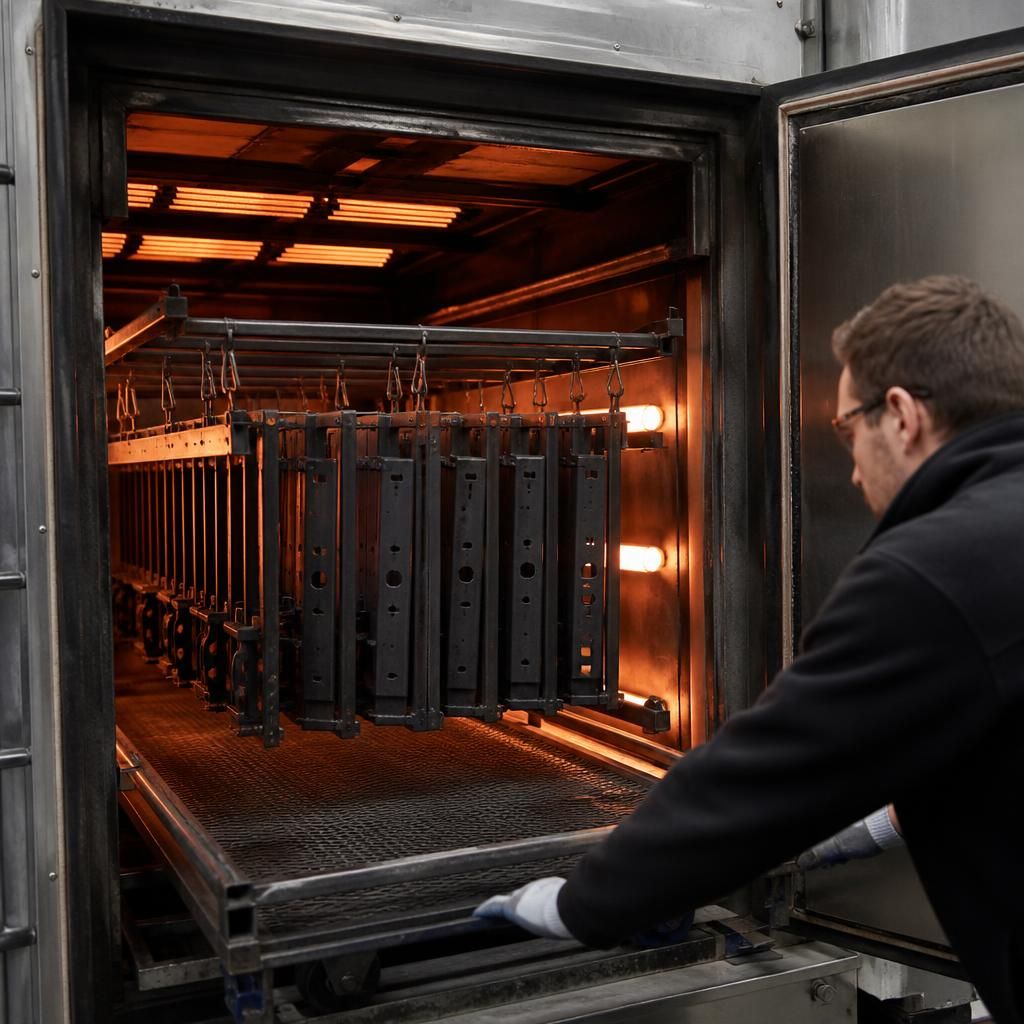
Curing requirements can determine whether a powder coating is suitable for a particular component. The resin must reach its specified cure state throughout the film, so the coating material should be matched to the part’s metal thickness, thermal mass and any components that could be affected by heat.
A formulation with an unsuitable cure schedule may remain under-cured, reducing hardness and chemical resistance, or become over-cured and lose flexibility or appearance. When parts include heat-sensitive inserts, bonded sections or tightly controlled dimensional features, the material choice should therefore be checked alongside the oven profile. A representative trial can help confirm that the selected powder achieves the required finish without affecting the component.
Discuss your industrial powder coating material requirements
Discuss your industrial powder coating material requirements with our team, including the component substrate, service conditions and required finish. We can help identify the information needed to assess a suitable coating specification for your application.