

What are the benefits of using nylon powder coatings in industrial applications?
Nylon powder coatings provide industrial metal components with a tough, wear-resistant finish that can withstand repeated contact, impact and abrasion. They also offer low friction and resistance to many chemicals, making them suitable for components exposed to sliding, handling or demanding operating conditions.
Nylon powder coating is a thermoplastic finish that melts and flows over a prepared metal surface to form a continuous protective layer. Its main industrial benefits, beyond general surface protection, are electrical insulation, noise reduction, a smooth low-maintenance surface and the ability to provide a relatively thick coating on components with demanding service requirements.
Electrical insulation: Nylon is a non-conductive material, so a coating can help isolate metal components from electrical contact. This can be useful for brackets, housings, supports, wire forms and other parts where the substrate needs physical protection without remaining electrically exposed. The insulating performance depends on the nylon grade, coating thickness, continuity of the film and the conditions in which the component operates. Where electrical performance is safety-critical, the selected coating system should be tested for the intended voltage, temperature and environment.
Noise and vibration control: The polymer layer can provide a degree of cushioning between metal surfaces. This makes nylon powder coatings useful where coated parts come into contact with one another, slide against fixtures or transmit impact noise. Applications may include handling equipment, storage systems, machine components and parts used in transport or manufacturing environments. The coating does not replace a purpose-designed acoustic or vibration-control material, but it can reduce the harshness associated with direct metal-to-metal contact.
Continuous coverage on complex components: When correctly applied, nylon powder can flow into a coherent film around edges, bends and formed sections. This gives the component a consistent barrier rather than leaving the metal exposed beneath a thin or discontinuous layer. The result depends heavily on part geometry, grounding, powder application, melt conditions and the quality of the pre-treatment. Sharp edges, recesses and areas that are difficult to reach may require particular attention during coating design and inspection.
Smooth, easy-clean surfaces: Nylon can produce a smooth finish that limits the tendency of dirt and process residue to remain attached. This is valuable on equipment that is handled frequently or cleaned as part of routine maintenance. The appearance can also be more forgiving than an uncoated metal surface, although the final texture, gloss and colour depend on the chosen formulation and application method.
Thick-film capability: Nylon powder coatings are available for applications requiring a substantial polymer layer rather than a thin decorative finish. A thicker coating can help separate the underlying metal from fixtures, products or other surfaces. It may also provide useful edge protection and improve the feel of handles, guards and formed components. Specifying the correct thickness is important: excessive build can affect dimensions, clearances, threads, moving interfaces and the appearance of corners.
Processing and repair considerations: As a thermoplastic, nylon softens when reheated rather than curing through the irreversible chemical reaction associated with thermosetting powder. This characteristic can be advantageous for some manufacturing and refurbishment requirements, but it also means that the finished component must not be exposed to temperatures beyond the coating’s service limits. Repairs, stripping and recoating need to be assessed against the substrate and the condition of the existing film; simply applying new powder over a contaminated or poorly bonded layer is unlikely to produce a reliable result.
Nylon is not automatically the best choice for every industrial part. Moisture absorption can affect the material’s dimensions and properties, while prolonged high temperatures, strong ultraviolet exposure or particular chemicals may require a different nylon formulation or another coating resin. Compatibility with the substrate is also important, especially where galvanised steel, aluminium or previously coated metal is involved.
The correct specification should therefore consider the component’s operating temperature, electrical requirements, exposure to moisture and chemicals, dimensional tolerances, cleaning regime, appearance and method of use. Thorough cleaning and pre-treatment are essential because nylon powder adheres to the prepared surface; oil, rust, mill scale or residual contamination can undermine the coating regardless of the resin’s inherent properties. For industrial batches or specialist components, these factors should be reviewed before selecting the powder, application method and target film thickness.
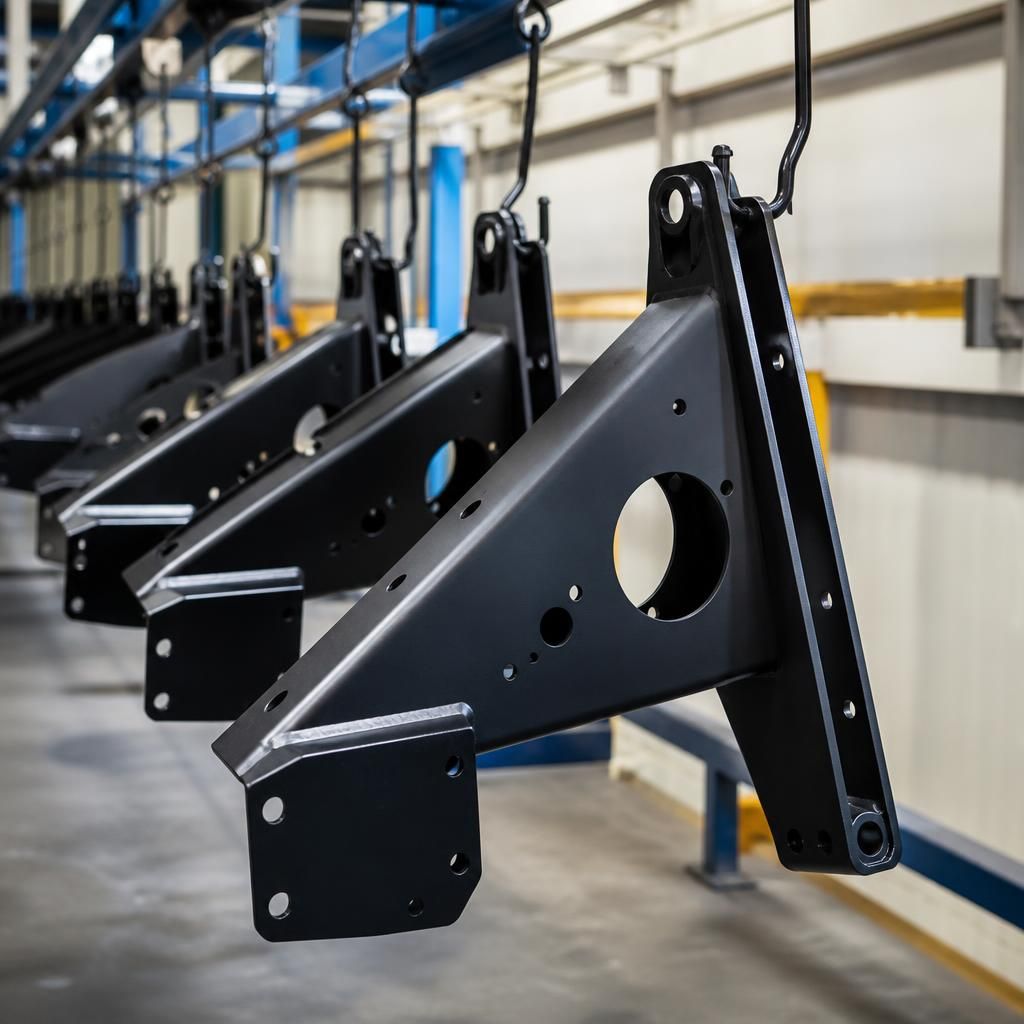
Nylon powder coatings are particularly valuable when a metal component needs a functional polymer surface rather than a purely decorative finish. Their performance can be tailored to the part’s working conditions, including contact with other materials, handling requirements and exposure to process chemicals. The coating specification should be based on the component’s operating environment and dimensional requirements, since nylon grade, film thickness and surface preparation all influence the finished result.