

What preparation processes are necessary before applying protective powder coatings?
Protective powder coating requires thorough substrate preparation, usually involving inspection, degreasing, removal of rust, mill scale and existing coatings, abrasive blasting or other suitable cleaning, followed by drying and masking of areas that must remain uncoated. The prepared surface is then checked for contamination, damage and profile before powder application, helping the coating bond consistently and provide effective corrosion protection.
Preparation for protective powder coating is a controlled combination of design review, substrate correction, material-specific pre-treatment and process control. The aim is not simply to make the metal look clean; it is to create a chemically suitable, physically sound surface that will allow the coating system to perform in its intended environment.
1. Confirm the coating specification and substrate
Preparation should be selected only after confirming the base material and the conditions the finished component will face. Mild steel, galvanised steel, aluminium and cast metals can require different treatments, and a process suitable for one may produce poor adhesion or premature failure on another. The specification should account for exposure to moisture, salts, chemicals, abrasion, UV radiation and temperature changes, as well as the required coating thickness and appearance.
Component drawings and coating requirements should also identify areas that must remain functional. Threads, bearing surfaces, electrical contact points, machined fits, hinge faces and close-tolerance interfaces may need planned protection during the process. This is a preparation decision because coating build-up in these locations can affect assembly or performance.
2. Correct defects before coating
Powder coating will follow the underlying shape rather than conceal manufacturing defects. Burrs, sharp projections, weld spatter, deep scratches and poorly finished joints should therefore be removed or corrected before pre-treatment. Sharp edges are particularly important on protective work because they can receive less effective coverage than broad faces, creating a vulnerable point in the coating system.
Welds should be continuous where the design requires them, with spatter removed and the surrounding metal properly finished. Pinholes, porosity and narrow crevices can retain moisture or process chemicals, while inaccessible lap joints may contribute to corrosion beneath the coating. Where these conditions cannot be corrected, the risk should be considered when selecting the design and coating system.
3. Deal with castings, galvanised surfaces and porous materials
Castings and other porous components may contain oil, moisture or gases within the material. Heating during curing can drive these contaminants towards the surface, causing pinholing, bubbling or loss of appearance. Depending on the component, a controlled heat treatment before coating may be required to release volatile material. This is commonly known as outgassing control and should be assessed before the final powder is applied.
Galvanised and zinc-coated parts need preparation that respects the zinc layer. Excessively aggressive treatment can remove useful protection, while unsuitable pre-treatment can leave a surface to which powder bonds inconsistently. White rust, loose zinc deposits and manufacturing residues must be addressed using a method compatible with the coating specification. Aluminium and mixed-metal assemblies also need care because different metals can react differently during chemical treatment.
4. Apply the correct chemical pre-treatment
For many protective systems, a chemical conversion stage is used after the main physical preparation. This creates a thin, adherent layer that improves the interface between the metal and the powder coating and can support corrosion resistance if the coating is later damaged. The chemistry must be matched to the substrate; treatments for steel are not automatically suitable for aluminium or zinc-coated components.
Process control is important at this stage. Concentration, contact time, temperature, rinsing and drying all influence the result. Poor rinsing can leave residues, while inadequate drying can introduce moisture into the coating process. A pre-treatment line should therefore be monitored against the relevant process specification rather than judged by appearance alone.
5. Control handling and contamination after preparation
Once a component has reached the required condition, it should be handled in a way that does not reintroduce grease, moisture, dust or fingerprints. Clean gloves, suitable racks and controlled movement between stages help protect the prepared surface. Contact points must be planned so they do not create uncoated areas in critical locations or interfere with the electrical path needed for powder application.
Parts should also be positioned so that trapped water or treatment residues can drain. Drainage and venting are especially relevant to hollow sections, boxed fabrications and assemblies with enclosed spaces. If liquid or gas remains trapped, it can cause defects during curing or create a later corrosion risk.
6. Carry out a final pre-application check
Before powder is applied, the preparation record should confirm the substrate, treatment route and any repairs made. The component should be free from visible residue and ready for the specified coating system, with critical dimensions, contact areas and drainage features protected or maintained as required. For demanding projects, checks may include surface cleanliness, treatment coverage, coating compatibility and test panels or sample parts.
These controls are particularly valuable for batch work and fabricated components with different materials or geometries. They help ensure that the preparation method is repeatable across the complete order rather than suitable for only one easily accessible face.
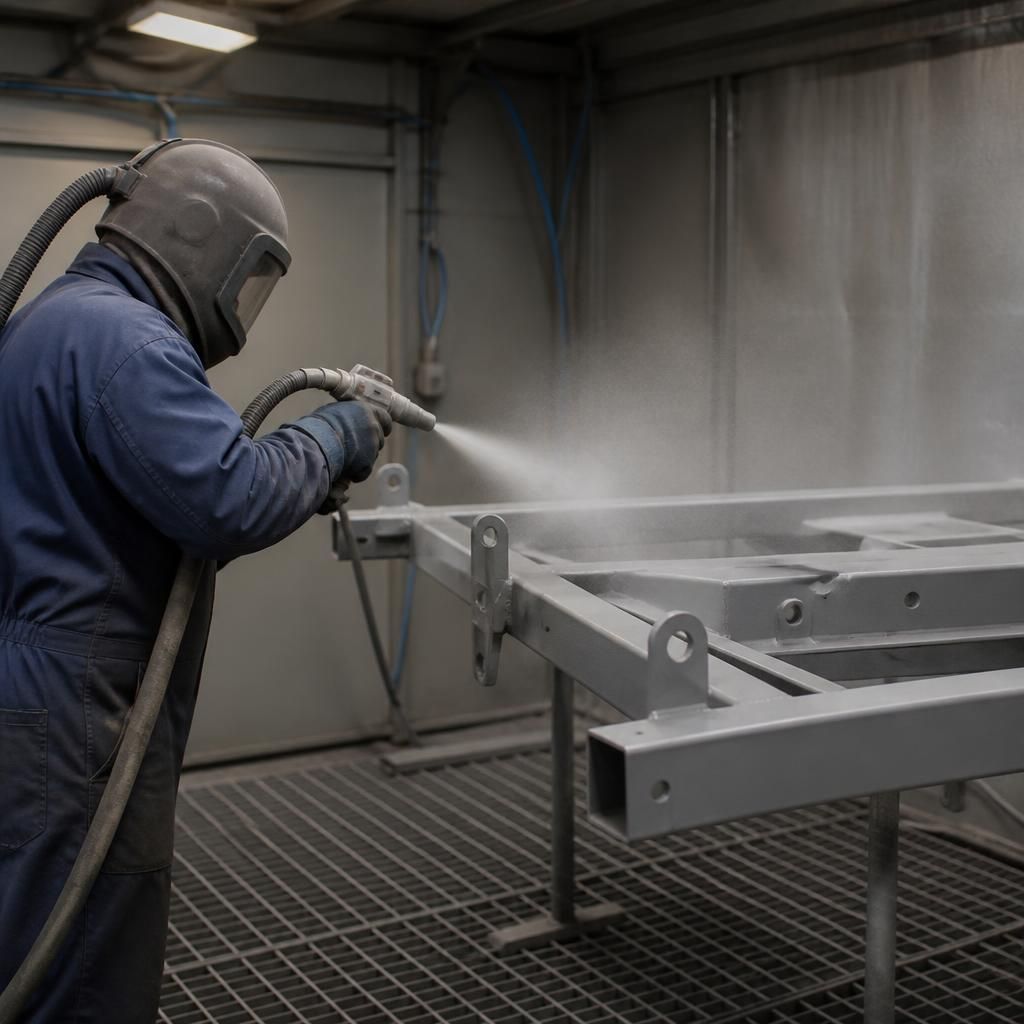
Abrasive blasting prepares more than the appearance of the metal. It removes tightly bonded oxidation and residues while creating a controlled surface profile, giving the powder coating a physical key to bond to. The blasting medium and pressure must suit the substrate: an overly aggressive process can distort thin sections or damage zinc-coated surfaces, while insufficient preparation may leave contamination or an unsuitable profile.
After blasting, components should be protected from moisture and airborne dust until powder application. The prepared surface should be assessed for remaining scale, embedded media and uneven areas, with any issue corrected before coating rather than concealed beneath the powder.