

What are the advantages of using protective powder coatings over traditional liquid paint?
Protective powder coatings generally provide a harder, more uniform and more durable finish than traditional liquid paint, helping metal components resist abrasion, impact, corrosion and weathering. The dry application process also avoids liquid solvents and can reduce coating waste, making powder coating a practical option for many industrial components and batch-production requirements.
Protective powder coatings offer several practical advantages over traditional liquid paint, particularly for metal components manufactured or coated in controlled batches. The powder is applied electrostatically and then heated so that it melts, flows and cures into a continuous polymer film. This process can improve coating consistency, simplify production handling and reduce several problems associated with liquid paint application.
More efficient transfer of coating material
During electrostatic application, charged powder particles are attracted to the earthed metal component. This helps the coating reach exposed faces and reduces the amount of material that passes the workpiece compared with conventional spray application. Unused powder may also be collected and reused where the equipment and coating specification allow it. Liquid paint overspray, by contrast, normally requires careful control, extraction and disposal.
The efficiency of the process can be particularly useful for repeat production runs. Once the component is correctly prepared and the application parameters have been established, successive parts can be coated using a consistent method rather than relying on the changing viscosity, drying behaviour and application technique associated with liquid paint.
A cured film with useful mechanical properties
Powder coating forms a cured film rather than leaving a liquid carrier to evaporate. The resulting finish can provide strong resistance to everyday handling, scuffing and contact with equipment. This is valuable for fabricated parts that are moved between manufacturing stages, packed for transport or installed in demanding industrial settings.
Because the coating is cured as part of a controlled heating cycle, it is less dependent on ambient drying conditions than liquid paint. Temperature, time and film build can be monitored during production, helping the coater identify process variations before a larger batch is completed. Liquid paint can be affected by humidity, temperature, airflow and the time needed between coats.
Fewer drying and handling complications
Liquid-painted components may need an extended period for the coating to dry or harden sufficiently for handling. If they are moved too early, the surface can mark, pick up contamination or become damaged at contact points. A correctly cured powder-coated component can usually proceed to inspection and handling once it has cooled, subject to the coating system and production specification.
Powder coating can also reduce the need for repeated liquid coats to achieve the required coverage. The appropriate number of coats still depends on the metal, preparation method, powder type, colour, target film thickness and exposure conditions. A specification should therefore define the required finish rather than assuming that the thickest possible coating is the best option.
Cleaner production and simpler storage
Traditional liquid paint commonly requires thinners, cleaning solvents and measures to control flammable or volatile materials. Powder is supplied as a dry material, so storage and equipment-cleaning arrangements are different. This can simplify some aspects of a coating operation and reduce reliance on solvent-based cleaning, although powder still needs to be stored correctly and handled in accordance with its safety information.
Powder coating does not eliminate environmental or safety responsibilities. Application requires suitable extraction and control of airborne particles, and curing uses an industrial oven. The complete process should be assessed rather than judging the coating solely by the absence of liquid paint.
Potential lifecycle benefits
A coating that remains intact during manufacture, transport and service can reduce the frequency of remedial work. Fewer touch-ups may mean less interruption for the user and less preparation, material and labour associated with recoating. This is a lifecycle consideration rather than an automatic saving: the correct pretreatment, powder chemistry, film thickness and curing conditions are essential to achieving the intended service performance.
Powder coating may also support a more repeatable appearance across a production batch. Colour, gloss and texture are influenced by the powder specification and the curing process. Parts should be assessed under appropriate lighting, and samples or agreed standards may be needed where colour matching is important.
Important limitations when comparing the two methods
Powder coating is not suitable for every component. The item must normally tolerate the curing temperature, and its dimensions must fit the available application and oven equipment. Assemblies containing heat-sensitive materials, sealed cavities, certain plastics or components that must not be heated may require an alternative coating method.
Liquid paint can remain advantageous for on-site repairs, very large fixed structures, substrates that cannot be heated and applications requiring extensive wet-on-wet or multi-layer systems. It may also be more practical where a component cannot be dismantled for oven curing. The better choice depends on the substrate, component size, production volume, exposure conditions, required appearance and repair arrangements.
For industrial metal parts, the fairest comparison is therefore based on the full coating system rather than the material alone. Confirm the preparation standard, powder type, target film thickness, curing requirements, inspection method and intended environment before placing a batch into production. Powder coating often provides a more controlled and efficient route than liquid paint, but its advantages are realised only when the component and specification are suitable for the process.
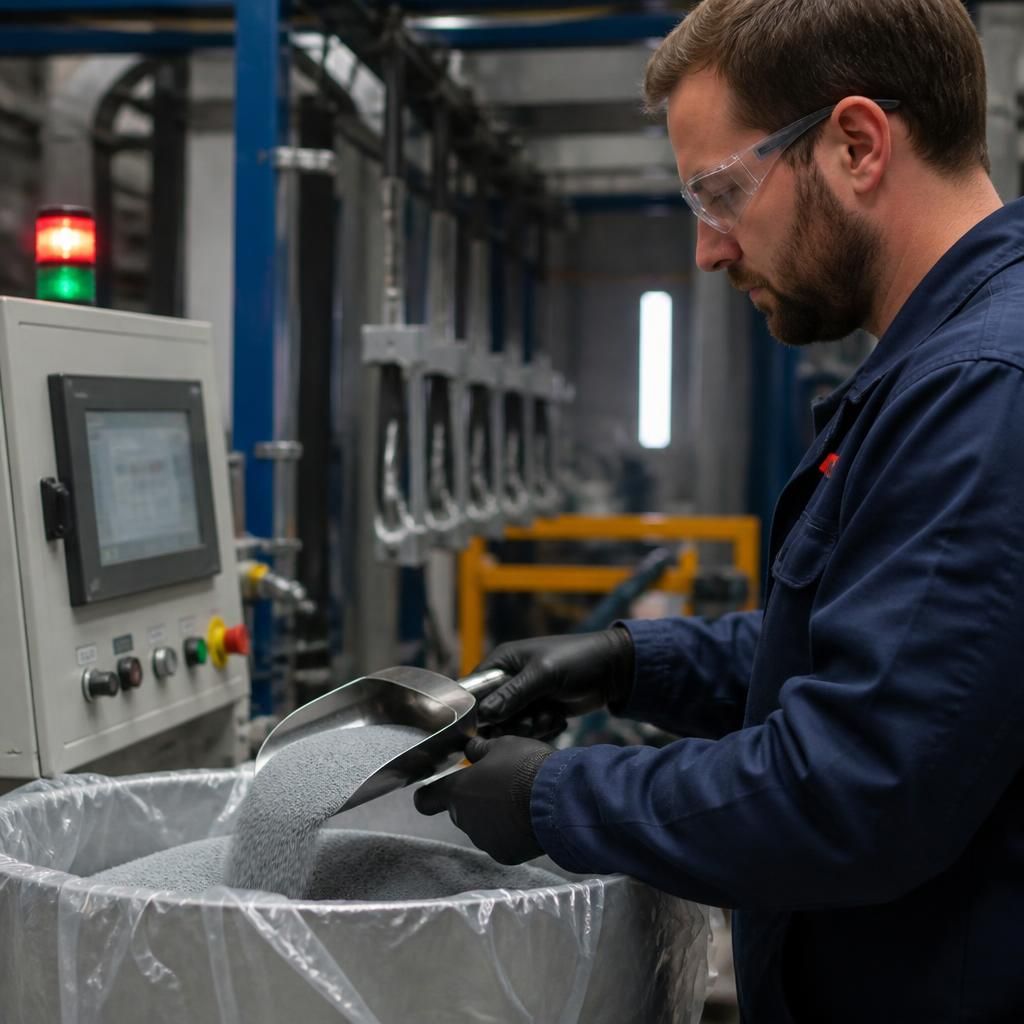
Protective powder coatings can simplify production control because the dry material is supplied as a defined formulation rather than a liquid system that may require mixing, thinning or viscosity adjustment before application. This reduces variation caused by changing solvent levels, incorrect ratios or paint reaching the end of its usable pot life.
For repeat batches of metal components, the coating specification can therefore be linked to consistent application settings, including powder type, electrostatic charge, spray parameters and target film thickness. The result is a more controlled process for manufacturers and fabricators, provided the powder is stored correctly and the equipment is calibrated for the component and finish required.
Assess whether protective powder coating suits your components
Share your component drawings or samples, substrate, dimensions and intended service environment for an assessment of whether protective powder coating is suitable. The coating specification can then be considered against the preparation, powder type, film thickness and curing requirements.