

How do different finishes in powder coating affect the durability and maintenance of steel components?
Different powder coating finishes affect steel components mainly by changing surface cleanability, scratch visibility and resistance to dirt retention, while overall durability also depends on pre-treatment, coating thickness and the service environment. Smooth, higher-gloss finishes are generally easier to clean, whereas matt and textured finishes can disguise minor marks but may require more careful cleaning because their surface profile can retain contaminants.
Powder coating finish affects the durability and maintenance of steel components mainly through its surface profile, coating formulation and resistance to the conditions in which the component will operate. The visual finish alone does not determine service life: pre-treatment, film thickness, curing, edge coverage and the powder chemistry are equally important. A carefully specified finish can reduce marking, support easier inspection and remain suitable for the component’s exposure environment.
Finish and mechanical wear
Gloss level and texture influence how a coating responds to handling, abrasion and repeated contact. A textured or wrinkle finish can provide a less uniform contact surface, which may help make small scuffs and handling marks less visually prominent. However, texture does not make the steel immune to impact or abrasion. A severe impact can still break through the coating, expose the substrate and create a local corrosion risk.
Smooth finishes can make damage easier to identify during inspection because chips, dents and coating loss are more obvious against the even surface. This can be useful for components subject to routine quality checks or where early detection of damage is important. In either case, the underlying coating formulation and the quality of the cure have a greater effect on resistance to wear than the appearance category alone.
Gloss, satin, matt and textured finishes
- High-gloss finishes: provide a continuous-looking surface and can make coating defects, impact damage and unevenness more apparent. Their suitability depends on the powder system and the service environment rather than gloss level alone.
- Satin finishes: offer an intermediate appearance and are often selected where a less reflective surface is required without a pronounced texture. Their maintenance requirements still depend on the contaminants and chemicals encountered in service.
- Matt finishes: reduce reflected light and can give a more restrained appearance. They should be assessed against the cleaning products and handling conditions expected in use, as aggressive cleaning can alter the appearance of some coatings.
- Textured and wrinkle finishes: can reduce the visual prominence of minor handling marks and provide a particular tactile appearance. Their profiles may make close inspection of small defects more involved, so cleaning and inspection methods should be agreed before production.
These categories should not be treated as a simple ranking from least to most durable. For example, a textured exterior-grade powder may outperform a smooth interior-grade powder in outdoor exposure, while a chemically resistant smooth coating may be more appropriate for an industrial component exposed to cleaning agents.
Weathering and corrosion protection
Outdoor durability is governed primarily by the powder’s resistance to ultraviolet exposure, moisture, temperature changes and pollutants. A decorative finish can retain its appearance while the steel is protected only if the complete coating system is appropriate and continuous. A finish with a low sheen is not automatically more resistant to weathering than a high-gloss finish, and a textured surface is not a substitute for proper pre-treatment.
Corrosion normally begins where the coating system has been damaged, poorly bonded or inadequately applied. Edges, corners, recesses, drilled holes and joints require particular attention because they can receive less consistent coverage or retain moisture. Finish selection should therefore be considered alongside steel preparation, coating thickness, curing conditions and the design of the component. Where corrosion exposure is significant, the specification may need a suitable pre-treatment and coating system rather than a purely decorative change of finish.
Chemical and temperature exposure
Maintenance can be affected by oils, fuels, detergents, salts, solvents and process chemicals. Some powder coatings tolerate these substances well, while others may soften, stain, lose gloss or develop a surface change after repeated exposure. The correct choice depends on the chemical, its concentration, contact time, temperature and frequency of exposure.
Components exposed to heat should also be assessed against the operating temperature and any thermal cycling. Repeated heating and cooling can place stress on the coating and substrate, particularly where the component includes sharp transitions, different materials or areas with uneven thermal expansion. The finish should be selected from a powder system tested for the expected conditions rather than from appearance alone.
How finish affects inspection and repair
The finish changes how easily operators can identify coating faults. On an even surface, pinholes, inclusions, runs and impact damage may be more apparent. On a pronounced texture, small surface irregularities can be less visually distinct, although larger defects remain identifiable. Inspection should therefore consider both visual appearance and measurable coating performance, including adhesion, continuity and thickness where relevant to the specification.
Local repair can also be more noticeable with textured, metallic or special-effect finishes. A liquid touch-up may not reproduce the original texture, gloss or colour precisely, and a repaired area can weather differently from the surrounding powder coating. For components where future repair is likely, the maintenance plan should identify an approved repair method and define when a part should be recoated rather than locally touched up.
Cleaning and maintenance considerations
Steel components should be cleaned using a method compatible with the coating system. In general, maintenance should begin with removal of loose contamination using a suitable soft method, followed by a compatible detergent solution where required and thorough rinsing. Abrasive pads, harsh solvents and strongly aggressive chemicals can change the appearance or damage the coating, particularly when used repeatedly.
Cleaning instructions should reflect the selected finish and the operating environment. A component exposed to road salt, industrial deposits or process residue may need more frequent planned cleaning than one used in a clean indoor setting. Inspection during cleaning provides an opportunity to identify chips, blistering, edge corrosion or areas where the coating has been worn away. Damage should be assessed promptly so that the repair method matches the severity and the exposure conditions.
Choosing a finish for a steel component
- Define the environment, including indoor or outdoor use, moisture, ultraviolet exposure, chemicals, abrasion and operating temperature.
- Identify whether the priority is appearance retention, reduced visibility of handling marks, resistance to a particular chemical or straightforward inspection.
- Specify the powder chemistry and performance requirements before selecting the visual finish.
- Check the component design for sharp edges, recesses, joints and areas that could compromise coating coverage or retain contamination.
- Agree cleaning products, inspection criteria and repair procedures with the coater and end user.
- Use representative samples or test panels when the finish is unusual, the environment is demanding or colour and texture consistency are important.
The most durable and maintainable result comes from treating finish selection as part of the complete coating specification. Appearance, powder formulation, steel preparation, application and curing must work together; changing only from gloss to matt or from smooth to textured cannot compensate for an unsuitable coating system or poor process control.
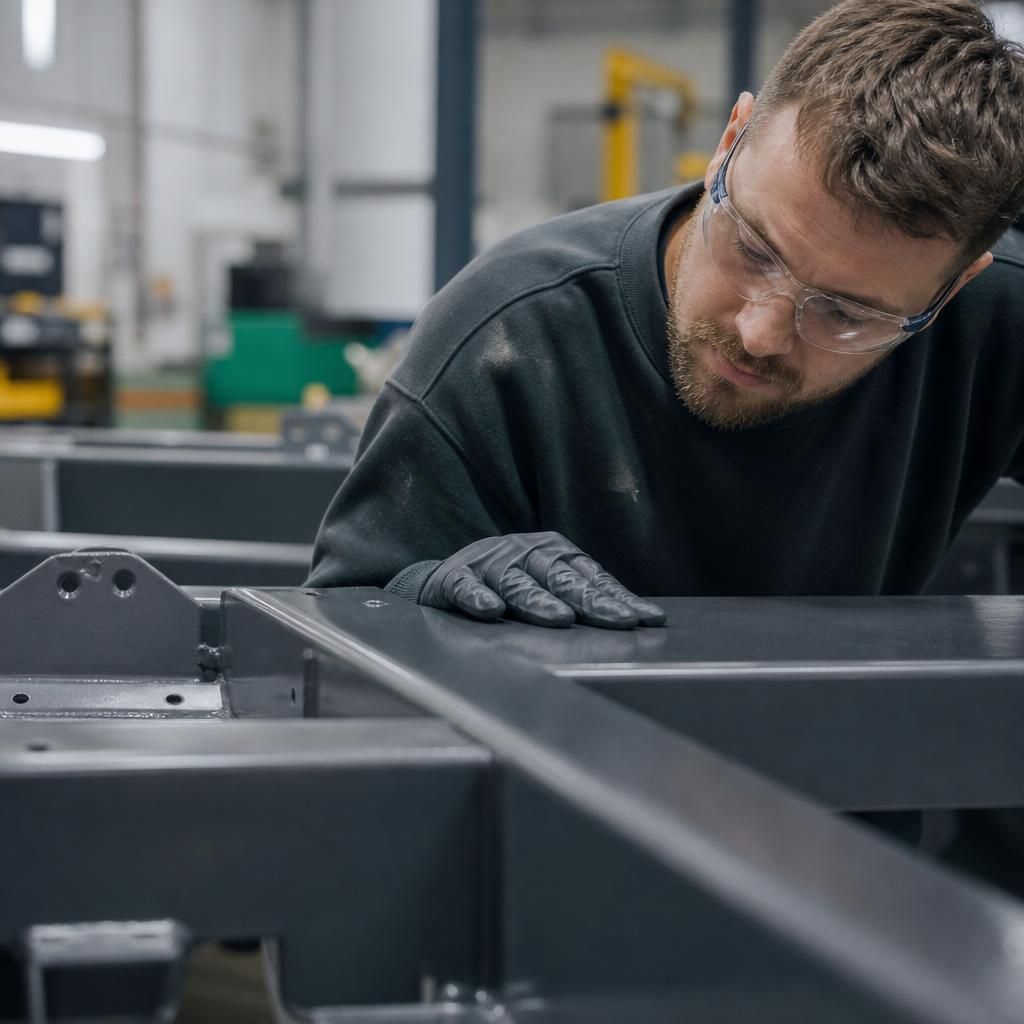
Finish can affect how clean or worn a steel component appears without changing the coating’s underlying protection. High-gloss surfaces may make fingerprints, water marks and light surface residue more noticeable, while matt finishes can develop polished-looking contact areas where repeated handling has altered the surface sheen. These changes are mainly appearance issues, but they can influence maintenance decisions and make consistent inspection lighting important. Any suspected coating failure should be assessed by checking for loss of adhesion, exposed steel, blistering or corrosion rather than relying on a change in sheen alone.