

How can powder coating thickness affect the performance of steel components?
Powder coating thickness affects how effectively a steel component is protected from corrosion, wear, impact and weathering. An insufficient or uneven coating may leave weak points, while excessive thickness can affect appearance, edge coverage, curing and the fit of assembled parts, so the correct specification must match the component’s use and exposure.
Powder coating thickness affects steel performance by controlling the barrier between the metal and its environment, as well as the coating’s resistance to mechanical damage, movement and chemical exposure. The most useful measurement is the dry film thickness (DFT) after curing, assessed against a specified target range rather than judged by appearance alone.
Corrosion protection
A continuous powder film limits the movement of water, oxygen, salts and other corrosive substances towards the steel surface. If the film is locally thin, porous or poorly bonded, corrosion can begin at that weak point and spread beneath the coating. A suitable thickness helps maintain a more consistent barrier across faces, corners and less accessible areas, but it cannot compensate for contamination, inadequate preparation or existing corrosion on the steel.
Thickness also influences how long a coating can resist exposure before the protective barrier is compromised. Components used indoors in controlled conditions may have different requirements from steel exposed to rain, condensation, road salts, industrial pollutants or coastal air. The correct specification should therefore consider the complete exposure environment rather than applying one thickness to every steel component.
Resistance to wear, impact and handling
A properly specified film gives the surface enough material to withstand normal handling, contact and light abrasion. This is particularly relevant to fabricated parts that are moved between manufacturing stages, installed on site or exposed to repeated contact during service. However, a thicker film is not automatically tougher. Performance depends on the powder formulation, adhesion, curing and the type of force involved.
For example, a coating may resist surface rubbing but still chip if the steel is struck sharply, or crack if the component flexes. Excessive build can make the film less forgiving when the substrate is bent or subjected to impact, while a thin or poorly bonded film may wear through more readily. Thickness must therefore be matched to the likely damage mechanism, not selected as the sole measure of durability.
Flexibility and movement
Steel parts can expand, contract, vibrate or flex during service. The coating has to remain attached while the substrate moves. A film that is too thick for the component and powder system may have less flexibility and can be more vulnerable to cracking, flaking or loss of adhesion at stressed areas. This matters for brackets, guards, fabricated frames, panels and other parts exposed to vibration or repeated loading.
Where a component will be formed after coating, thickness is especially important. Bending, pressing or sharp deformation can damage the film, so coating specifications should establish whether forming takes place before or after powder application. Coating a fully prepared and formed component is generally preferable where the design permits it.
Dimensional and assembly effects
Powder coating adds material to the steel surface. That build can affect close-fitting components, threaded holes, bearing seats, sliding interfaces, hinges and other areas manufactured to tight tolerances. It can also alter the clearance between mating parts. These effects are usually managed by identifying masking requirements, coating exclusion zones and critical dimensions before production.
Edges, internal corners and recessed sections deserve particular attention because the deposited powder does not distribute equally across every geometry. The specified thickness should be achievable on the important functional surfaces without creating unwanted build-up on assembly features. Drawings should identify surfaces that must remain uncoated or have controlled coating thickness.
Electrical and thermal behaviour
Powder coating is electrically insulating. Increasing the film thickness can increase the separation between the steel and any contacting electrical component, which may affect earthing, bonding or electrical continuity. Contact points, earth studs and conductive interfaces may therefore need to be masked, cleaned after coating or designed to accommodate the coating system.
The film can also influence heat transfer from the steel surface. For components exposed to sustained heat, the powder type, cured film thickness and operating temperature all need to be considered together. A coating specification should not rely on thickness alone when the part is used near heat sources or experiences significant temperature cycling.
Appearance as an indicator, not proof of performance
Visual uniformity can help identify obvious variation, but it does not confirm that the coating meets its required performance. Colour, gloss and texture can appear consistent while the actual film thickness varies between surfaces. Conversely, a textured finish can make visual assessment of the film particularly difficult.
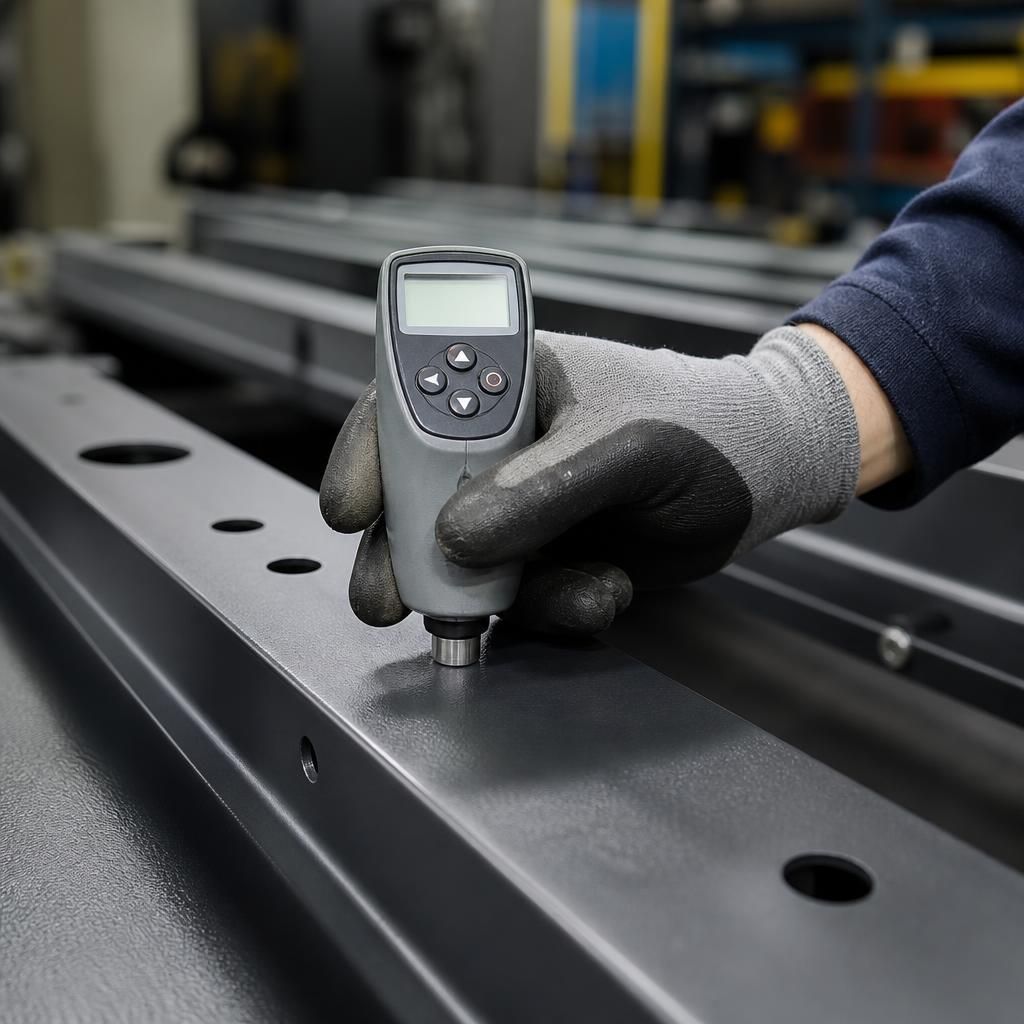
Thickness should be checked using an appropriate calibrated dry-film gauge on representative areas. Measurements normally need to cover the surfaces that matter to the component’s function, including accessible faces and areas where geometry may cause variation. The acceptance criteria should define the target range, permitted local variation and how readings are to be recorded.
How the right thickness is specified
Before coating steel components, consider:
- the corrosion category and conditions in which the component will operate;
- expected abrasion, impact, contact and handling;
- whether the steel will flex, vibrate, expand or contract;
- critical dimensions, threaded features and mating surfaces;
- electrical contact, earthing and thermal requirements;
- the powder system’s application and curing requirements; and
- which areas need masking, controlled build or a coating exclusion.
The coating supplier and applicator can then agree a practical thickness range for the particular steel grade, component geometry, powder system and end use. This is more reliable than requesting the thickest possible coating or specifying a single nominal value without considering the part’s design.
In practice, consistent preparation, controlled application, correct curing and verification of the finished DFT are as important as the selected thickness. A well-specified film supports corrosion resistance and service durability, while uncontrolled variation can create functional problems even when the average coating thickness appears acceptable.
Steel surface profile can affect how powder coating thickness translates into actual protection. Abrasive preparation creates microscopic peaks and valleys that help the coating bond, but the film may be thinner over the peaks and provide less effective coverage in the valleys. A specified thickness therefore needs to be considered alongside the prepared surface profile, rather than treated as an isolated measurement.
For this reason, the coating specification should define the required preparation condition and the method used to assess dry film thickness on the finished steel. Excessive surface roughness can make a nominal reading less representative of the coating’s protective coverage, while insufficient profile may reduce adhesion. Controlling both factors gives a more reliable relationship between measured thickness and service performance.