

What types of metal substrates can be handled by industrial powder coating systems?
Industrial powder coating systems can handle many conductive metal substrates, most commonly mild steel, stainless steel, aluminium, and suitably prepared galvanised or zinc-coated steel. The required pretreatment and powder selection depend on the substrate’s condition, geometry, corrosion exposure and curing temperature.
Industrial powder coating systems are suitable for most metal components that can be electrically grounded, withstand the required curing temperature and accept the necessary surface preparation. Suitability therefore depends not only on the metal itself, but also on its alloy, condition, shape, contamination, coating specification and the way it will be used.
Common component forms
Powder coating equipment can process a wide range of fabricated and manufactured items, including sheet-metal panels, folded sections, box section, angle, channel, tube, wirework, mesh, brackets, frames and guards. It can also be applied to many cast and machined components, provided their geometry allows the surface to be cleaned, coated and heated consistently.
Large or awkwardly shaped parts require particular consideration. Deep recesses, narrow cavities, overlapping joints and enclosed sections can restrict powder penetration or retain pretreatment chemicals. Hollow components may also release trapped air or moisture during heating, causing pinholes, blistering or contamination. Drain and vent holes, suitable hanging points and an appropriate racking method can improve the result.
Ferrous metal components
Iron- and steel-based fabrications are widely processed in industrial powder coating plants. Their condition is important: mill scale, rust, weld residue, cutting oils, grease and shop dirt must be removed before coating. Welded assemblies may need additional cleaning around seams and corners, while sharp edges can require attention because powder tends to form a thinner film over them.
Cast components need separate assessment. Porosity in a casting can release gas during the oven cycle, creating surface defects after the powder has flowed. Preheating, outgassing procedures or a suitable primer may be considered where the casting and final specification justify them. Machined areas may also need masking if coating would affect a bearing fit, sealing face or other close tolerance.
Non-ferrous alloys
Aluminium and other non-ferrous metals can be powder coated, but their pretreatment is not interchangeable with that used for ordinary steel. Aluminium oxide forms quickly on the surface, so cleaning and conversion treatment must be controlled to promote adhesion and corrosion resistance. Aluminium alloys can also have different thermal behaviour from steel, which affects how the part reaches the powder manufacturer’s specified metal temperature.
Copper and copper-based alloys, including brass, may also be coated in suitable applications. They can present challenges involving oxidation, surface contamination, colour changes and heat transfer. The coating specification should therefore identify the alloy and the expected service conditions before production begins.
Zinc-coated and previously treated parts
Zinc-coated components require careful preparation because the surface may contain passivation treatments, storage stains, oils or other residues. Heating can also cause gases to escape from the coating or from the underlying steel. Cleaning, abrasion, pretreatment and powder selection need to be compatible with the specific zinc finish.
Previously painted, lacquered or powder-coated parts are not automatically suitable for recoating. Existing finishes may need to be stripped or mechanically removed, and the remaining surface must be checked for adhesion, corrosion and chemical compatibility. Applying a new layer over an unsound coating can preserve or conceal the underlying defect rather than resolve it.
Features that can limit suitability
- Electrical conductivity: the part normally needs a reliable earth connection so the charged powder can be attracted to the surface. Heavy oxidation, non-conductive residues or poor contact through a coating can interfere with transfer efficiency.
- Temperature tolerance: the substrate and any attached components must tolerate the curing cycle. Heat-sensitive inserts, seals, plastics, adhesives and lubricants may need to be removed or protected.
- Contamination: oil, silicone, cutting fluid, weld spatter and handling residue can cause craters, fisheyes, poor adhesion or uneven film formation.
- Geometry: recesses, Faraday areas, narrow gaps and complex assemblies can be harder to coat evenly than open, accessible surfaces.
- Dimensional requirements: powder adds a measurable film thickness. Threads, bores, sliding fits, contact faces and locating features may need masking or post-coating machining.
- Corrosion condition: deeply rusted, pitted or chemically contaminated surfaces may require more preparation than a clean, newly fabricated component.
Matching the coating system to the substrate
The powder chemistry, pretreatment and curing profile should be selected together. A decorative finish may require a different approach from a coating intended to resist corrosion, abrasion, chemicals, impact or outdoor exposure. The substrate’s operating environment, expected service life and appearance requirements all influence the specification.
Before processing, a coating specialist will normally review drawings or sample parts, identify areas that must remain uncoated, confirm the required film build and check whether the component can be hung securely. This assessment is particularly important for mixed-metal assemblies, castings, zinc-coated surfaces and parts containing close tolerances. With appropriate preparation and process control, industrial powder coating systems can handle a broad range of metal forms and alloys rather than being limited to simple flat steelwork.
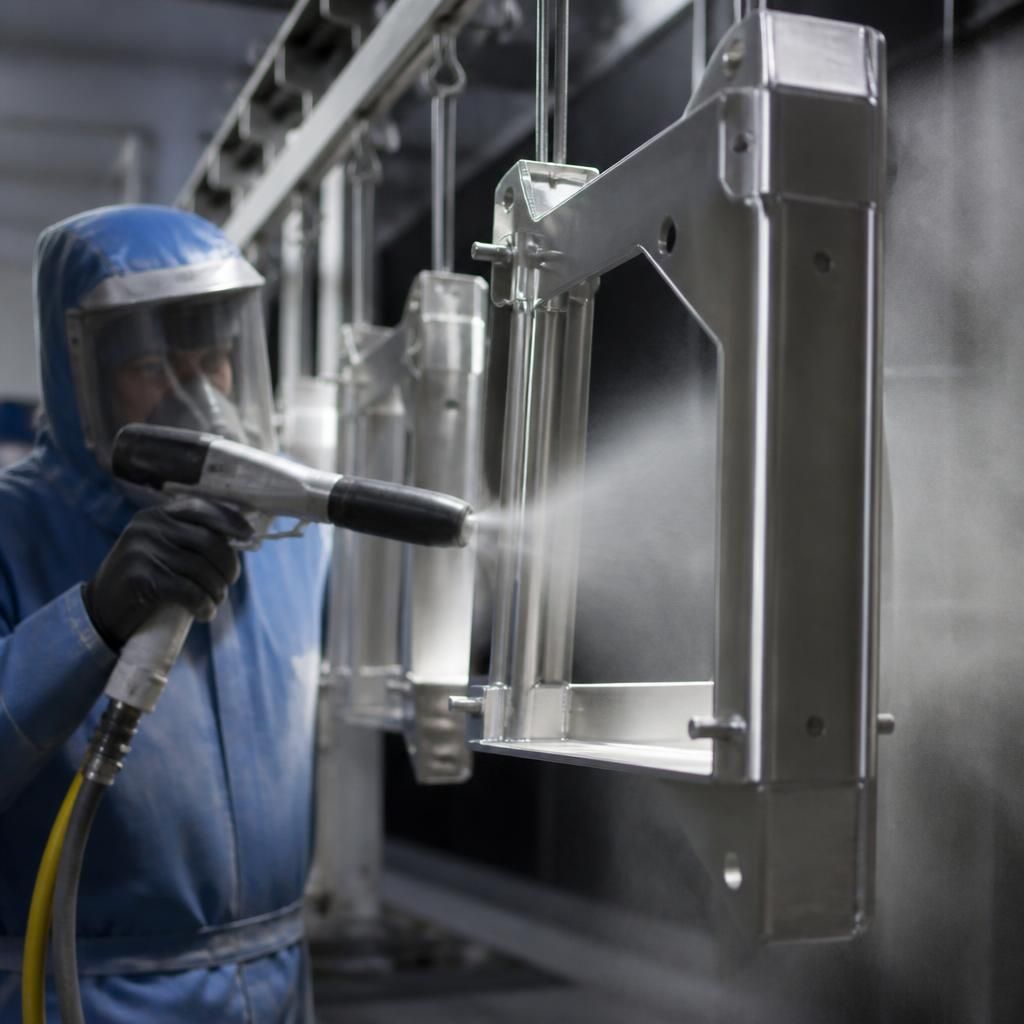
Stainless steel requires controlled surface preparation before powder coating. Its chromium-rich passive layer helps resist corrosion but can also reduce coating adhesion if the surface is not prepared correctly. Weld heat tint, fabrication residue and handling contamination may need particular attention, especially around seams and joins.
The stainless grade and service environment should be included in the coating specification. A suitable pretreatment and powder system can then be selected to support adhesion and long-term performance without treating stainless steel as ordinary mild steel.