

What features should be considered when choosing a powder coating oven for industrial use?
When choosing an industrial powder coating oven, assess its working dimensions and load capacity, temperature range and control accuracy, heat distribution, airflow, energy use, loading method and compatibility with the coating process. Safety systems, insulation, ventilation, maintenance access and the ability to accommodate current and expected production volumes are also essential considerations.
The best powder coating oven for industrial use is one that can reproduce the required cure cycle, accommodate the production pattern and integrate safely with the rest of the coating process. Beyond basic size, temperature and heating performance, selection should cover the oven configuration, heating method, process validation, control functionality, installation requirements, contamination control and whole-life cost.
Start with the coating and substrate requirements. Powder manufacturers specify a curing condition based on the temperature reached by the metal and the time it remains at that temperature. The oven therefore needs to suit the powder chemistry, substrate thickness and component thermal mass. A thin steel panel and a heavy fabricated assembly may enter the same oven at the same air temperature but require different heating times. Cure schedules should be checked against the powder technical data rather than selected from air temperature alone.
Consider whether the production pattern is better suited to a batch oven, a continuous oven or a combination of both. Batch equipment can be appropriate where component sizes, colours or job quantities change frequently. A continuous arrangement may be more suitable where parts follow a repeatable route and production is organised around a conveyor. The choice affects loading and unloading, changeover procedures, operator involvement and how easily different product families can be processed without disrupting the line.
Compare heating technologies according to the parts being coated. Convection systems heat components through circulating air and are generally versatile for assemblies with varied shapes and thicknesses. Infrared systems transfer heat directly to suitable surfaces and may provide faster response, although shadowed areas, complex geometries and reflective substrates need careful assessment. Hybrid ovens can combine methods where a rapid initial heat input and controlled through-heating are both useful. The heating method should be evaluated using representative parts, not only an empty-oven test.
Process control is another important distinction between basic and industrial equipment. Useful functions can include:
- recipe storage for different powder systems or product families;
- controlled set-up of heating stages, dwell conditions and operating modes;
- alarm records showing temperature deviations, sensor faults and equipment interlocks;
- user permissions to prevent unauthorised changes to approved settings;
- data logging for demonstrating that a defined cure cycle has been followed; and
- interfaces for linking the oven with conveyors, pretreatment equipment or wider production controls.
These features support repeatability and make process investigation more practical when a coated part does not meet the required finish. If quality records are important, confirm what information is recorded, how long it is retained and whether it can be exported in a usable format.
Plan for cure verification during commissioning and after changes. A suitable oven should allow temperature probes or data loggers to be positioned on representative components so that the metal temperature can be compared with the powder supplier’s cure requirements. Validation should cover typical minimum and maximum loads, heavy sections, awkward geometries and different loading positions. Rechecking may be needed after changes to airflow, burners, control settings, conveyor speed or the type of parts being processed.
Contamination control is especially relevant where several powder colours, textures or finishes are applied. Look for an internal arrangement and cleaning procedure that minimise powder accumulation and make product changeovers manageable. Consider access to filters, ducting and recirculation paths, as residue in these areas can affect subsequent colours or finishes. The operating method should also separate incompatible materials where cross-contamination could lead to rework.
Check the building and utility requirements before selecting a model. The oven may require a particular electrical supply or gas connection, combustion air, exhaust arrangements, flue routing and clearance around the equipment. The floor must support the installed load, while doors, access routes and lifting equipment need to accommodate delivery and future component replacement. These requirements can influence the practical position of the oven more than its footprint alone.
Environmental and regulatory considerations should be assessed as part of the installation design. Where combustion is used, the arrangement for flue gases, burner operation and fresh-air supply must be appropriate to the building and risk assessment. Extraction, ventilation and discharge arrangements should be reviewed alongside the oven rather than treated as separate items. The supplier should identify required clearances, isolation arrangements and inspection points in the technical documentation.
Finally, compare the full operating cost rather than the purchase price alone. Include fuel or electricity demand, warm-up behaviour, standby operation, planned servicing, replacement components, controls support and the cost of production lost during cleaning or faults. Heat recovery, staged operation and automatic shutdown can be useful where they match the production schedule, but their value depends on actual usage. A clear specification should state performance assumptions, commissioning tests, operator training, documentation and responsibilities for ongoing maintenance.
For a powder coating contractor or manufacturer assessing equipment, the most reliable selection process is to provide the oven supplier with representative components, powder cure data, loading patterns and expected future work. Testing those parts through the proposed process can reveal limitations that a catalogue specification will not show. Powder-coating specialists can also help relate oven performance to the coating, preparation and handling stages that determine the finished result.
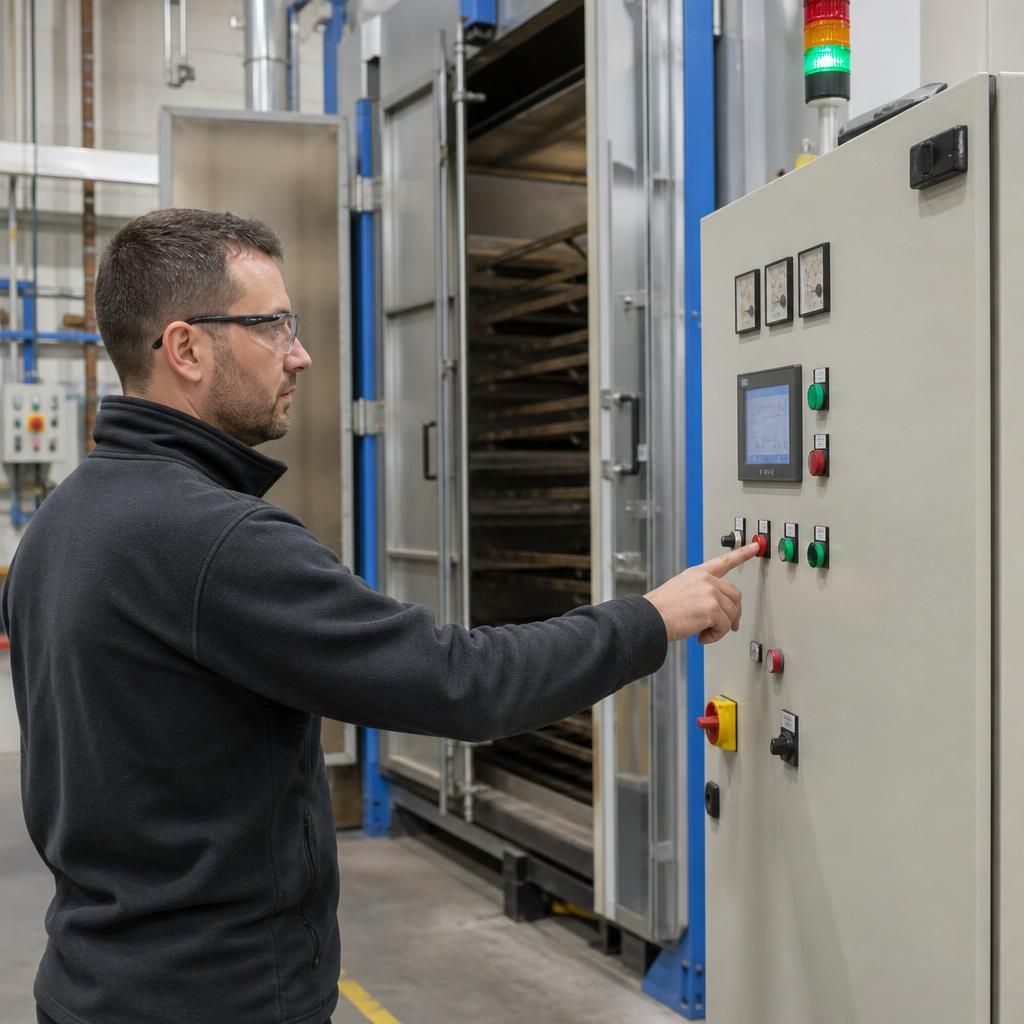
Safety systems should be assessed as a core oven specification, not treated as an installation detail. An industrial powder coating oven should prevent unsafe operation when a fault occurs and require a controlled reset before production resumes.
- Independent over-temperature protection should limit excessive heat if the main controller fails.
- Burner flame supervision and automatic fuel shut-off are important on gas-heated equipment.
- Emergency stops should be accessible to operators and linked to the relevant heating and conveyor functions.
- Access doors, panels and guards should be interlocked where opening them could expose personnel to heat or moving parts.
- The control system should indicate the cause of a shutdown rather than allowing an unexplained restart.
Ask for the safety circuit design, reset procedure, isolation points and inspection requirements before comparing oven models. These details affect operator training, maintenance planning and the safe integration of the oven into the wider coating system.