

What factors should be considered when choosing between different types of industrial powder coating ovens for optimal curing efficiency?
Choose an industrial powder coating oven by matching its working dimensions, load capacity and heating method to the components, coating and required production volume. Assess temperature uniformity, cure-cycle control, energy efficiency, heat recovery, ventilation, loading arrangements and compatibility with existing handling equipment to achieve reliable curing without unnecessary operating capacity.
The most suitable industrial powder coating oven is the one that can deliver the coating manufacturer’s required part temperature and dwell time consistently, while matching the component’s geometry, thermal behaviour, production method and site constraints. Comparing ovens only by nominal maximum temperature or chamber size can lead to poor curing, excessive energy use or equipment that is difficult to integrate and operate.
Start with the powder coating’s cure specification. Different powder formulations can require different combinations of metal temperature and time. The stated cure schedule normally refers to the temperature reached by the component, not simply the temperature of the air in the oven. This distinction is important for thick sections, assemblies with high thermal mass and parts with recessed areas. An oven should therefore be assessed on its ability to bring the coldest or slowest-heating areas of a representative load to the required cure condition.
Obtain the technical data for every coating that will be used and identify the lowest and highest process requirements. If several products have widely different cure schedules, consider whether one oven can accommodate them without compromising throughput or whether separate process settings, zones or equipment would be more appropriate.
Consider how the parts absorb and retain heat. Thin sheet, wirework, castings and fabricated frames do not heat in the same way. A large, dense component may need a longer heat-up period, whereas a lightweight part can reach curing temperature quickly. Hollow sections may also trap moisture, oil or air, creating defects during heating. The oven selection should account for these characteristics rather than relying on a single average part.
Part geometry affects more than heating time. Deep recesses, enclosed corners and tightly packed assemblies can restrict air movement and make it harder to achieve even curing. Where the design allows, parts should be positioned to expose coated surfaces properly and to prevent contact marks. The oven should provide suitable internal clearance and airflow without forcing parts into arrangements that create shaded or poorly heated areas.
Compare heating methods against the parts and coating process.
- Convection ovens transfer heat through moving heated air and are widely suited to mixed component shapes. Their performance depends on correct airflow design, circulation around the load and avoidance of dead spots.
- Infrared systems transfer radiant heat directly to suitable surfaces. They can be useful where rapid surface heating is beneficial, but line-of-sight, coating colour, surface profile and component geometry must be considered. Recessed or shielded areas may receive less radiant energy.
- Combined systems use more than one heating method to address different stages of the process. These can be useful where surface response and deeper heat penetration have to be balanced, although the control strategy becomes more important.
- Electric and gas-fired arrangements should be compared by considering site services, controllability, exhaust requirements, maintenance and the total operating conditions of the installation rather than purchase price alone.
Examine airflow and the oven atmosphere. Air circulation should support even heat transfer without disturbing powder before it has fused. Excessive turbulence can affect delicate or freshly coated components, while insufficient circulation can leave cooler pockets. The arrangement of fans, ducts and return paths should be reviewed in relation to the actual load shape, hanging method and surface area.
Air quality also matters. Powder residue, oil vapour, cleaning chemicals or combustion products can contribute to surface contamination and finish defects. A suitable design should control the movement of contaminants, separate incompatible processes where necessary and provide access for inspection and cleaning. This is particularly important when changing between contrasting colours or coating types.
Assess process control and verification. Useful controls include independent temperature sensing, adjustable set points, alarms for abnormal conditions and records that allow operators to identify deviations. The control system should make clear whether a displayed value represents chamber air temperature, product temperature or another measurement.
Before approving an oven, carry out a temperature survey using representative parts and the intended loading arrangement. Place probes at locations likely to heat slowly, such as heavy sections, corners and recessed areas. Repeating this exercise after installation, and following significant changes to the load or process, helps confirm that the selected oven is curing the coating rather than merely heating the chamber.
Check the practical operating environment. Important considerations include the available floor area, access for installation and maintenance, door or conveyor clearances, extraction routes, electrical or fuel connections and the position of other powder coating equipment. The oven should not create an obstruction for loading, unloading or inspection. Serviceable components such as fans, burners, filters, sensors and seals should be accessible without extensive dismantling.
Safety provisions also form part of the comparison. Review guarding, insulation, hot-surface protection, emergency stops, interlocks, combustion safeguards and the management of fumes or exhaust. The installation should be assessed against applicable UK workplace, electrical, gas and machinery requirements by appropriately qualified personnel. Powder handling and curing should be considered as one process, because contamination, fire risk and ventilation arrangements can extend beyond the oven chamber itself.
Allow for changeovers and future process variation. A coating operation may use several colours, finishes, component designs or masking arrangements. An oven that is technically capable of curing one product may be inefficient if every change requires extensive adjustment or cleaning. Consider how easily operators can inspect the chamber, remove residue, alter settings and confirm that the next batch is ready for processing.
Finally, compare the whole-life implications of each oven type. Include commissioning, calibration, planned maintenance, replacement parts, operator training, cleaning and the effect of downtime on the wider coating process. The lowest initial cost is not necessarily the most appropriate choice if the design is difficult to verify, maintain or adapt. A sound selection is based on documented cure requirements, representative trials, measured product temperatures and the conditions in which the oven will actually be operated.
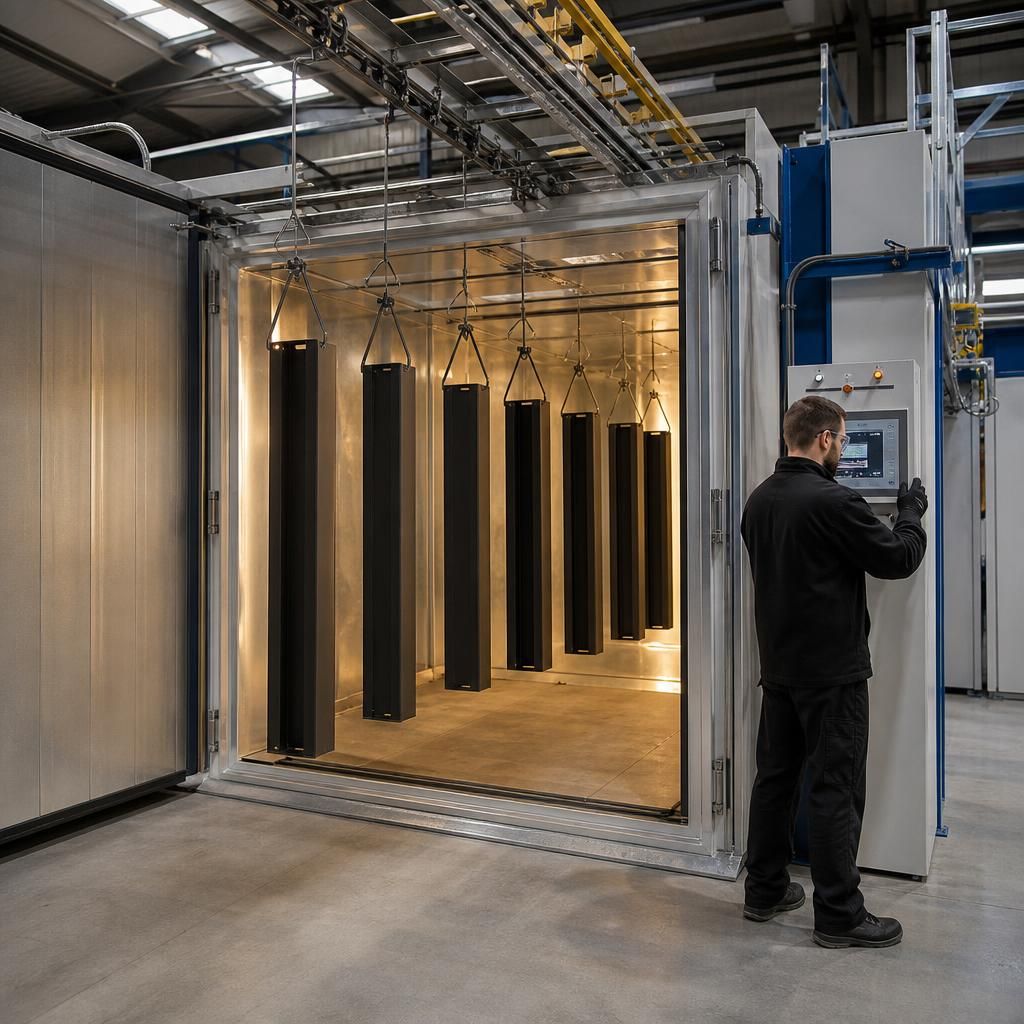
Oven capacity should be assessed against the complete curing cycle, not just the chamber’s internal dimensions. A batch oven may suit varied parts and intermittent production, while a conveyorised oven is generally better where components follow a repeatable sequence. The relevant comparison is how many correctly spaced parts can be processed during each cycle without restricting airflow, damaging the finish or creating a queue before or after curing.
When comparing options, review:
- the usable loading area after allowing for racks, hanging points and safe clearances;
- the time needed for loading, heating, curing, cooling and unloading;
- whether the oven can accommodate the smallest regular batch without excessive unused capacity;
- how easily part spacing and fixtures can be changed for different component designs; and
- whether the oven’s output matches the capacity of the preparation, application and inspection stages.
An oven that is larger than the process requires can increase heated volume and make smaller loads less economical, whereas an undersized oven may create handling delays. Capacity should therefore be selected from actual part dimensions, loading patterns and planned workflow rather than from nominal chamber volume alone.