

What are the benefits of using electrostatic powder coating technology?
Electrostatic powder coating charges dry powder particles so they are attracted to and adhere evenly to grounded metal components. This improves transfer efficiency, reduces overspray and supports consistent, durable finishes suitable for industrial production.
Electrostatic powder coating technology is a dry-finishing process designed to place coating material accurately onto conductive metal before it is cured in an oven. Its main benefits are improved material utilisation, repeatable application, strong film performance and a cleaner production process than many conventional liquid-coating methods.
More efficient use of coating material: The electrical attraction between the powder and the component helps more of the applied material reach the workpiece rather than becoming airborne or settling outside the intended coating area. Unattached powder can often be collected and managed through suitable recovery equipment, subject to the powder type, colour control requirements and the installation design. This can make the process more economical to operate and easier to control in batch production.
Repeatable coating thickness: Application parameters can be adjusted for the component, powder specification and required finish. Controlling gun settings, earthing, powder flow, part presentation and gun-to-part distance helps produce a more uniform film. Repeatability is particularly important where components must meet dimensional requirements, fit with other parts or present the same appearance across a production run.
Good coverage of suitable component shapes: Powder can be applied to frames, brackets, panels, fabricated assemblies and other metal parts with varied profiles. Electrostatic attraction can assist deposition around edges and into less exposed areas, although it does not remove the need for correct gun positioning. Recesses, enclosed sections, sharp corners and areas affected by the Faraday cage effect may require adjustments to application technique, part rotation or equipment settings.
Durable cured films: Once the powder has been correctly applied and heated to the required cure schedule, it forms a continuous coating with resistance to wear, impact, moisture and many everyday industrial conditions. The actual performance depends on the resin system, film thickness, substrate preparation, curing profile and the environment in which the finished part will be used. Protective or specialist powder formulations may be selected where standard decorative coating is not sufficient.
Efficient production handling: Powder coating does not require the evaporation of liquid solvents during application. This supports a straightforward process sequence in which prepared components are coated, conveyed or transferred to an oven, cured and then inspected. The method is well suited to repeatable work because recipes and operating conditions can be documented and reproduced for future batches.
Reduced solvent use: Powder is supplied as a dry material, so the process does not rely on the solvent content associated with many liquid paints. This can simplify certain aspects of workplace control, storage and extraction design. It does not mean that preparation, cleaning, ventilation or safe handling can be disregarded: pretreatment chemicals, dust management and curing equipment still need to be managed appropriately.
Wide choice of finishes: Electrostatic application can be used with powders offering different colours, gloss levels, textures and performance characteristics. This allows one coating process to serve both functional and appearance-led requirements, provided the selected powder is compatible with the substrate and the intended service environment. Colour changes should be planned carefully, as equipment cleaning and recovery arrangements affect the risk of cross-contamination.
Factors that determine the result: Electrostatic equipment improves control, but it is only one part of the complete finishing system. Results also depend on:
- cleaning and pretreatment of the metal surface;
- effective electrical earthing of components and racks;
- the condition, storage and handling of the powder;
- correct spray settings and suitable booth airflow;
- oven temperature, air circulation and time at curing temperature;
- part loading, spacing and orientation; and
- inspection of film thickness, adhesion, appearance and cure.
For industrial users, the most important benefit is therefore process control rather than electrostatic attraction alone. A correctly specified system can help deliver repeatable finishes with efficient powder use and robust cured-film performance across suitable metal components. Where requirements involve unusual substrates, complex geometries, large parts or specialist protective coatings, the application method, powder chemistry and curing conditions should be assessed together before production begins.
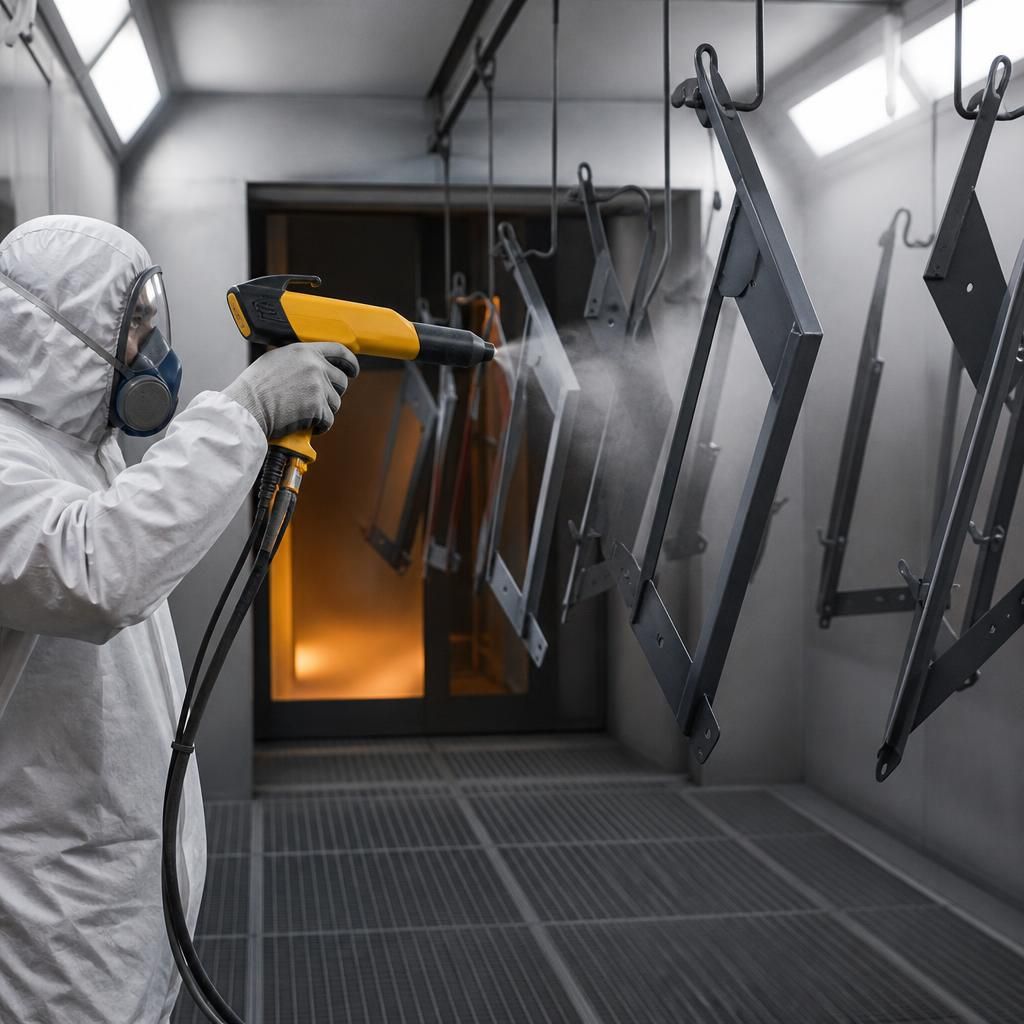
One practical benefit of electrostatic powder coating is that the charged powder remains temporarily attached to the grounded component before curing. This allows coated parts to be moved from the spray booth to the oven without the runs, sags or solvent evaporation associated with wet paint application.
The coating is not fully bonded at this stage, so parts still need careful handling to prevent contact damage or powder loss. Correct charging, grounding and part positioning help maintain the deposited layer until heat fuses it into a continuous cured film. This makes the process suitable for repeatable handling of brackets, panels, frames and other conductive metal components.
Discuss Your Electrostatic Powder Coating Requirements
If you are assessing electrostatic powder coating for your metal components, discuss the substrate, component dimensions, production volumes and required finish with the Powder-coatings.co.uk team. This allows the application method, powder specification and curing requirements to be considered together.