

How do conveyorised powder coating plants enhance productivity in industrial applications?
Conveyorised powder coating plants enhance productivity by moving components through preparation, coating and curing stages in a controlled sequence, reducing manual handling between processes. This supports repeatable coating quality, efficient batch processing and a more consistent production flow for industrial metalwork.
A conveyorised powder coating plant improves industrial productivity by converting coating into a planned, continuously paced production process. Its productivity comes from coordinating loading, surface preparation, powder application, curing, unloading and inspection so that labour, equipment and floor space are used efficiently rather than managed as separate operations.
Throughput is governed by line balance. Each stage must accommodate the same planned rate of work. If preparation takes longer than application, or if the curing oven becomes a bottleneck, components accumulate and the plant loses capacity. Effective system design therefore matches conveyor speed, oven dwell time, booth capacity and loading arrangements to the parts being processed. This makes the available production capacity more predictable than relying on separate, manually scheduled workstations.
Consistent part positioning supports faster processing. Components are loaded onto suitable hooks, racks or fixtures in a repeatable orientation. This helps operators apply powder to the required faces and recesses without repeatedly repositioning each item. Correct spacing also allows air movement and heat transfer around the workpiece, which is important for achieving the specified cure without creating avoidable handling or inspection problems.
Productivity depends on efficient batch planning. Similar components can be grouped by substrate, size, colour, coating specification or curing requirement. This reduces unnecessary changes to booth settings, powder supply and handling fixtures. A planned sequence can also limit the amount of time spent preparing the line for the next product family. For manufacturers and fabricators processing varied metalwork, this balance between batch size and product flexibility is often more important than simply increasing conveyor speed.
Integrated curing improves production control. The oven must provide the correct combination of metal temperature and dwell time for the powder system and component thickness. A conveyorised arrangement makes the route through the oven repeatable, while temperature monitoring helps identify deviations before a large quantity of work is affected. Consistent curing reduces the risk of holding finished parts for additional checks or sending them back through the process because the coating has not developed the required properties.
Less variation can reduce rework. Rework may result from contamination, incomplete coverage, incorrect film build, poor earthing, unsuitable pre-treatment or inadequate curing. A conveyorised plant does not remove these risks, but it provides a structured process in which they can be monitored and controlled. Standardised loading, application settings and inspection points make it easier to identify where a defect was introduced and to correct the cause rather than repeatedly repairing finished parts.
Labour can be allocated to higher-value tasks. Operators still have important responsibilities, including checking components, loading and unloading work, preparing fixtures, monitoring coating conditions and inspecting finishes. However, a coordinated line reduces the need for staff to transport parts between every stage. This can make responsibilities clearer and helps supervisors plan staffing around loading, coating, quality control and maintenance requirements.
Conveyorised systems also support production traceability. Work can be organised using job instructions, batch identification and defined inspection criteria. Recording the coating specification, preparation method and curing conditions provides useful information when repeat orders or quality investigations arise. For industrial customers, this supports more reliable communication between production, quality and purchasing teams.
The most productive layout is not necessarily the fastest one. A line designed without sufficient space for loading, cooling, inspection, masking or colour changes may create delays elsewhere. Practical planning should consider:
- the dimensions, weight and geometry of the components;
- the required surface preparation and drying stages;
- the powder application method and access to complex areas;
- oven capacity and the curing requirements of the chosen coating;
- fixture design, hook recovery and the risk of contact marks;
- product changeovers, batch sizes and the range of finishes required;
- inspection, cooling, packing and dispatch space after curing; and
- access for cleaning, maintenance and safe operator movement.
For high-volume work with reasonably consistent component dimensions, these controls can deliver substantial operational advantages. For mixed, low-volume or unusually shaped parts, a fully conveyorised arrangement may need flexible fixtures, adjustable settings or a combination of automated and manual stations. The correct approach is to match the plant configuration to the product mix, coating specification and required production pattern rather than treating conveyorisation as a universal replacement for all other methods.
In practice, productivity is assessed through the complete process: usable output, first-time quality, changeover control, labour requirements, oven utilisation and the ability to meet different batch specifications. A well-designed conveyorised powder coating plant improves these measures by making the route through production controlled, repeatable and easier to plan.
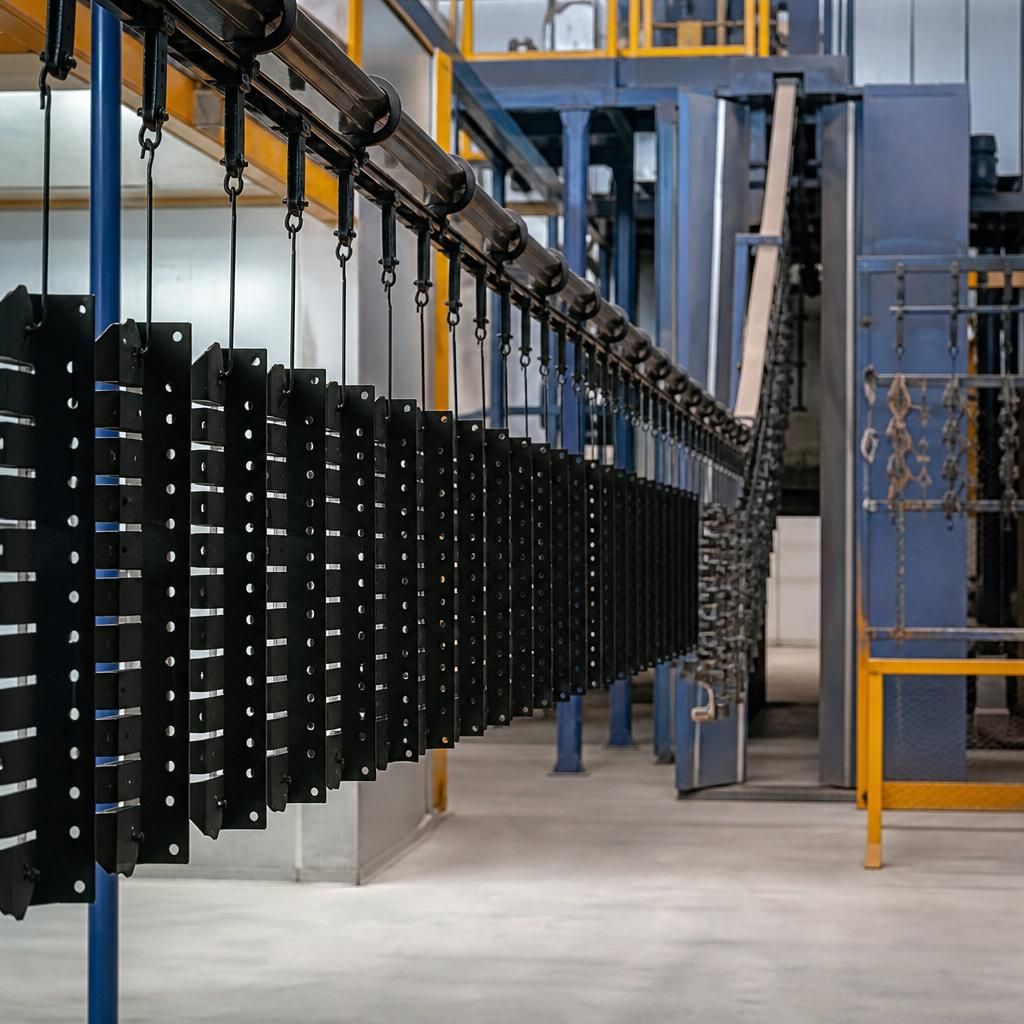
Carrier utilisation is a key productivity factor in a conveyorised powder coating plant. Loading each hook, rack or fixture with the correct number of components increases usable output from every conveyor movement, provided parts remain sufficiently separated for powder access, airflow and heat transfer.
Overloading can reduce productivity rather than improve it. Touching components may cause uncoated areas, contact marks or uneven curing, creating inspection and rework requirements. A suitable carrier plan therefore balances component density with coating access and oven performance. For repeat products, dedicated or adjustable fixtures can make this loading pattern more consistent and help the plant maintain a productive flow without relying on higher conveyor speeds.