

What factors should be considered when selecting an industrial powder coating specialist to ensure optimal results for complex projects?
Selecting an industrial powder coating specialist should be based on their experience with complex components, ability to prepare different metal substrates, control of coating specifications, capacity for batch work, and documented quality procedures. Also assess whether their collection and delivery arrangements, technical communication, colour and finish matching, and inspection processes align with the project’s requirements.
Selecting an industrial powder coating specialist for a complex project requires more than comparing finish prices. The decision should be based on whether the coater can translate the component design and service conditions into a controlled, repeatable process, while protecting critical dimensions, functional surfaces and project documentation.
Start with the component’s operating conditions. The finished part may be exposed to moisture, chemicals, abrasion, impact, heat, ultraviolet light or continual handling. These conditions determine the appropriate powder chemistry, film performance and surface preparation requirements. A suitable specialist should ask where the component will be used, how it will be cleaned, whether it is indoors or outdoors, and which areas must retain particular mechanical or electrical properties. A decorative finish alone may not be suitable where corrosion protection or chemical resistance is the primary requirement.
Check that the specification is sufficiently precise. Complex projects should define the substrate, coating system, colour, gloss level, texture, required film thickness, masking points and acceptance criteria. It is also important to identify surfaces that must remain free from coating, such as threads, bearing seats, earth points, mating faces and precision bores. Ambiguity at this stage can result in rework, assembly problems or a finish that is visually acceptable but unsuitable for the component’s function.
Assess how the specialist handles part design and geometry. Hollow sections, deep recesses, sharp edges, narrow gaps, welded joints and assemblies with dissimilar metals can make powder application more difficult. The racking method, electrical contact points and gun access all influence coverage and finish. Ask the coater to review drawings or representative samples before production, particularly where the component has tight tolerances or concealed areas. This review should establish whether parts need additional drainage holes, revised hanging points, temporary fixtures or defined masking methods.
Consider dimensional and masking control. Powder coating adds a measurable layer to a component, so the process must account for areas where clearance is limited. A capable specialist should be able to discuss how masking materials, plugs, caps and fixtures will be selected and removed without damaging the finish. The agreed approach should distinguish between cosmetic masking and masking that is essential to the component’s operation.
Ask how curing is validated. Powder is not fully functional simply because it appears dry. The coating must reach the required curing conditions across the relevant part, and the correct oven profile depends on the powder system, metal thickness, component mass and loading arrangement. For complex work, ask how the curing process is checked and how variations caused by different part sizes or oven positions are managed. This is particularly relevant when a project includes both lightweight fabrications and heavy sections.
Review the specialist’s equipment against the project. The available booth, oven, conveyor or manual application equipment should be appropriate for the largest, heaviest and most geometrically difficult components. Equipment suitability also affects colour changes, contamination control, reclaim decisions and the ability to process specialist coating systems. The question is not simply whether a part can physically fit: it must be possible to hang, coat, cure and handle it without compromising the finish.
Look for a clear sample and approval process. A production sample, agreed reference panel or retained master can establish the expected appearance before the full run begins. Approval should cover more than colour. It may include gloss, texture, edge appearance, masking lines, coverage of difficult areas and acceptable minor variations caused by the component’s geometry. For repeat work, the approved reference provides a useful comparison when future batches are processed.
Examine traceability and change control. Complex projects can involve several drawings, revisions, powder references or component variants. The specialist should have a practical method for identifying incoming parts, linking them to the correct specification and recording any approved deviation. Changes to the design, powder system, masking method or curing conditions should be communicated and agreed rather than introduced informally. Traceability is especially important where coated components form part of a larger manufactured assembly.
Clarify how defects and non-conforming parts are managed. Ask what happens if a component has contamination, damage, incomplete coverage, incorrect masking or an appearance outside the agreed tolerance. A sound process separates suspect parts, records the issue and establishes whether repair, stripping, recoating or customer approval is appropriate. Recoating is not suitable for every component, so the potential effect on dimensions, adhesion and performance should be considered before corrective work begins.
Consider handling and packaging after coating. A correctly applied finish can still be damaged by poor storage, contact between parts or unsuitable wrapping. The project specification should address hanging marks, separators, protective materials, stacking limits and the point at which components can safely be moved. Parts with prominent cosmetic faces or vulnerable edges may require a different handling method from robust fabricated items.
Compare communication and commercial clarity. A useful quotation should identify what is included, the assumptions made about part condition, any exclusions, preparation or masking requirements, and the information needed before work begins. It should also make clear how variations in component design or specification will be treated. During technical discussions, the specialist should explain constraints in practical terms rather than treating powder coating as a one-size-fits-all operation.
For a complex industrial project, the strongest choice is therefore the specialist that can demonstrate process control from design review through curing, approval, traceability and post-coating handling. Manufacturers, fabricators, construction firms and automotive businesses can use these criteria to compare potential coating partners on technical suitability and risk control, rather than relying on price or finish samples alone.
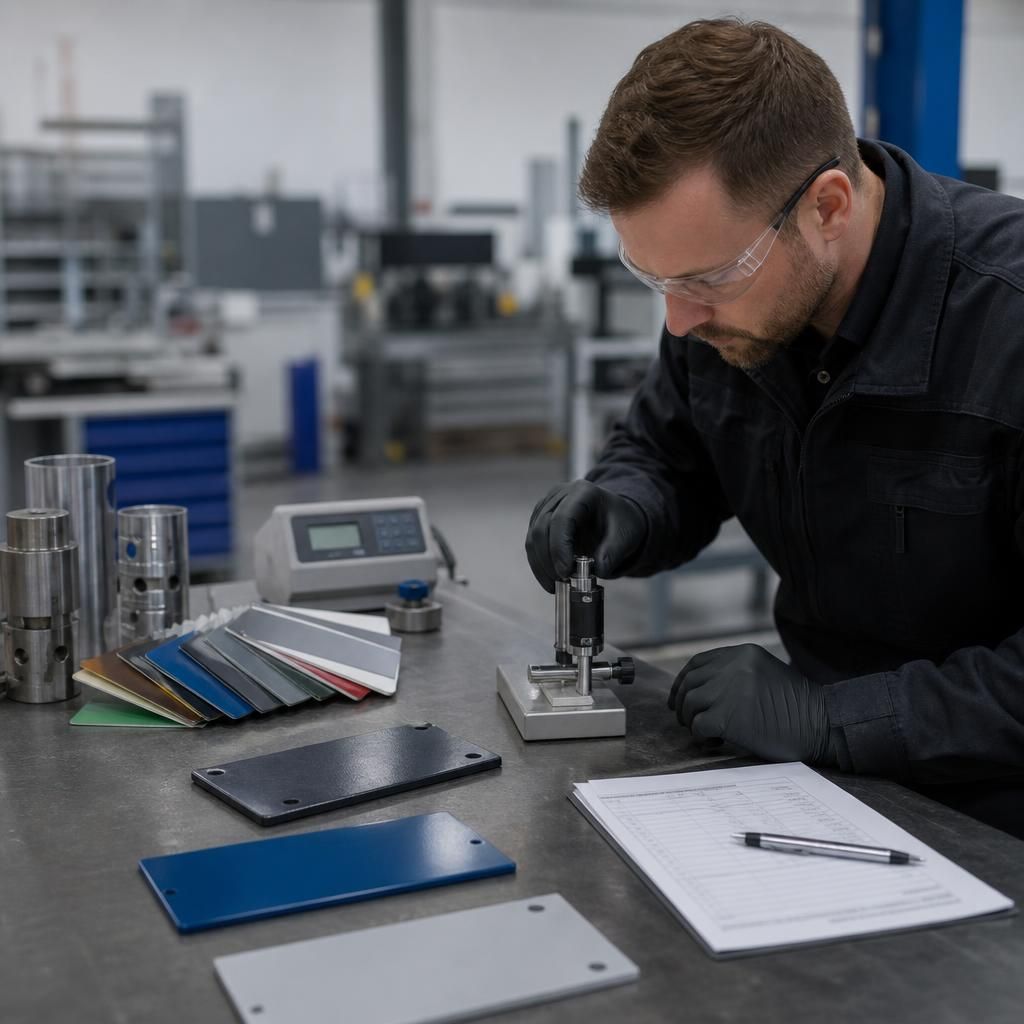
For complex projects, assess how the specialist verifies coating performance rather than relying on appearance alone. A colour sample can confirm visual suitability, but it does not demonstrate adhesion, resistance to the expected environment or compatibility with the component’s intended use. Ask which performance checks are relevant to the specification and whether representative panels, sample components or documented test results can be used to support approval.
The evidence should relate to the finished coating system, including the substrate, preparation method and powder selected. This helps distinguish a specialist able to validate a technical requirement from one offering only a decorative finish. Agree in advance which records form part of the project file and how any result outside the agreed requirement will be assessed.
Discuss your complex powder coating project
If you are assessing a coating partner for a complex project, discuss your component drawings, substrate, quantities and performance requirements with Powder-coatings.co.uk. This enables the proposed coating approach, preparation requirements and project assumptions to be considered before production planning begins.