

What are the benefits and limitations of using powder coating compared to liquid paint?
Powder coating generally provides a harder, more durable and solvent-resistant finish than liquid paint, with efficient application and little or no solvent content. Its limitations include the need for suitable curing equipment, fewer practical options for on-site application, and less flexibility when coating heat-sensitive components or achieving very small colour-matched repairs.
Powder coating is usually the better choice for metal components that need a consistent, hard-wearing finish produced under controlled factory conditions. Compared with liquid paint, it can offer stronger production repeatability, good material utilisation and a wide range of decorative and functional finishes. Liquid paint remains more suitable where very thin films, extensive colour matching, complex in-situ work or low-temperature application are the main priorities.
Key benefits of powder coating
- Consistent film formation: Powder is applied as a dry, electrically charged material and then fused to the prepared metal. When application and curing are properly controlled, this produces an even coating with a uniform appearance across batches. It also avoids some of the runs, sags and solvent entrapment associated with poorly controlled wet paint application.
- Efficient use of coating material: Overspray can often be collected and reused, depending on the powder type, colour and recovery system. This can reduce material waste compared with liquid paint, where overspray may require treatment or disposal. Recovery is less straightforward when different colours or formulations are being used, so it should not be assumed that all excess powder can be reclaimed.
- Strong range of finishes: Powder systems are available in different colours, gloss levels, textures and functional formulations. This allows a specification to address appearance as well as requirements such as improved resistance to abrasion, corrosion or chemicals. The appropriate formulation depends on the component’s environment rather than appearance alone.
- Reduced drying-stage handling: Once the coating has been correctly cured and cooled, components do not have the same wet-film handling concerns as freshly painted parts. This can simplify movement, packing and subsequent assembly, provided the coating has been inspected and the parts are protected from impact during handling.
- Repeatable batch production: Powder coating is well suited to repeat orders and groups of similar components. Fixed application settings, controlled oven conditions and documented preparation methods can help maintain a consistent result between production runs. This is particularly useful where coated parts must match one another during assembly.
- Lower solvent content: Powder is supplied as a dry coating material rather than a liquid formulation based on solvent. This can reduce solvent-related emissions within the coating process, although the overall environmental impact still depends on pretreatment, curing energy, packaging, transport and the management of waste.
Limitations and practical disadvantages
- Restricted application to electrically suitable parts: The electrostatic process works most effectively when the component can be properly grounded and when the powder can reach the required surfaces. Recesses, narrow internal sections and enclosed areas may receive less powder because of the Faraday cage effect. Component design, racking and spray technique therefore influence coverage.
- Masking and dimensional control: Powder adds a measurable film to the surface. Threads, precision fits, bearing seats, contact points and machined faces may need masking or post-coating treatment. If tolerances are tight, the coating specification should be considered during component design rather than after manufacture.
- Colour changes can affect production efficiency: The application equipment and booth must be cleaned between incompatible colours or formulations to prevent contamination. Frequent changes, small batches and many special colours can increase preparation time and material handling. A liquid system may be more convenient for some highly varied, low-volume work.
- Defects may require more than a simple touch-up: Dust, oil, poor preparation, incorrect curing or handling damage can lead to pinholes, craters, poor adhesion or an inconsistent texture. Local repair is possible in some circumstances, but a repaired area may not perfectly match the original powder finish. Components with significant defects may need stripping and recoating.
- Substrate preparation remains critical: Powder does not hide contamination, mill scale, rust, weld residues or unsuitable surface condition reliably. Cleaning, degreasing, blasting or chemical pretreatment must be selected for the metal and the intended service environment. Poor preparation can cause adhesion failure regardless of the coating material chosen.
- Initial equipment requirements can be substantial: A powder process normally requires application equipment, suitable extraction, curing capacity and safe handling arrangements. The economics are therefore different for a production coater compared with a business seeking occasional in-house finishing. The cost comparison should include preparation, masking, colour changes, inspection, energy and potential rework, not just the price of the coating material.
Where liquid paint may be preferable
Liquid paint offers greater flexibility for work that cannot be placed in a curing oven or that needs to be completed in position. It can also be useful when a very thin coating is required, when a precise wet-film build is specified, or when a repair must blend into an existing painted surface. Liquid systems may provide a broader choice for certain substrates and specialist formulations, although their performance depends on correct preparation, application and drying conditions.
Liquid paint is not automatically the less durable option. The final result depends on the resin system, surface preparation, coating thickness, number of coats and service conditions. Similarly, powder coating is not automatically suitable for every metal component: part size, geometry, tolerances, masking requirements and the maximum permitted curing temperature all need to be assessed before specifying it.
How to make the comparison for a project
- Define the service environment, including exposure to moisture, chemicals, sunlight, abrasion and repeated handling.
- Confirm the substrate and its preparation requirements, as aluminium, steel, galvanised surfaces and previously coated parts may need different treatment.
- Check component dimensions, access to all surfaces, racking points and any areas that must remain uncoated.
- Set requirements for film build, colour, gloss, texture, adhesion, appearance and dimensional tolerances.
- Compare the complete process cost, including preparation, masking, transport, curing, inspection, colour changes and possible rework.
- Agree how finish quality will be assessed, particularly for batch work where appearance must remain consistent from one component to the next.
In practical terms, powder coating is strongest where metal parts can be processed in a controlled facility and where consistent appearance, robust performance and repeatable batch production are important. Liquid paint retains an advantage where flexibility of application, very fine film control, on-site work or straightforward local repair outweighs those benefits. The correct choice is therefore determined by the component and its operating conditions, not by the coating type alone.
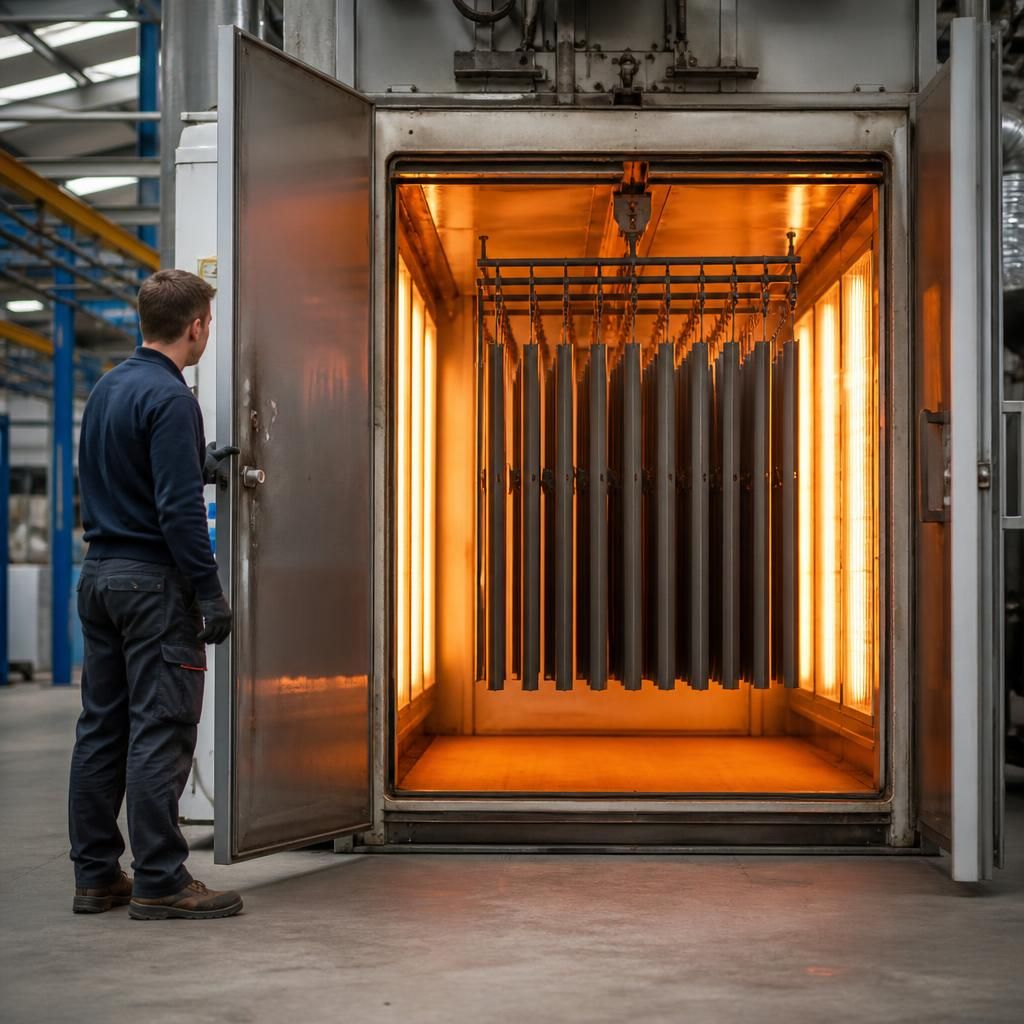
Curing is a key difference between powder coating and liquid paint. Powder must be heated so that the particles melt, flow together and chemically cure into a continuous film. The required cure depends on the powder formulation and component, so the relevant condition is the temperature reached by the metal rather than oven air temperature alone.
This makes the component’s mass, geometry and loading important when comparing the two methods. If the metal does not receive sufficient heat, the coating may not develop its intended performance; excessive heat can affect the finish or the component itself. Liquid paint can avoid an oven-based cure, but its drying or curing behaviour still depends on the selected formulation and application conditions. The comparison should therefore assess the complete curing requirement alongside the coating’s expected service environment.