

How does the curing process affect the durability of powder coating?
The curing process melts and chemically cross-links the powder coating at a controlled temperature and time, forming the hard, continuous film that protects the metal. Correct curing develops the coating’s intended adhesion, hardness, impact resistance and corrosion protection, while under-curing or over-curing can reduce durability and affect the finish.
Powder coating durability depends on achieving the correct cure throughout the coating film and across the entire metal component. The specified combination of metal temperature and time allows the powder to develop its designed physical and chemical properties; if the component does not receive a consistent cure, performance can vary between areas of the same part.
Why the oven profile matters
Curing is controlled by the temperature reached by the metal, not simply the temperature displayed inside the oven. A large or heavy component may take longer to reach the required temperature than a small, thin item, even when both enter the oven together. The coating on the larger component therefore needs a suitable dwell period after the metal itself reaches the required temperature.
Oven temperature, air circulation, loading arrangement and component mass all affect this profile. Parts positioned close together, shielded from airflow or suspended in a way that creates cold areas may cure differently from exposed surfaces. Reliable process control therefore considers the complete load rather than relying only on a general oven setting.
What happens when a coating is under-cured?
Under-cured powder has not developed its full network of cross-links. The resulting film may feel acceptable initially but can have reduced resistance to scratching, impact, chemicals, moisture and corrosion. It may also show poorer adhesion when exposed to demanding service conditions. In practical terms, an under-cured finish is more likely to lose protective performance before a correctly cured coating of the same type.
Signs can include a coating that is softer than expected, marks readily during handling, or reacts adversely to solvents used during quality checks. Appearance alone is not a dependable indication: a film can look smooth and even while lacking the performance expected from the powder specification.
How over-curing affects performance
Excessive heat exposure or an unnecessarily long dwell can also reduce performance. Depending on the powder chemistry and colour, over-curing may cause yellowing, loss of gloss, colour change or embrittlement. A brittle film may be less able to withstand impact, forming operations or movement in service. Some finishes are particularly sensitive to changes in colour and gloss, so process conditions must be matched to the product data rather than treated as interchangeable.
Repeated heating can be relevant where components are recoated, assembled after coating, or exposed to later manufacturing processes. The cumulative thermal history should be considered when deciding whether a powder and process are suitable for the application.
The powder specification sets the curing requirements
Different powder formulations have different curing windows. The required conditions can vary according to the resin system, intended end use, colour, gloss level and application method. A low-temperature formulation cannot automatically be treated in the same way as a standard industrial powder, and changing the powder may require changes to the oven process.
The technical data for the selected powder should be used to establish:
- the required metal temperature;
- the minimum and maximum suitable time at that temperature;
- any permitted curing range;
- the recommended film thickness; and
- any restrictions relating to recoating, over-baking or subsequent processing.
These requirements should be considered alongside the component design and the conditions expected in service. A coating selected for indoor equipment may not have the same durability requirements as one intended for exterior exposure, chemical contact or frequent mechanical handling.
Film thickness and coverage also influence durability
Curing cannot compensate for an unsuitable or inconsistent coating thickness. A film that is too thin may provide inadequate barrier protection, particularly at edges, corners and exposed features. Excessive thickness can lead to runs, orange peel, pinholing or other appearance and performance problems. Thick deposits may also respond differently to heating than the surrounding film.
Component geometry is important because recesses, box sections, welds, sharp edges and joints can be difficult to coat uniformly. The powder must be applied consistently, with appropriate attention to areas that are more likely to receive too little or too much material. Correct preparation and application give the curing stage a uniform film to develop.
How a professional coater verifies the process
Effective quality control checks the process rather than judging the finish by appearance alone. Depending on the specification and application, verification may include:
- recording the metal temperature at representative points on the component;
- checking that the full load follows the intended time and temperature profile;
- measuring coating thickness at suitable locations;
- carrying out adhesion, hardness or solvent-resistance checks where required; and
- inspecting colour, gloss, coverage and surface defects after cooling.
Testing should reflect the finished component and its expected use. A small test panel may help monitor a powder batch, but it does not always reproduce the heat-up behaviour of a heavy fabricated part. For that reason, difficult or varied components require particular attention to temperature measurement and loading conditions.
Practical implications for industrial components
Before coating, the coater should understand the metal type, component dimensions, wall thickness, assembly method, required finish and operating environment. This information helps determine whether the selected powder and curing schedule are appropriate. It also highlights parts that may need a different loading position, additional process checks or a coating system designed for more demanding exposure.
For manufacturers and fabricators, providing accurate drawings and application requirements can prevent a mismatch between the coating specification and the production process. Where components vary significantly in size or mass, curing should be assessed for the most demanding items rather than assumed to be identical across the batch.
In summary, curing affects durability by determining whether the powder reaches the performance level intended by its formulation. Consistent metal temperature, suitable dwell time, controlled film thickness and verification of the finished coating work together to produce dependable protection. The curing schedule should therefore be treated as a defined part of the coating specification, not as a final oven setting applied uniformly to every component.
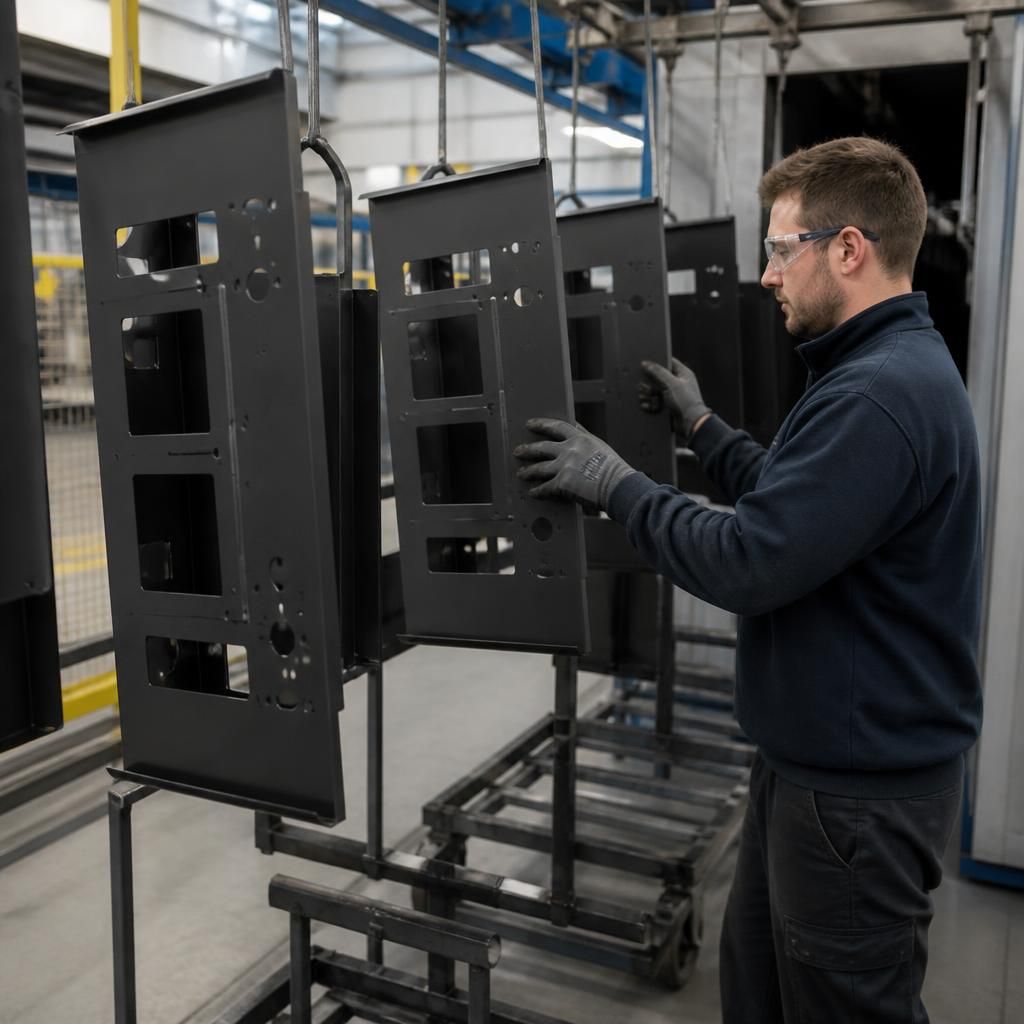
Post-cure cooling and handling can affect the practical durability of a powder-coated component. Once the coating has completed its cure, the finish still needs to cool without being marked, contaminated or damaged at contact points. Handling, stacking or packaging parts while they are still hot can imprint the surface, create pressure marks or weaken protection where the film is scratched through to the metal.
Industrial components should therefore be supported in a way that minimises contact with visible or functional surfaces during cooling. Care is particularly important for edges, threaded areas, mating faces and coated sections that will be assembled later. Suitable separators and clean handling equipment help prevent damage that could compromise the coating’s protective role, even when the original oven cycle was correct.
Discuss Your Powder Coating Curing Requirements
Discuss your component dimensions, metal type, finish requirements and operating environment with our powder coating team to help identify suitable curing requirements. Providing these details at the outset supports a coating specification aligned with the component and its intended use.