

What types of custom finishes can be achieved with industrial powder coating?
Industrial powder coating can produce custom finishes in a wide range of colours, sheen levels and surface textures, from smooth low-gloss appearances to textured or more decorative effects. Specialist options, including nylon and protective coatings, can also be selected where the metal component requires specific resistance or performance characteristics.
Custom industrial powder-coated finishes are specified by combining the required appearance with the performance the metal component must deliver in service. This allows a finish to be tailored not only to a product’s visual specification, but also to its exposure, handling requirements, installation method and maintenance environment.
For many components, the coating system is selected according to the conditions the finished part will face. A performance-led specification may prioritise resistance to:
- Corrosion caused by moisture, condensation or outdoor exposure
- Abrasion and impact during handling, assembly or regular use
- Oils, cleaning agents, fuels or other industrial chemicals
- Ultraviolet exposure where the component is installed externally
- Heat or temperature variation within the limits of the coating system
- Electrical or hygiene requirements associated with the finished product
These requirements can lead to different coating formulations and preparation methods, even when two components appear similar. The correct choice depends on the base metal, the intended environment and the level of exposure. A coating suitable for an internal machine enclosure, for example, may not be the right specification for an exposed construction component or an automotive part subject to repeated contact and contamination.
Customisation can also involve how the coating is applied to the component. Parts may require masking so that certain areas remain free from powder. This is useful for threaded holes, electrical contact points, bearing seats, earth points and close-tolerance mating surfaces. Selective coating can preserve the dimensional accuracy or function of these areas while protecting the remaining metal.
Some assemblies require more than one coating stage. A primer or undercoat may be used where additional adhesion or corrosion protection is required, followed by a finishing coat selected for the final service conditions. In other cases, the most suitable approach is a single carefully controlled coating system. The decision should be made before production because additional layers affect film thickness, tolerances, curing and the way components are prepared.
Finish design is also affected by the geometry of the part. Recesses, corners, welds, folded edges and enclosed sections can influence powder coverage and curing. A practical specification therefore considers the whole component rather than selecting a finish from a visual sample alone. Parts may need to be arranged, hung or masked in a particular way to avoid contact marks and ensure that important surfaces receive an even coating.
For batch work, a custom finish should include clear acceptance criteria. These can cover the approved colour reference, permitted surface characteristics, coated and uncoated areas, film-build requirements, masking lines and the acceptable level of minor visual variation. Confirming these details before processing helps prevent a finish that is technically sound but unsuitable for assembly or presentation.
When requesting a quotation or discussing a specification, provide drawings, photographs or samples where available, together with information about:
- The metal type and condition of the component
- Its internal or external use and likely exposure
- Areas that must remain uncoated
- Required dimensional tolerances and assembly points
- Expected contact with chemicals, abrasion, heat or moisture
- Any appearance standards that must be maintained across a batch
This information enables the coating process to be matched to the component’s actual function. The result is a custom finish designed as part of the product specification, rather than a purely cosmetic choice made after manufacture.
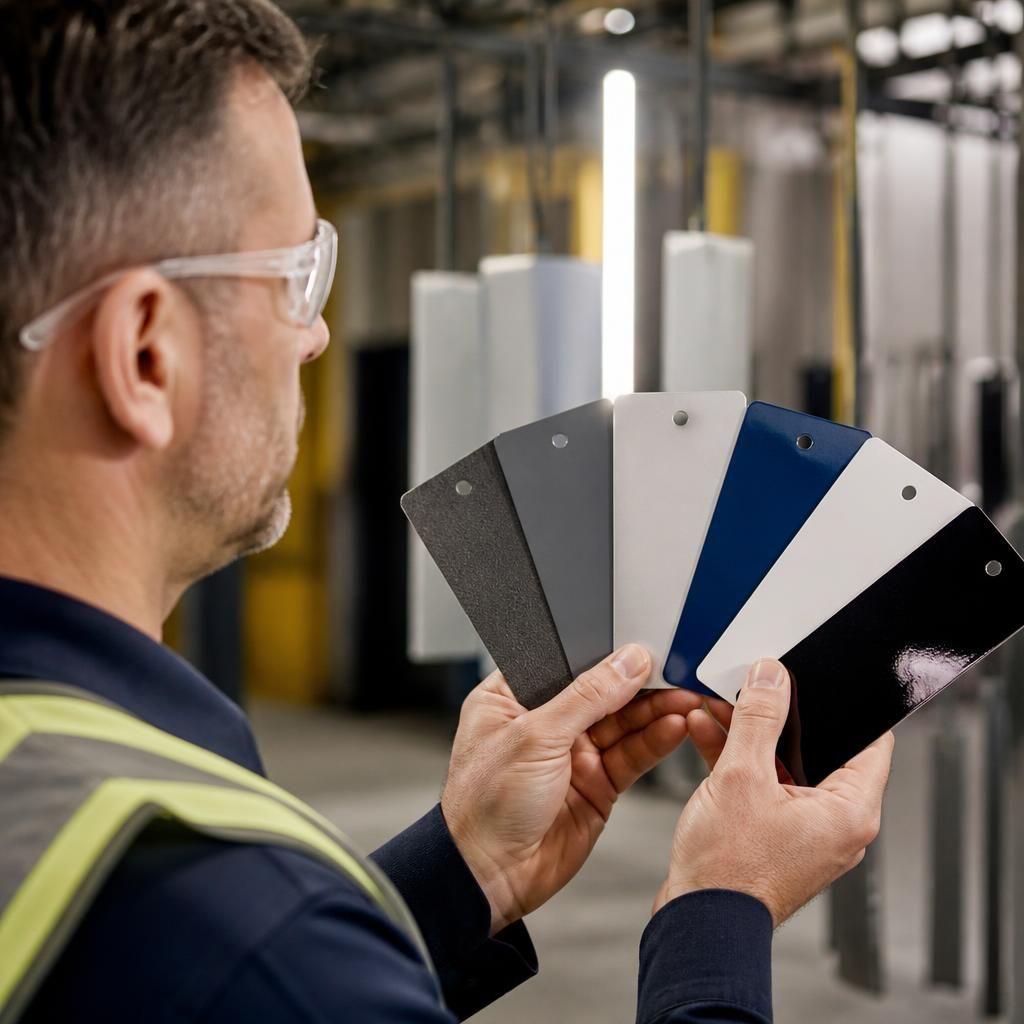
A custom powder-coated finish should be assessed as a combination of colour, sheen and texture rather than by colour reference alone. The same colour can appear noticeably different in a smooth gloss finish compared with a low-sheen or textured surface, particularly under changing lighting conditions.
For repeat production, approving a representative sample or panel helps establish the intended appearance before the full batch is processed. The specification can then record the approved finish and the acceptable level of visual variation, giving manufacturers and fabricators a clear reference for inspection.