

What factors determine the quality and durability of an industrial powder coating?
Industrial powder coating quality and durability depend on thorough surface preparation, the correct powder for the component and service environment, controlled application, and accurate curing. Coating thickness, part design, handling and exposure to moisture, chemicals, abrasion and UV also affect how well the finished coating performs over time.
Industrial powder coating quality and durability are determined by how well the complete coating specification, component design, production controls, inspection methods and post-coating handling work together. A coating can look consistent immediately after application yet fail prematurely if the metal is unsuitable, critical areas are missed, components are damaged during handling or the finished result is not checked against defined acceptance criteria.
Component material and condition
The base metal affects how a coating behaves. Steel, aluminium, galvanised steel and other substrates have different surface characteristics, thermal responses and corrosion risks. Castings, welds, sharp edges, porous areas and previous repairs may also create local weaknesses. Weld spatter, trapped residues and enclosed sections can lead to defects if the component design allows contamination or moisture to remain hidden.
Designs intended for coating should therefore include suitable drainage and ventilation for hollow sections, accessible surfaces and edges that do not create extreme film-thickness variation. Threads, bearing faces, electrical contact points and close-tolerance areas may need masking or a coating allowance. These details affect both the appearance and the functional fit of the finished part.
Coating specification
A durable result depends on defining what the finish must do, not simply selecting a colour. The specification may need to cover:
- the required appearance, including gloss, texture and colour consistency;
- resistance to corrosion, chemicals, impact, abrasion or outdoor exposure;
- acceptable coating build and dimensional tolerances;
- areas that must remain uncoated or electrically conductive; and
- the expected service conditions and cleaning methods.
For demanding applications, a primer and topcoat system may be more appropriate than a single coating layer. Compatibility between layers, the substrate and any sealants or adjoining materials must be considered. A finish that is suitable for an indoor enclosure may not be suitable for plant exposed to aggressive chemicals, repeated impact or persistent moisture.
Coverage of difficult areas
Part geometry influences whether the powder reaches every required surface. Recesses, internal corners, deep channels and closely spaced sections can be difficult to coat evenly. Electrostatic effects may reduce powder deposition in recessed areas, while edges can receive a different film build from broad faces. The hanging arrangement and orientation of a component can also affect access and drainage.
These issues should be reviewed before production, particularly for fabricated assemblies and components with concealed faces. A trial component or technical review can identify areas that require a revised rack position, masking arrangement or coating specification.
Process control and equipment condition
Reliable quality depends on repeatable plant settings and properly maintained equipment. Factors include powder delivery, gun performance, earthing, booth cleanliness, oven temperature uniformity and the way parts move through the line. Contamination from another colour, incompatible residue or airborne dust can cause inclusions, pinholes and visible blemishes.
Equipment should be checked and maintained so that variations are identified before they affect a batch. Keeping the powder, component and process information traceable also makes it easier to investigate a defect and distinguish an isolated handling issue from a wider production problem.
Inspection and testing
Visual inspection is useful for identifying runs, sags, craters, inclusions, missed areas, colour differences and surface blemishes, but appearance alone does not prove performance. Depending on the specification, checks may include:
- dry-film thickness measurements at representative points;
- adhesion assessment;
- gloss and colour comparison;
- checks for visible porosity or incomplete coverage; and
- functional inspection of masked faces, threads, apertures and mating surfaces.
Testing should reflect the intended use of the component. For example, a decorative item and a part exposed to abrasion require different evidence of suitability. Acceptance limits should be agreed before coating begins, particularly where appearance, dimensional accuracy or corrosion protection is critical.
Handling, assembly and installation
Many coating failures occur after production rather than during application. Metal hooks, straps, forklifts, abrasive packaging and stacking pressure can chip or scratch the film. Contact between freshly coated parts may mark the surface, while incorrect lifting can damage edges and corners. Components should be supported at suitable points, separated where necessary and protected during storage and transport.
Assembly can introduce further damage through over-tightened fasteners, drilling, welding or contact with incompatible sealants. Any post-coating work should be identified in advance because exposed metal, repaired areas and cut edges may need an approved treatment to preserve the intended protection.
Practical specification checks
Before placing an industrial coating order, provide the component material, drawings, critical dimensions, areas to be masked, service conditions, appearance requirements and any testing or documentation requirements. Confirm how difficult-to-coat features will be treated and how parts will be packed after finishing. Clear information at this stage allows the coating process to be assessed against the actual use of the component rather than judged only by its initial appearance.
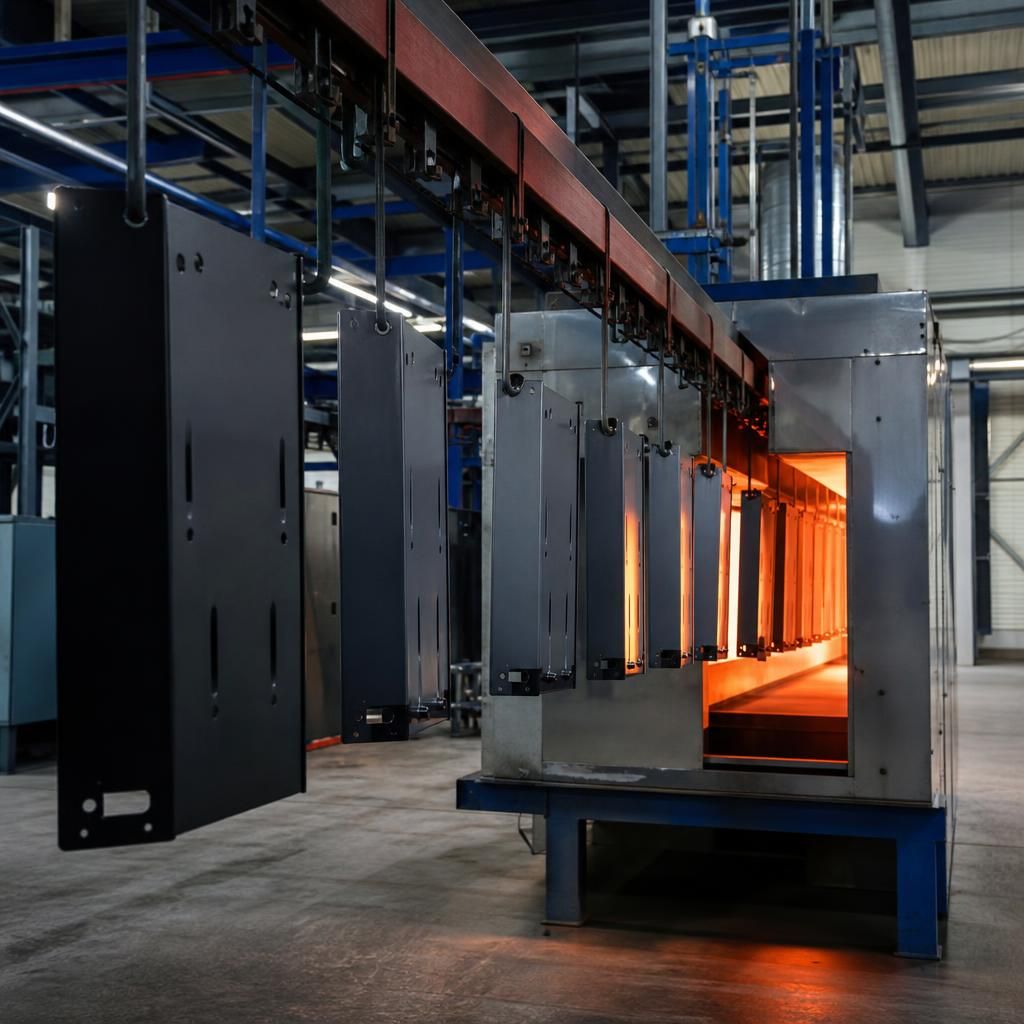
Curing is a critical control point in industrial powder coating. The powder must reach its specified curing conditions at the metal surface, not simply pass through an oven set to a particular air temperature. Component thickness, material, geometry, loading pattern and line speed all affect how quickly the part heats through.
Insufficient curing can leave the film with weaker adhesion and reduced resistance to impact, chemicals or moisture. Excessive heat exposure can also affect colour, gloss and the coating’s physical properties. For this reason, the curing schedule should be assessed against the actual component and verified through appropriate process checks rather than applied as a fixed setting to every job.
Review your industrial powder coating specification
Review your component drawings, service conditions and finish requirements before requesting an industrial powder coating assessment. Sharing these details helps determine whether the proposed specification is suitable for the part and its intended use.