

What environmental and safety measures does the powder coating company implement to ensure compliance with industry regulations and standards?
The company supports environmental and safety compliance through controlled powder-coating procedures, responsible material handling, suitable personal protective equipment and appropriate control of airborne dust and waste. These measures help protect workers, reduce environmental impact and maintain finishes in line with relevant industry requirements.
Environmental and safety compliance is supported through documented risk controls, competent handling of coating materials, maintained plant, staff training and traceable operating records. Together, these measures help the powder-coating operation meet relevant UK health, safety, environmental and product-quality requirements without treating compliance as a single end-of-line check.
Risk assessment and chemical control
Work activities are assessed for hazards associated with powder application, pre-treatment, curing and the movement of metal components. Where substances present a health risk, control measures are managed in line with the principles of the Control of Substances Hazardous to Health (COSHH) Regulations. Safety data sheets provide the basis for storage, handling, spill response and disposal instructions, while information is made available to personnel who use or work near those materials.
Materials are identified and kept in suitable conditions to prevent contamination, damage or unintended mixing. This is particularly important where different powders, primers, specialist protective coatings or pre-treatment chemicals are used on separate jobs. Clear identification and job records also help establish which materials and process settings were used for a particular batch.
Equipment, heat and fire-risk controls
Powder-coating equipment, extraction systems, curing ovens and associated electrical installations require inspection and planned maintenance. Checks help identify worn components, faulty controls, damaged cables, temperature irregularities and other defects before they affect people or production. Guards, interlocks and emergency controls should remain accessible and functional.
Fine powder can present a combustible-dust risk if it accumulates or becomes suspended in the air. Compliance therefore depends on keeping the application area suitably controlled, preventing unnecessary build-up on surfaces and maintaining equipment in accordance with its operating instructions. The operation also needs suitable arrangements for ignition control, housekeeping, fire response and the safe isolation of plant during maintenance.
Training and competence
Personnel need instruction appropriate to their duties, including safe equipment operation, material identification, spill response, emergency procedures and the limits of each process. Training is reinforced through operating procedures and supervision rather than relying solely on personal protective equipment. Visitors, contractors and anyone working near the coating process also need to understand relevant site controls.
Competence records provide evidence that people carrying out specialist tasks have received suitable instruction. Refresher training is appropriate when equipment, materials or procedures change, or when an inspection identifies a recurring issue.
Environmental controls and waste management
Powder coating generally avoids the solvent emissions associated with many liquid-paint systems, but environmental responsibility still depends on how the process is managed. Powder residues, contaminated packaging, used preparation materials and other process waste should be separated, stored securely and transferred through appropriate waste arrangements. Applying the waste hierarchy helps prioritise prevention, reuse or recovery where technically suitable before disposal.
Environmental controls also extend to preventing accidental releases, protecting drains and ground, and responding promptly to spills. Records of waste movements and material use can support regulatory checks and help identify opportunities to reduce unnecessary consumption. Where wet pre-treatment is used, any resulting chemical or wastewater controls must be managed according to the substances involved and the applicable site requirements.
Records, inspection and continual review
Documented procedures and inspection records give the company evidence that controls are being applied consistently. Useful records can include equipment maintenance, staff training, material safety information, waste movements, incident reports and corrective actions. Batch and job documentation can also link the finished component to its preparation, coating and curing conditions.
These controls are reviewed when a process changes, a new material is introduced, equipment is modified or an incident occurs. This risk-based approach helps keep procedures aligned with current operating conditions and relevant UK regulations, including workplace safety, chemical control, fire safety and environmental waste requirements. For a B2B customer, the practical benefit is clearer traceability and a more controlled route from incoming metalwork to finished components.
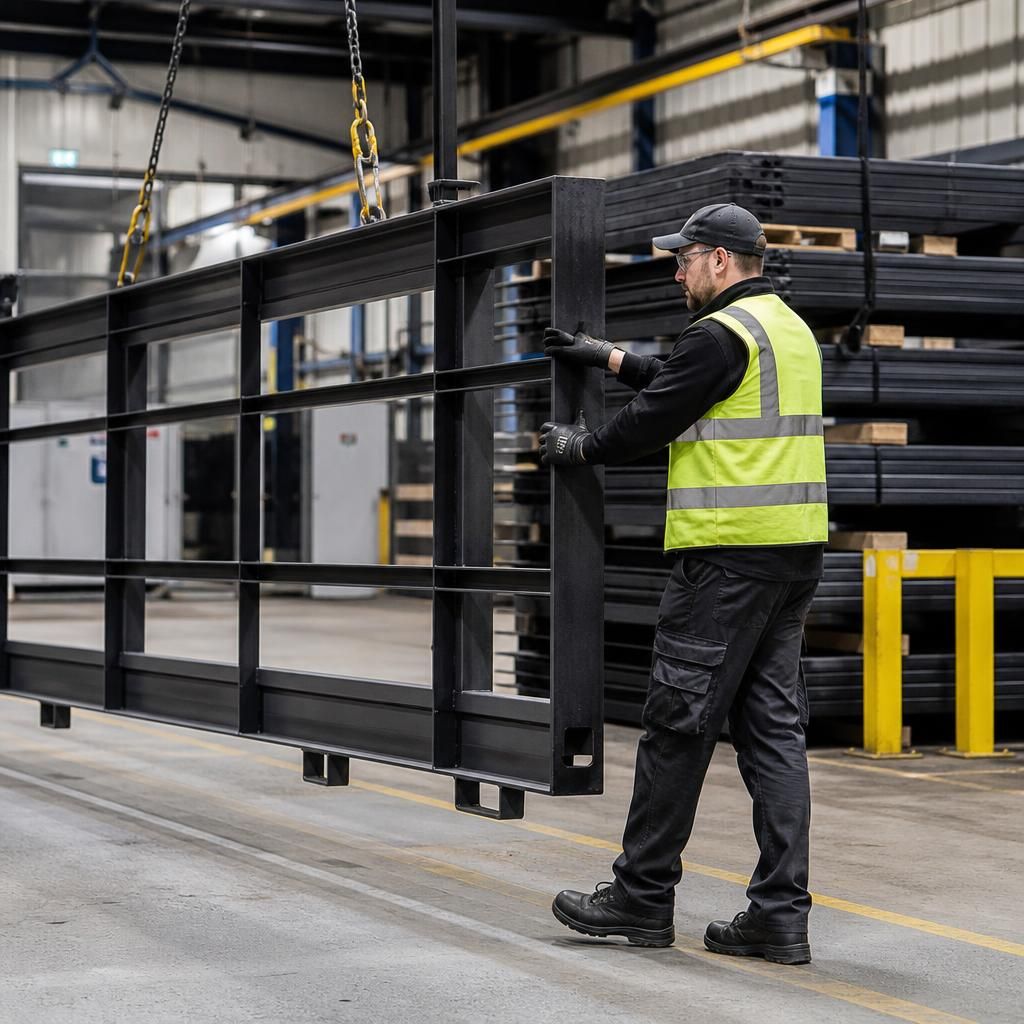
Safe movement of metalwork is a further part of powder-coating compliance, particularly when components are large, heavy or handled in batches. Incoming and finished items should be assessed for lifting hazards, secured during transport around the site and placed on stable supports to prevent falls, crush injuries or damage to the coating. Suitable handling equipment, clear walkways and controlled loading areas help separate people from moving loads and reduce avoidable risks.
These controls also protect environmental performance and product quality. Preventing collisions, dropped components and damaged packaging reduces waste and the need for rework, while keeping coated parts protected during collection or delivery helps preserve the finish achieved during processing. Handling instructions and job information can ensure that staff and transport personnel understand any unusual dimensions, sharp edges or support requirements before the component is moved.
Discuss your powder coating compliance requirements
Discuss your component requirements and any compliance documentation your project needs with the powder-coating company. Providing details of the metalwork, coating system and intended use helps establish the appropriate process controls and records.