

What are the benefits of choosing powder coating over traditional liquid painting for industrial applications?
Powder coating generally provides a tougher, more consistent and longer-lasting finish than traditional liquid paint for industrial metal components. Its dry application can also reduce material waste and simplify handling, making it well suited to demanding production environments.
Powder coating is often preferred to traditional liquid painting for industrial metalwork because it combines a solvent-free application method with efficient coverage, a broad choice of finishes and a coating film that is well suited to repeat production. The advantages are most apparent where components are manufactured in batches, exposed to regular handling or need a dependable decorative and protective finish.
Reduced reliance on solvents
Liquid paint normally uses solvents to keep the coating fluid during application and to help it form a film as it dries. Powder coating is supplied as a dry material, so the process does not require the same solvent carrier. This can reduce the presence of solvent vapours in the coating area and avoids the need to manage liquid paint thinners and associated containers as part of the application process.
This distinction can be relevant to manufacturers and fabricators reviewing workplace controls, storage arrangements and environmental procedures. It does not mean that powder coating is impact-free: the powder application equipment, curing oven, extraction systems and preparation stages still need to be properly controlled.
Efficient application for batch production
Powder is applied electrostatically, causing the charged particles to be attracted to the earthed metal component before curing. This makes the process suitable for repeatable production runs where similar parts are coated in a controlled sequence. Powder can also be applied as a relatively substantial film in a single coating cycle, whereas liquid systems may require several coats with drying intervals between them, depending on the specification and the required appearance.
For industrial work, this can simplify the production route. Components can move from preparation to application and then to oven curing without the extended air-drying stages associated with some liquid paint systems. The actual cycle still depends on the metal, component design, powder specification and curing requirements, so powder coating is not automatically the best option for every part.
Lower handling and storage complexity
Dry powder is not managed in the same way as liquid paint. There is no liquid paint pot to keep within a usable viscosity range by adding solvent, and there is less need to handle solvent-based cleaning materials during routine application. These differences can help make the coating operation more straightforward in a manufacturing environment, particularly where production teams process regular batches of comparable components.
Powder is also available in a wide range of colours, gloss levels, textures and specialist formulations. This allows the finish to be selected according to the component’s appearance, intended use and exposure conditions rather than relying on a single general-purpose paint system.
Good suitability for metal components
Powder coating is particularly practical for steel, aluminium and other heat-tolerant metal parts that can be electrically grounded and placed in a curing oven. It is used on items such as fabricated assemblies, brackets, enclosures, frames, panels and automotive components. The dry powder can reach edges, profiles and shaped surfaces effectively when the component has been designed and hung appropriately for the process.
However, component design matters. Deep recesses, narrow cavities, threaded areas and surfaces that must remain uncoated may require careful masking, jigging or a different coating approach. Components containing heat-sensitive materials, sealed cavities or parts that could distort during curing need to be assessed before powder coating is specified.
Potential cost advantages over the full production cycle
Powder coating can offer economic advantages where the coating specification, component design and batch size suit the process. A dry application, reduced dependence on liquid solvents and the ability to apply a substantial film efficiently can help limit some material, handling and process costs. The benefit is not simply the price of the coating material; it also depends on preparation, masking, curing, inspection, packaging, transport and whether the finished part meets the required specification without rework.
Liquid paint may remain more suitable for very small quantities, on-site touch-up, heat-sensitive substrates or components that cannot be placed in an oven. A fair comparison should therefore consider the complete process rather than comparing the purchase price of powder with the price of a tin of paint.
More predictable specification and finish selection
For industrial buyers, powder coating makes it possible to define requirements in terms of colour, sheen, texture, film build, preparation standard and service environment. This supports clearer communication between the component manufacturer, coating provider and end user. It is particularly useful when a batch of parts must match an established product finish or when different components need to share the same appearance.
Liquid painting can also deliver controlled results, but its performance is more affected by wet-film application, drying conditions, solvent evaporation and the time between coats. Whichever system is selected, the result depends on correct preparation, suitable material selection, controlled application and inspection against the agreed specification.
When powder coating is the better choice
- Choose powder coating when the component is a suitable, heat-tolerant metal and a repeatable factory-applied finish is required.
- It is often advantageous for batch production, fabricated metalwork and parts that need a defined decorative or protective finish.
- Consider liquid painting where the substrate cannot tolerate curing temperatures, where on-site application is essential, or where frequent touch-up and colour changes are more important than production efficiency.
- Check whether masking, dimensional tolerances, threaded areas and internal surfaces affect the suitability of either process.
The most appropriate choice depends on the metal, component geometry, expected service conditions, required appearance, batch requirements and downstream assembly process. An industrial powder coating specialist can review these factors before production so that the selected finish is practical for the part as well as appropriate for its intended use.
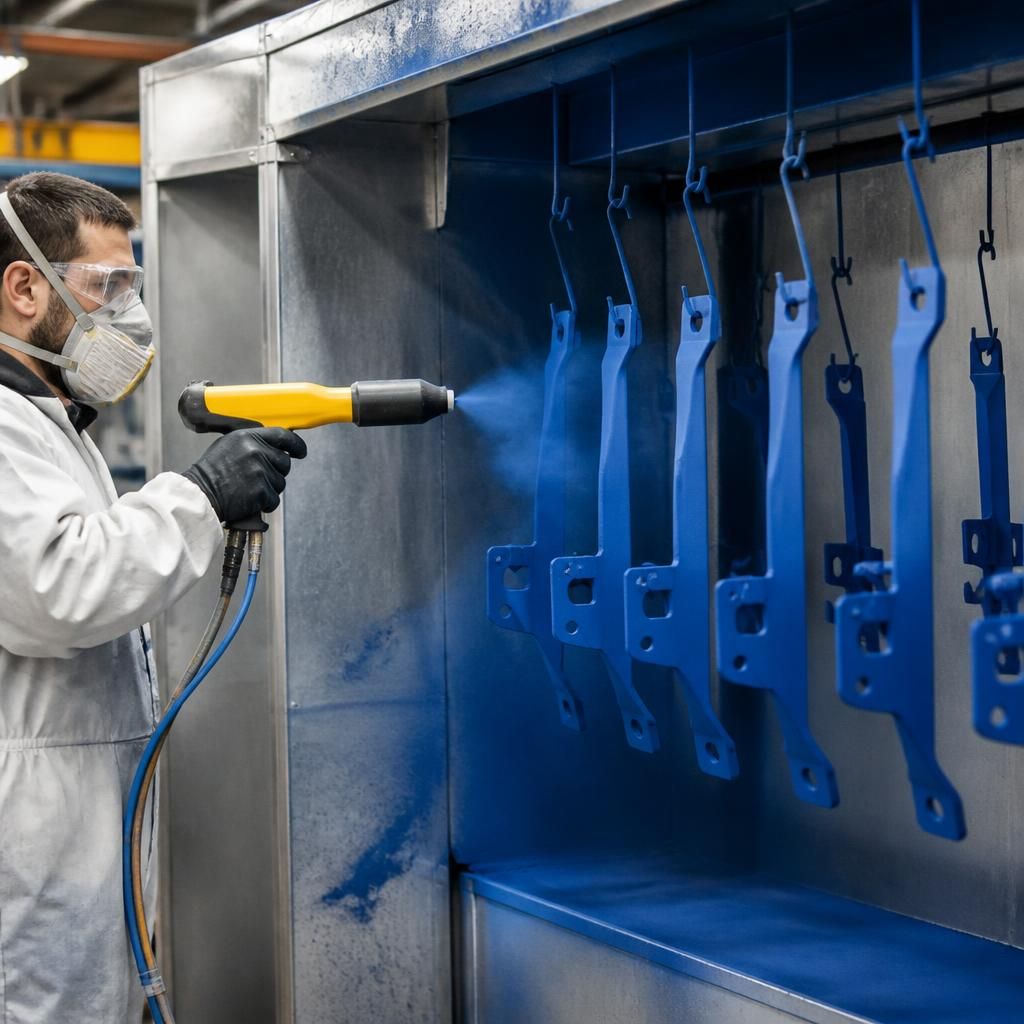
Powder coating can reduce coating material waste because unused overspray may be collected and reused where the recovery equipment and powder specification allow it. This differs from liquid paint overspray, which is typically captured as wet, solvent-containing waste and cannot be returned to the paint supply in the same way.
For manufacturers processing repeat batches, this recovery potential can make material usage easier to control and support a more efficient coating process. It depends on correct collection, filtration and segregation, particularly where different colours or formulations are applied.