

How does the powder coating company ensure the consistency and quality of each coating application?
Consistency is maintained through controlled preparation, carefully monitored application conditions and checks at key stages of each coating job. The powder coating company assesses the finished surface for coverage, adhesion and appearance so that batch-produced metal components meet the required finish specification.
Consistent powder coating depends on controlling the complete process, not simply inspecting the finished colour. The company maintains quality by translating each customer’s requirements into a defined coating specification, applying the same method across the batch and recording the checks needed to confirm that the result meets that specification.
Before production begins, the work is reviewed for details that can affect the finish. These include the component material, its dimensions and geometry, the required colour or texture, the intended service environment, masking requirements and any areas that must remain uncoated. Confirming these points helps prevent variations caused by incorrect powder selection, unsuitable hanging arrangements or coating areas that were not identified at the outset.
Job information is kept with the components as they move through the process. This provides a reference for the selected finish, preparation requirements, curing conditions and inspection criteria. For repeat work, the same information supports reproducibility between batches. If a specification changes, the revised requirement can be distinguished from an earlier version rather than relying on informal instructions.
Application consistency also relies on suitable equipment and disciplined operating practices. Spray equipment, guns, nozzles, hooks, racks and other contact points must be kept in a condition that does not introduce contamination or interfere with powder transfer. Equipment settings are selected according to the component and powder system, while regular checks and maintenance help identify wear, build-up or faults that could produce uneven coverage.
Curing is treated as a controlled part of quality assurance. The coating must receive the heat exposure specified for the powder and the component, taking account of the part’s mass and geometry rather than relying only on the oven’s displayed temperature. Monitoring the curing conditions helps confirm that the finish has developed the required hardness, adhesion and resistance characteristics without over-curing or under-curing the coating.
Inspection is carried out against the agreed requirements rather than by visual preference alone. Depending on the job, checks may consider:
- colour, gloss, texture and overall visual uniformity;
- coverage of edges, recesses and less accessible surfaces;
- visible defects such as runs, contamination, pinholes, thin areas or impact damage;
- coating thickness where a specified thickness range applies;
- adhesion and cure-related performance where these checks are required; and
- masking, uncoated areas, apertures and component identification.
Batch work benefits from inspection at more than one point. Reviewing an early component or initial part of a run can identify a developing issue before it affects the whole batch. Finished components are then handled and packed in a way that reduces marking, rubbing and contamination during movement, because a coating can be damaged after application even when the application itself was satisfactory.
If an item does not meet the agreed criteria, it is separated for assessment rather than being treated as acceptable by default. The cause may relate to the substrate, preparation, powder, application, curing or handling. Identifying the source allows the appropriate corrective action to be considered and prevents a recurring defect from being repeated across later components.
This combination of written specifications, repeatable operating methods, equipment control, curing verification, staged inspection and traceable job information gives manufacturers, fabricators and other industrial customers a practical basis for consistent results. It is particularly important where coated components are produced in batches or need to match an established finish across successive orders.
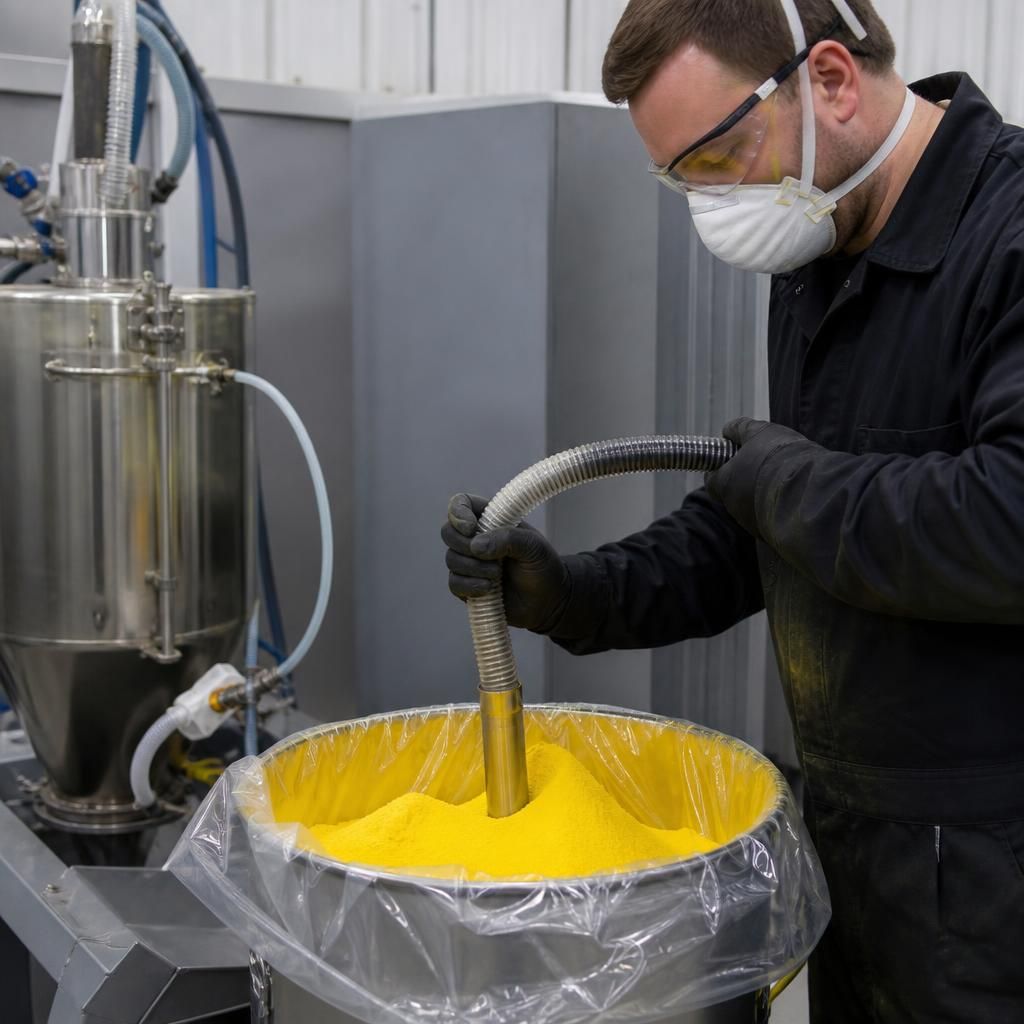
Powder condition is an important part of consistent application. The material must be stored and handled in accordance with the coating system’s requirements so that moisture, contamination or clumping does not affect fluidisation and transfer through the spray equipment. Poorly conditioned powder can contribute to uneven coverage, changes in surface texture or inconsistent deposition across components.
Maintaining separation between different powders also helps prevent unintended colour or finish variation. This is particularly relevant for batch work, where the same coating material must remain suitable throughout the run. Controlling the powder before it reaches the spray equipment complements the checks carried out during application and helps protect the uniformity of the finished coating.