

What factors influence the choice of powder coating type for different projects?
The choice of powder coating type depends on the metal substrate, expected exposure to weather, chemicals or abrasion, required durability, appearance, component size and production volume. These factors help determine the most suitable resin system, finish, colour and pre-treatment for the project.
The most suitable powder coating type is determined by the component’s functional requirements, the coating system’s chemistry and the way the part will be manufactured, installed and maintained. The decision should therefore consider more than the colour or general appearance of the finished coating.
1. Required performance from the coating
Different powder formulations are designed to provide different combinations of hardness, flexibility, chemical resistance, electrical insulation and impact protection. For example, epoxy-based coatings are often selected where strong adhesion and resistance to chemicals are important, but they may not be the first choice for components that receive prolonged direct sunlight. Polyester systems are commonly considered for external applications because they offer better resistance to ultraviolet exposure. Hybrid powders combine characteristics of epoxy and polyester and may suit indoor components requiring a balance of appearance and general protection.
Polyurethane powders can be considered where a smooth finish and resistance to weathering or chemicals are required. Nylon coatings are used for specialist applications in which low friction, impact resistance, abrasion resistance or a degree of flexibility is more important than a conventional decorative finish. The correct choice depends on the component’s actual duty rather than on the resin name alone.
2. The difference between a decorative and a functional coating
A decorative coating is primarily judged by its uniformity, texture, gloss and visual consistency. A functional coating may instead need to reduce friction, provide electrical insulation, withstand repeated contact or protect an edge from mechanical damage. Some projects need both characteristics, but one requirement can influence the formulation and application method.
For example, a smooth architectural finish may not be appropriate for a component that needs additional grip, while a heavily textured coating may interfere with the fit of accurately assembled parts. The specification should identify which properties are essential and which are simply preferred.
3. Component geometry and coating access
Shape affects how powder reaches the metal and how evenly the coating cures. Recesses, narrow channels, internal corners, perforations and overlapping sections can create areas where powder is difficult to deposit or where trapped air affects coverage. Faraday cage effects may also reduce powder deposition in deep corners and enclosed features.
Parts with complex geometry may require a different application strategy, revised hanging positions or selective masking. Threads, bearing seats, mating faces, drain holes and electrical contact points usually need to remain free from coating. These details should be identified before production because they influence both the suitable powder system and the preparation of the parts.
4. Dimensional and assembly tolerances
Powder coating adds a measurable layer to the component. This is normally straightforward on broad surfaces, but it can affect close-fitting assemblies, threaded holes, press fits, hinges and sliding interfaces. A coating that is appropriate for a structural frame may be unsuitable for a precision component if the additional thickness has not been allowed for in the design.
Critical dimensions should be recorded on the drawing, together with areas requiring masking or post-coating machining. Where parts are assembled after coating, the specification should also consider whether contact surfaces need exposed metal for earthing, bonding or mechanical fit.
5. The curing requirements and the metal’s heat tolerance
Powder coating normally requires controlled heating to fuse and cure the powder. The selected system must therefore be compatible with the substrate, any existing treatment and the component’s construction. Thin sections, heavy fabrications and mixed-material assemblies can heat at different rates, which may affect the final result if the cure schedule is not properly controlled.
Heat-sensitive inserts, seals, bearings, adhesives and electronic components may need to be removed before coating or protected through an alternative process. If a component cannot tolerate the required curing conditions, a different coating technology or a different assembly sequence may be necessary.
6. Surface preparation and existing treatments
The powder type must be compatible with the condition of the metal and the preparation process available. Oil, welding residue, rust, mill scale and previous coatings can prevent proper adhesion. Galvanised or zinc-coated steel may require specific preparation, while aluminium and steel each have different preparation considerations.
Where the component is already painted or coated, the existing layer may need to be removed rather than coated over. The intended powder system should be selected alongside the pre-treatment, because adhesion and corrosion protection depend on the complete coating system rather than the powder in isolation.
7. Required edge coverage and protection of vulnerable areas
Edges, welds, cut-outs and fabricated joints often require particular attention. Sharp edges can receive less effective coverage than broad faces, and residues in weld seams can affect the finish. Designs may need rounded edges, suitable drainage and clean weld profiles to support consistent coating performance.
For components exposed to demanding service conditions, a multi-stage protective system may be more suitable than a single decorative powder coat. This can involve a primer or specialist protective layer beneath the topcoat, provided that the products are chemically compatible and the preparation process supports adhesion between layers.
8. Production method and batch requirements
The coating should be practical to apply across the required production quantity. Parts produced in batches may need consistent racking, repeatable masking and a powder system that can be controlled across different component shapes. Very small parts can present handling and coverage challenges, while large fabrications may require separate consideration of heat penetration, hanging and movement through the curing process.
When several components must match, the specification should define the powder reference, approved finish, acceptable visual variation and inspection method. Keeping the application conditions consistent is important where parts from different batches will be used together.
9. Regulatory, safety and end-use requirements
Some applications have requirements relating to electrical insulation, contact with specific substances, fire performance, hygiene or use in a regulated environment. These requirements should be confirmed before selecting a coating because a general-purpose powder may not satisfy the relevant technical or legal specification.
The coating specification should state the expected service conditions, inspection criteria, repair procedure and any restrictions on cleaning products. This gives the applicator a clear basis for selecting the powder and helps the end user maintain the finished component correctly.
10. Repair, maintenance and future recoating
Projects should also account for what happens if the coating is damaged in service. Some finishes are easier to repair locally than others, and repairs may not be visually identical to the original application. If the component is likely to be modified, drilled or welded later, those activities should be planned before coating or followed by suitable preparation and repair.
A sound specification records the powder type, finish, preparation method, cure requirements and masked areas. For industrial components, this information helps maintain consistency when replacement parts or future batches are required.
For a practical selection, provide the coating specialist with the component material, drawing or photographs, intended use, assembly tolerances, preparation history, cure limitations and any required technical standards. Industrial powder coating providers can then assess whether a conventional polyester, epoxy-based, hybrid, polyurethane, nylon or protective coating system is appropriate, and whether the part design or preparation needs to change before production.
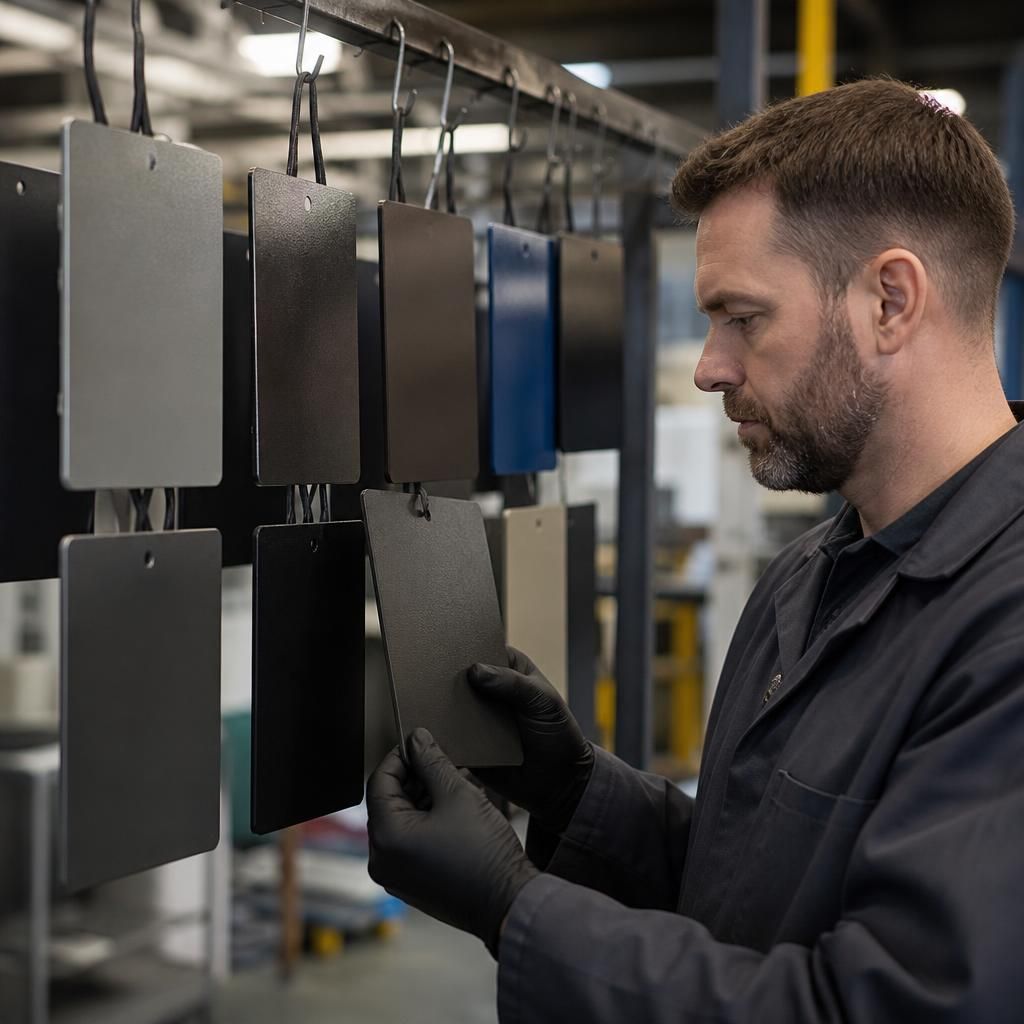
Where the application or finish is unusual, a trial panel made from the same substrate can help confirm the powder coating choice before a full production run. It allows the intended colour, gloss, texture and overall appearance to be reviewed under representative conditions, while also highlighting any interaction between the surface and the selected coating system. This is particularly useful when appearance must remain consistent across components made from different metals or supplied by different fabrication processes.