

What are the logistics involved in managing collection and delivery for large-scale coating projects?
Managing collection and delivery for large-scale coating projects requires coordinated scheduling, accurate component records, suitable transport protection and clear handover checks. Loads should be organised by batch and coating specification, with collection and delivery across the Midlands planned around production stages, inspection and any agreed packaging requirements.
Logistics for large-scale coating projects is the controlled movement of components through collection, preparation, coating, inspection and return. The objective is to keep parts identifiable, undamaged and in the correct production sequence while coordinating transport with the coating provider’s capacity, the customer’s manufacturing schedule and the requirements of the finished coating.
Begin with a logistics assessment. Before transport is arranged, establish the quantity, dimensions, weight, shape and handling requirements of the parts. Long sections, fabricated frames and irregular assemblies may need more floor space or specialist lifting equipment than standard small components. The assessment should also identify parts that cannot be stacked, items with exposed surfaces that must not rub together, and components that require a particular orientation during loading or unloading.
Site conditions are equally important. The collection and delivery plan should account for vehicle access, loading-bay restrictions, ground conditions, height limitations, turning space and the equipment available to load the goods. Where a site uses cranes, forklifts or lifting eyes, these requirements should be agreed in advance. Providing accurate information prevents a vehicle arriving that cannot safely reach the loading point or handle the consignment.
Plan the movement around the production route. Large projects often contain several component types, coating colours or finish requirements. Separating these into practical transport groups can reduce unnecessary handling and make it easier to release completed work into the next manufacturing stage. However, splitting a project into multiple consignments is only useful when the receiving team can identify, store and use each group correctly. The transport plan should therefore show which items belong together and whether partial deliveries are acceptable.
Transport protection needs to suit both the component and the coating. Suitable stillages, pallets, frames, separators and edge protection can help prevent abrasion, impact and contact damage. Newly coated parts should not be placed where their finished surfaces can bear against unprotected metal or sharp edges. Packaging should also allow safe unloading and, where relevant, avoid trapping moisture against the coating. For large fabricated items, purpose-built supports may be more appropriate than standard pallets, particularly where the load could flex or become unstable.
Documentation provides control between each handover. A useful consignment record can include:
- part or drawing references;
- quantities and component descriptions;
- the required coating system, colour and finish;
- special handling or orientation instructions;
- the number and type of containers, stillages or frames;
- any items held back, rejected or awaiting clarification; and
- the person or department responsible for receiving the load.
These details should be consistent with the purchase order, drawings and coating specification. If the specification changes after collection, the change should be recorded before the affected components enter production. This avoids uncertainty over whether a part should be coated, held separately or returned for further preparation.
Handover checks should cover the condition and completeness of the load rather than relying only on a package count. The receiving party can check visible damage, container condition, loose items and any obvious mismatch between the consignment and its paperwork. Photographs may be useful for recording the condition of unusual or vulnerable items, especially where several parties handle the goods. Any discrepancy should be documented and referred to the relevant project contact before the next stage proceeds.
Allow for exceptions and changes. Large-scale work can be affected by late design amendments, incomplete fabrication, inaccessible parts, transport damage or a component that does not pass inspection. A practical plan states how these situations will be handled: whether affected items are separated, whether a replacement collection is required, and how the change is reflected in the production and delivery records. Keeping non-conforming or unidentified parts apart from released work helps prevent accidental installation or dispatch.
For a powder coating provider, collection and delivery are therefore part of the production-control process, not separate courier tasks. A suitable arrangement links the physical handling method, project documentation, coating requirements and receiving procedures. Customers considering a large batch should provide component information early, explain site constraints and agree how loads will be presented, checked and stored at each stage. Powder-coatings.co.uk supports industrial projects with collection and delivery arrangements designed around batch work, large components and specialist coating requirements, subject to the details of the individual project.
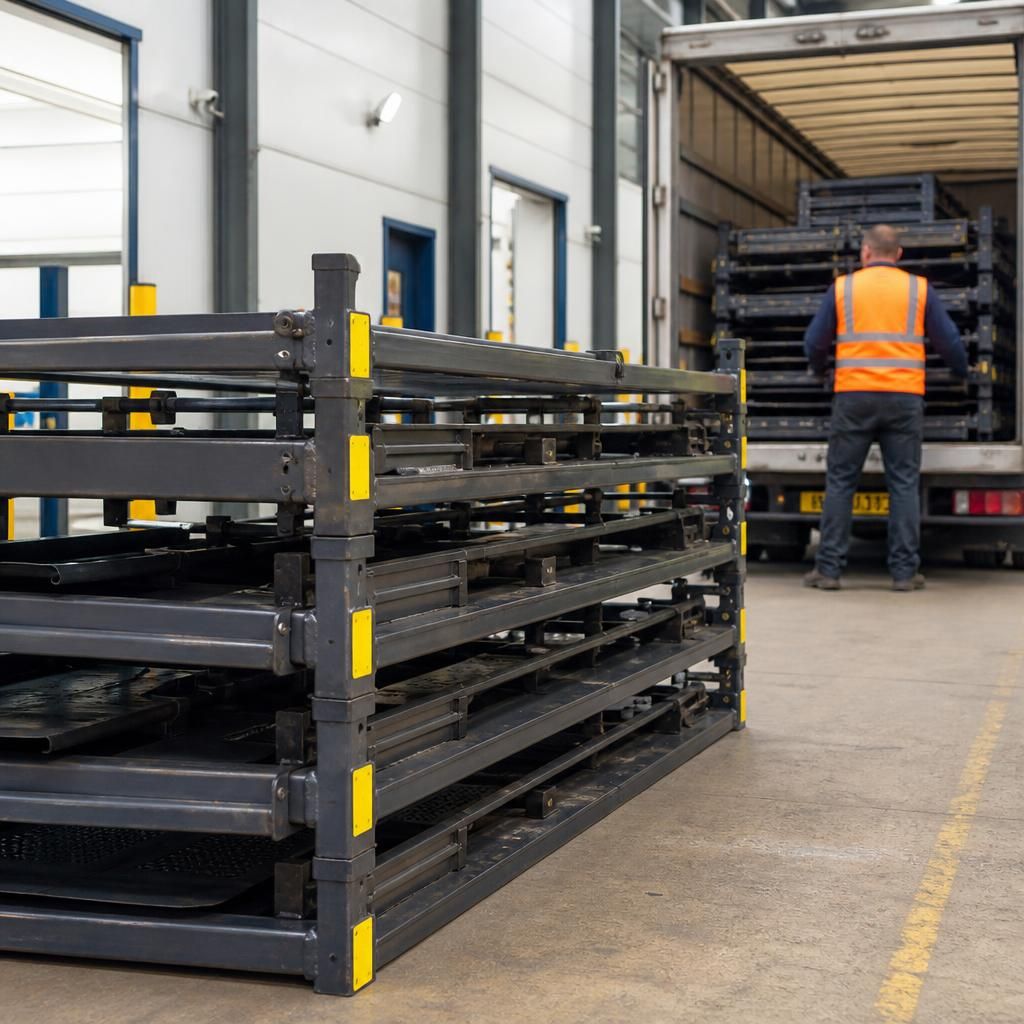
Returnable transport equipment, such as stillages, frames and specialist supports, needs its own management plan during a large-scale coating project. The collection and delivery arrangement should state which equipment is supplied, who owns it, how coated components are secured within it and when it must be returned or made available for the next load.
This is particularly important where components move through several coating batches. Empty stillages should not be treated as an afterthought: their collection, storage and condition can affect the next consignment. Any damaged or unsuitable support should be identified before reuse, while the equipment dimensions and loading method should remain consistent with the agreed handling procedure. Recording the container or frame reference against each batch also helps distinguish the coated parts from the transport assets and supports an orderly return journey.
Discuss Your Large-Scale Coating Logistics
Discuss your large-scale coating project with Powder-coatings.co.uk, including the component types, quantities and handling requirements involved. This allows the collection and delivery arrangements to be considered alongside the coating specification and production route.