

How do different high temp powder coating formulations affect stainless steel's performance in varying industrial environments?
Different high-temperature powder coating formulations alter stainless steel’s resistance to heat, thermal cycling, chemicals, moisture and corrosion. The most suitable formulation depends on the operating temperature and environmental exposure, with resin chemistry, pigments and additives affecting adhesion, flexibility, durability and appearance.
Different high-temperature powder coating formulations change how stainless steel behaves in service by determining the coating’s thermal stability, bond strength, flexibility and resistance to the surrounding atmosphere. A formulation selected for dry heat may perform poorly where the same component is exposed to condensation, chemicals, abrasion or repeated heating and cooling, so the coating must be matched to the complete operating environment rather than temperature alone.
Silicone-based formulations: Silicone and silicone-modified powder coatings are commonly considered where stainless steel will experience sustained elevated temperatures. Their binder chemistry is designed to retain adhesion and coating integrity under heat better than many conventional organic powder systems. They can be suitable for applications such as heat shields, exhaust-related components, industrial ovens and heated enclosures, provided the temperature profile and exposure conditions fall within the product specification.
Silicone-rich systems may undergo a change in colour, gloss or surface texture as temperature increases. This does not automatically indicate immediate loss of protection, but it can be unacceptable where appearance or colour consistency is important. The formulation should therefore be assessed for both functional performance and its expected visual change over the component’s service life.
Epoxy-silicone and hybrid systems: Hybrid formulations combine properties from more than one resin type. An epoxy component can contribute useful adhesion and resistance to some industrial contaminants, while silicone modification can improve the system’s ability to tolerate heat. These coatings may be appropriate where a component experiences a combination of moderate thermal exposure and chemical or mechanical demands. They should not be selected solely because a hybrid resin appears to offer a broad range of properties; the balance between heat resistance, flexibility and chemical resistance depends on the specific formulation.
Conventional epoxy-rich powders can provide strong adhesion and effective protection in many industrial applications, but prolonged high heat can cause embrittlement, loss of gloss, softening or progressive binder degradation. They may therefore be more appropriate for components with limited thermal exposure, intermittent heat or cooler external surfaces rather than for continuously hot stainless steel.
Formulations for chemically aggressive environments: Where heated stainless steel is exposed to oils, fuels, cleaning agents, process chemicals or corrosive vapours, the coating must resist the particular substances present at their operating temperature. Heat can accelerate chemical attack and make a coating more permeable, allowing contaminants to reach the metal interface. A formulation with strong dry-heat performance may consequently be unsuitable in a process area involving solvents, alkaline cleaners or acidic condensate.
Compatibility should be checked against the actual chemical, concentration, contact time and temperature. A coating’s performance against a substance at ambient temperature cannot automatically be applied to the same substance when the component is hot. Chemical exposure can also occur during cleaning, maintenance or accidental spillage, even where it is not part of the normal process.
Moisture, condensation and corrosive atmospheres: Stainless steel is corrosion-resistant, but its performance can be affected by deposits, crevices, chlorides and restricted drainage. A powder coating can provide an additional barrier, although defects at edges, joints, fasteners or impact points may become locations for moisture ingress. Formulations intended for humid or contaminated environments need reliable adhesion and resistance to underfilm corrosion, particularly when the component repeatedly moves between hot and cool conditions.
In coastal, de-icing or salt-contaminated locations, the coating specification should consider chloride exposure as well as temperature. In industrial buildings, airborne process chemicals and cleaning residues may be more significant than outdoor weather. These conditions can favour a formulation with stronger barrier and chemical-resistance properties, but the design of the component and the quality of the coating application remain equally important.
Thermal expansion and cycling: Stainless steel and the cured coating expand and contract at different rates. Repeated cycling can place stress on the interface, especially at sharp corners, welded areas, holes and transitions between thick and thin sections. A formulation with suitable flexibility and cohesive strength can accommodate this movement more effectively than a rigid, brittle film. Excessive hardness is not necessarily an advantage if it causes the coating to crack when the substrate moves.
Thermal cycling can also expose weaknesses that are not visible after a single heat exposure. Small cracks may allow moisture or chemicals to reach the stainless steel, while repeated cooling can draw contaminants into damaged areas. For components that cycle frequently, evaluation should include heating, cooling and inspection between cycles rather than a single static temperature test.
Atmosphere and oxygen availability: The surrounding atmosphere affects the way a powder coating ages. Dry air, steam, combustion gases, reducing atmospheres and chemical vapours can produce different failure mechanisms. Some systems are designed primarily for clean, dry heat, while others are formulated for more demanding industrial exposure. If the component operates inside an oven, furnace, exhaust system or process vessel, the specification should identify whether the atmosphere is oxidising, humid, contaminated or chemically reactive.
Restricted airflow and enclosed spaces can also affect heat distribution. Local hot spots may cause premature degradation even when the average component temperature appears acceptable. Formulation selection should therefore consider the hottest surface areas, contact with adjacent materials and the possibility of heat being retained around brackets, folds or enclosed sections.
Colour, pigments and additives: The binder is not the only part of the formulation that affects performance. Pigments can alter heat absorption and colour stability, while additives influence flow, flexibility, slip, film formation and resistance to degradation. Dark colours may absorb more radiant heat than lighter colours, potentially increasing the coating temperature even when the surrounding air temperature is unchanged. Certain bright or organic pigments may also show greater colour change under prolonged heat.
For this reason, the same resin family may perform differently in different colours or finishes. A specification should identify whether the priority is stable appearance, electrical insulation, low friction, chemical resistance, abrasion resistance or maximum thermal endurance, since these requirements can compete with one another.
Application and cure remain part of formulation performance: A high-temperature powder cannot compensate for contamination, poor edge coverage, an unsuitable film build or an incorrect cure schedule. Stainless steel requires a properly prepared surface, and the coating must be cured in accordance with the product’s technical requirements. Under-cure can leave the film with inadequate cohesion and chemical resistance; excessive heat can damage the coating or alter its appearance. Welds, cut edges and complex profiles may require particular attention because they can heat differently from the main body of the component.
Selection should begin with a service profile covering continuous and peak temperatures, heating and cooling frequency, atmosphere, chemicals, moisture, abrasion, impact and appearance requirements. The proposed formulation can then be assessed using the manufacturer’s technical data, representative test panels and, for critical components, testing that reproduces the intended thermal and environmental exposure. This approach is more reliable than choosing a coating from a nominal temperature description alone.
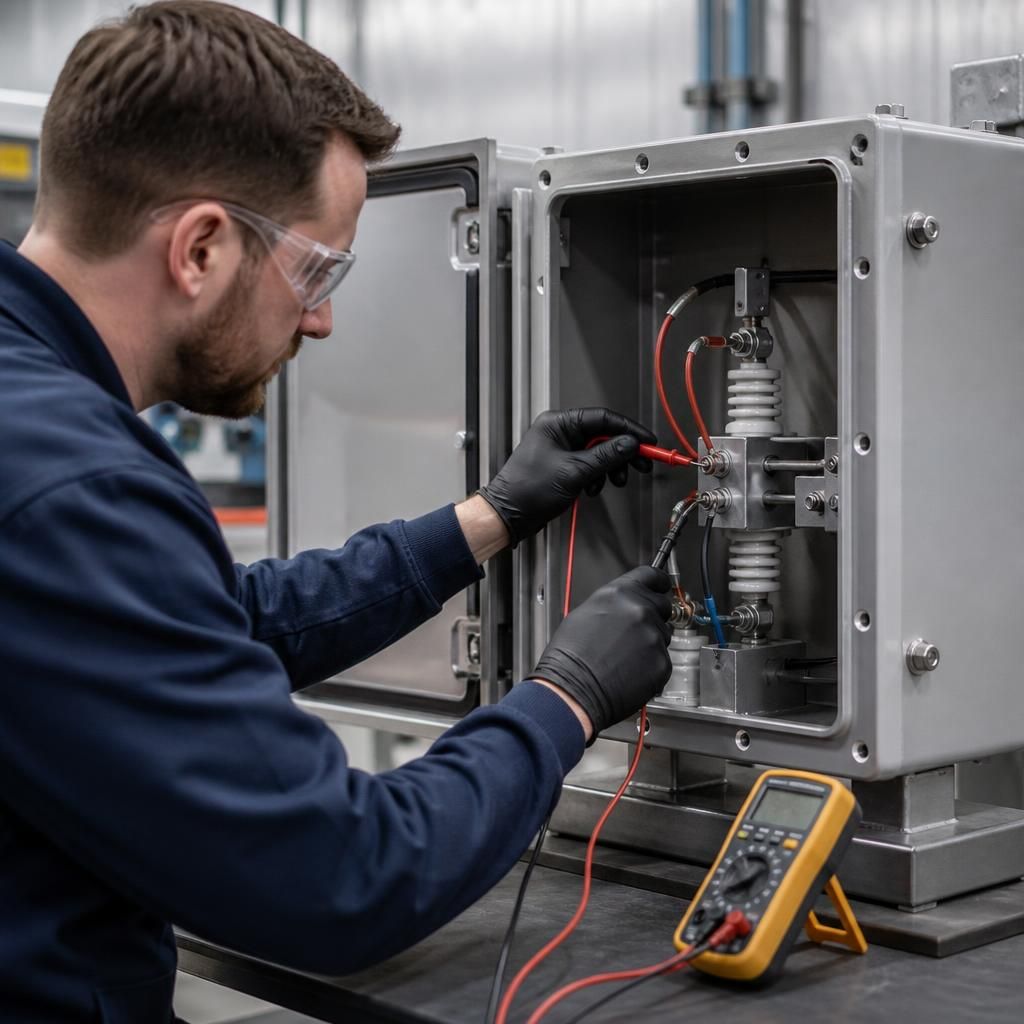
Some high-temperature powder formulations are selected not only for protection, but also for electrical insulation. On heated stainless steel components such as enclosures, supports or sensor housings, the binder and additive package can influence insulation resistance and dielectric strength as the coating temperature rises.
A formulation suitable as a general heat-resistant barrier is not automatically suitable for electrical insulation. The specification should therefore consider operating voltage, service temperature, required film thickness and the shape of contact areas. Testing after thermal ageing and repeated heating can show whether the coating retains its insulating properties, particularly around edges, holes and other areas where film continuity may be difficult to maintain.
Discuss Your Stainless Steel High Temp Powder Coating Requirements
Discuss your stainless steel high temp powder coating requirements with our team and provide details of the component, operating conditions and finish required. We can help identify a suitable coating approach for your industrial application.