

Are there specific environmental conditions that affect the performance of stainless steel high temp powder coatings?
Yes. Operating temperature and thermal cycling are the primary factors, while moisture, salt, chemicals, outdoor exposure and abrasive conditions can also affect adhesion, corrosion protection and the coating’s service life.
Environmental conditions affect stainless steel high temperature powder coatings both during application and throughout service. The coating’s performance depends on the complete exposure profile: the surrounding atmosphere, the type of contaminants present, the temperature pattern, the condition of the stainless steel and the suitability of the powder formulation and cure.
Atmospheric moisture is particularly important before and after coating. Condensation, persistent humidity and water trapped in joints or crevices can interfere with adhesion if the metal is not completely clean and dry before application. In service, water retained beneath brackets, around fasteners or at overlapping sections can create localised corrosion sites. Stainless steel remains corrosion-resistant because of its passive surface film, but deposits and restricted drainage can prevent that surface from maintaining consistent protection.
Chloride-bearing environments require specific attention. Coastal air, de-icing residues, process salts and some cleaning products can leave chloride deposits on the coating or at exposed edges. If the finish is damaged, poorly bonded or too thin in a vulnerable area, chlorides may contribute to corrosion beneath the coating. Component design therefore matters: drainage, sealed joints where appropriate and the avoidance of dirt traps can be as important as the coating selection itself.
Atmospheric chemicals can alter the coating even when the stainless steel underneath remains stable. Acids, alkalis, solvents, oils, fuels and cleaning agents vary considerably in their effect on a powder coating. The relevant question is not simply whether a product is described as chemical-resistant, but which chemicals are present, at what concentration, at what temperature and for how long. Vapours may also affect a finish in enclosed process areas. A formulation that performs well in a dry industrial atmosphere may not be appropriate for continuous contact with a liquid chemical or repeated exposure to aggressive wash-down agents.
Outdoor installation introduces several combined stresses. Ultraviolet radiation can cause colour change, loss of gloss, surface chalking or gradual embrittlement in formulations that are not intended for prolonged exposure. Rain and airborne deposits can then make the surface more difficult to clean. Industrial fallout, dust and combustion residues may retain moisture or chemicals against the finish, increasing the importance of suitable cleaning and inspection practices.
The temperature environment must be assessed as a profile rather than as one maximum value. A component may experience gradual heating, rapid temperature changes, prolonged heat, intermittent operation or separate hot and cool zones. These conditions can produce different results. Repeated expansion and contraction may place stress on the coating-to-metal bond, while temperature gradients across a large or complex part can create localised strain. Nearby welds, sharp corners, heavy sections and thin sections may also heat and cool at different rates.
High temperature can change the appearance and physical properties of a powder finish over time. Depending on the formulation and exposure, the surface may darken, lose gloss, become less flexible or show reduced resistance to handling damage. These changes do not necessarily occur at the same point as a loss of adhesion or corrosion protection. For that reason, the required finish should be selected against the full operating conditions, including start-up and shut-down cycles, not solely the stated peak temperature.
Contamination during manufacture or service can create local failures. Silicone, grease, cutting fluids, welding residues, marking products, dust and handling oils may cause cratering, pinholing, poor wetting or weak adhesion if they remain on the stainless steel. Heat-affected areas around welds can have different surface chemistry from the surrounding metal. Abrasive residues or embedded iron particles may also create visible staining and local corrosion that is mistakenly attributed to the powder itself.
Application conditions influence the result as well. The stainless steel needs an appropriate preparation process for its grade, surface condition and intended exposure. The selected powder must be applied at a controlled film thickness and cured according to its technical requirements. Insufficient cure can leave the coating with inadequate mechanical or chemical performance, while excessive heat can affect appearance or the substrate. Complex parts may need particular attention to recessed areas, edges and Faraday-cage regions where coverage can be less consistent.
When assessing a stainless steel high temperature powder coating, document:
- the normal and peak operating temperatures;
- the frequency and severity of heating and cooling cycles;
- whether the part is indoors, outdoors, enclosed or exposed to process vapours;
- contact with water, salts, chemicals, oils or cleaning agents;
- the likely levels of impact, rubbing, dust and particulate contamination;
- the stainless steel grade, weld condition, geometry and drainage arrangements; and
- the required appearance and acceptable change in colour or gloss over the service life.
These details allow the coating specification, preparation method, cure requirements and inspection regime to be matched to the actual environment. Where exposure is unusual or severe, representative testing under the expected combination of temperature, chemicals and cleaning conditions is more informative than relying on a single general resistance claim.
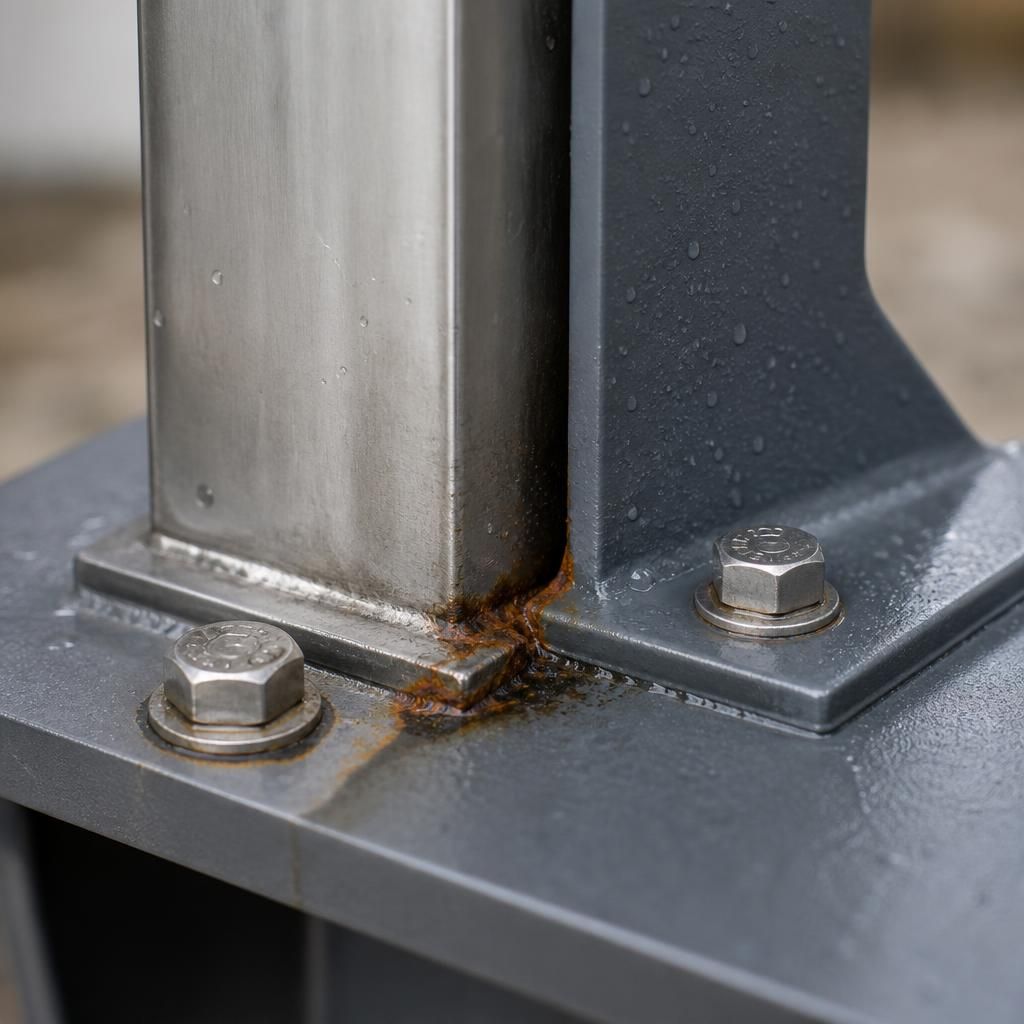
Contact with dissimilar metals can introduce an additional environmental risk for stainless steel high temperature powder coatings. If moisture or process liquid reaches an uncoated edge where stainless steel meets carbon steel, aluminium or another conductive metal, galvanic corrosion may occur at the joint. The coating can reduce exposure across the surface, but it cannot replace suitable joint design or isolate metals where electrolyte contact is likely.
Assess fasteners, brackets and interfaces as part of the coating specification. Suitable separation, controlled drainage and protection of cut edges can help limit moisture retention and corrosion at these points. This is particularly relevant where coated components are installed outdoors, exposed to wash-down or positioned in areas where condensation can collect between different metals.
Discuss Your Stainless Steel High Temp Powder Coating Requirements
Discuss your stainless steel high temperature powder coating requirements with our team, providing the component details and intended operating environment for informed specification guidance. This helps identify a suitable coating approach for your application.