

What safety measures should be implemented during the sand blasting process for high-temp coatings?
Sand blasting for high-temp coatings should be controlled through a documented risk assessment, trained operators, restricted access, suitable ventilation or dust extraction, and correctly maintained equipment. Operators should use appropriate respiratory, eye, hearing, hand and body protection, while hoses, blast pots, connections and abrasive materials are inspected and handled safely before work begins.
Safety during sand blasting for high-temperature coatings depends on controlling the risks created by abrasive particles, compressed air, dust, noise, contaminated surfaces and the metal component itself. A safe process combines suitable engineering controls, controlled operating procedures, environmental checks, equipment safeguards, exposure monitoring and emergency arrangements before, during and after blasting.
- Use a suitable blasting area: Carry out the work in a purpose-designed blast room, cabinet or enclosed system wherever practicable. The enclosure should contain abrasive rebound, prevent dust migration and provide safe access for loading and unloading components. Doors, viewing panels and seals should be kept in good condition, and blasting should not begin if the enclosure or its interlocks is defective.
- Control the compressed-air system: The blast pot, receiver, regulators, valves and pressure-rated hoses should be compatible with the operating pressure and maintained under a planned inspection regime. Use a dead-man control that stops blasting when the operator releases it. Hose couplings should be secured against separation, with whip checks or equivalent restraints where appropriate. Never point a blast nozzle at a person, use compressed air to clean clothing or skin, or bypass a control valve.
- Check the component before blasting: Remove or isolate oils, fuels, chemicals and other residues that could create a fire, toxic-exposure or reaction hazard. Identify hollow sections, trapped liquids, sharp edges, fragile welds and thin areas that could be damaged by abrasive impact. Parts should be supported securely so that vibration, movement or toppling cannot occur during the operation.
- Prevent ignition and thermal hazards: Keep flames, hot-work activities and other ignition sources away from abrasive dust and residues. Confirm that components are at a suitable temperature for handling and blasting, particularly where they have come from fabrication, heat treatment or previous coating processes. Where a coating or substrate may contain hazardous contaminants, establish the required controls before disturbing it.
- Select and manage abrasives safely: The abrasive should be suitable for the substrate and the specified surface profile, without introducing a contamination that could impair the high-temperature coating. Avoid materials that may generate an unacceptable respirable dust hazard, and obtain the relevant safety information for unfamiliar products. Store abrasive in dry, stable conditions, prevent spillage and dispose of used material and removed coating in accordance with its contamination status.
- Reduce exposure at source: Use enclosure, automated blasting or remote operation where the work allows it, rather than relying solely on personal protective equipment. Dust-control systems should be operating before abrasive flow starts and should remain effective while residual dust settles. Air movement must not spread contaminated dust into adjacent work areas, and extraction filters should be serviced according to the equipment manufacturer’s requirements.
- Manage noise and vibration: Assess noise from the nozzle, compressor, component and enclosure as a combined exposure. Enclose or isolate noisy equipment where possible, limit time spent close to operating machinery through task planning, and provide suitable hearing protection in designated areas. Operators should also report unusual vibration, pressure fluctuation or changes in nozzle performance, as these can indicate equipment faults.
- Maintain safe movement and posture: Arrange hoses, cables, components and abrasive containers to avoid trip hazards and awkward manual handling. Use lifting equipment or mechanical aids for heavy parts, with loads secured before positioning. Operators should be able to control the nozzle without overreaching, and the blast hose should not be dragged across unstable platforms or sharp edges.
- Apply a controlled start-up and shut-down procedure: Before pressurising the system, confirm that the nozzle is directed into the enclosure, the operator is ready and no unauthorised person can enter the work zone. At the end of blasting, isolate the air supply, depressurise the pot and hose, secure the nozzle and clean the area using methods that do not re-suspend dust. Do not open or dismantle pressurised equipment.
- Prepare for emergencies: The work area should have accessible first-aid arrangements, a reliable means of communication and a procedure for incidents involving eye contamination, inhalation, hose failure, entanglement, fire or component movement. Emergency stop controls should be identifiable and functional. Any exposure or equipment failure should be reported, recorded and investigated before the process resumes.
- Verify the result without creating a new hazard: Inspect the blasted surface using appropriate lighting and clean inspection methods. Do not use uncontrolled compressed air to remove dust from the component or clothing. If contamination, excessive roughness, flash rust or substrate damage is found, stop and assess the cause before coating, since correcting an unsafe or defective preparation should not involve exposing workers to avoidable dust.
These measures should be supported by written operating instructions, records of equipment checks, abrasive and waste controls, exposure assessments and periodic reviews whenever the substrate, abrasive, coating specification or blasting equipment changes. For high-temperature coating work, the safety process should also confirm that the prepared surface is compatible with the coating specification without compromising containment or worker protection.
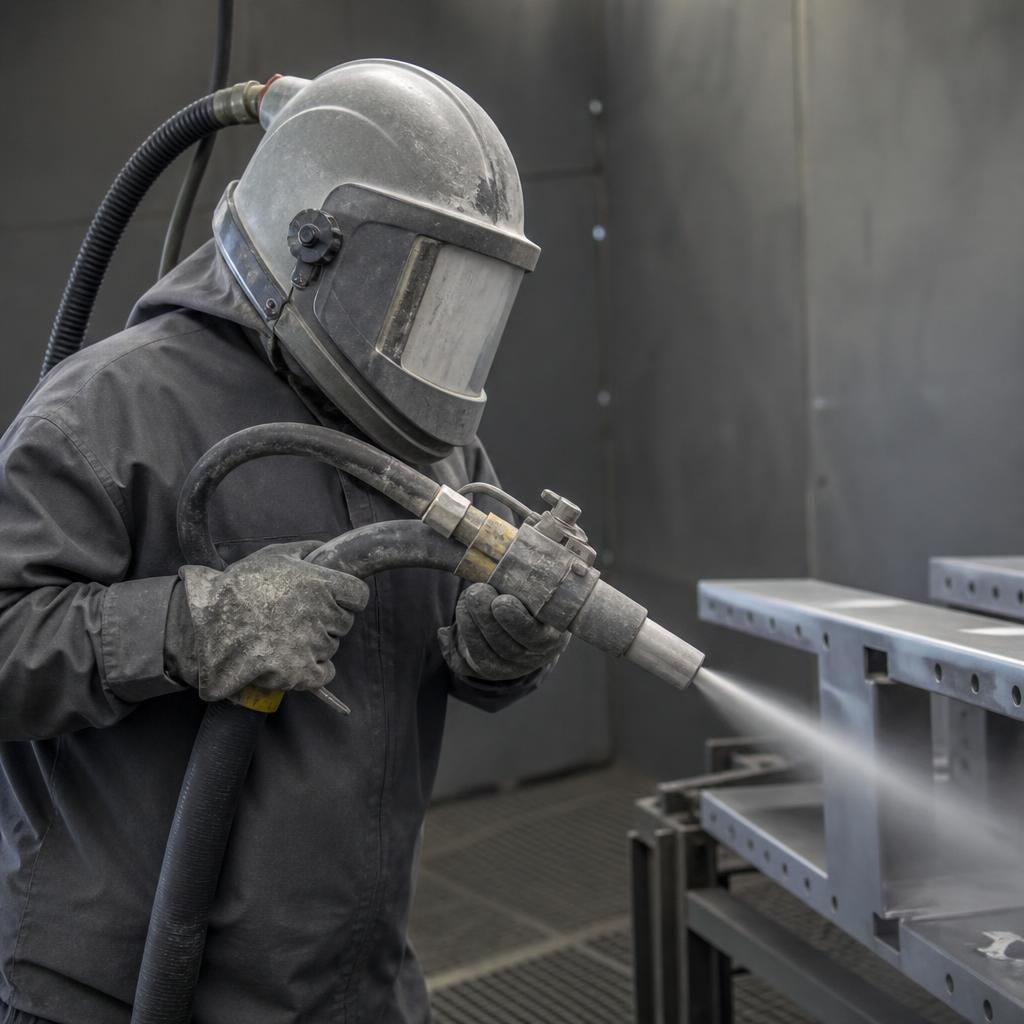
Respiratory protection for sand blasting must be selected for the dust and coating residues that the risk assessment identifies, rather than treated as a standard disposable mask requirement. Where blasting creates hazardous airborne dust, the operator may require a suitable blasting helmet or other approved respiratory protective equipment designed for the task. The equipment must provide the required level of protection, be compatible with the enclosure and air supply, and be maintained in accordance with the manufacturer’s instructions.
Operators should receive instruction on correct fitting, inspection, cleaning and storage. Tight-fitting equipment requires an appropriate face-fit test, and facial hair or other obstructions can prevent an effective seal. Filters, breathing-air components and visors should be checked before use and replaced when damaged, contaminated or beyond their service limits. RPE should support, not replace, enclosure, extraction and other controls that reduce airborne dust at source.