

How does the choice of blasting equipment impact the quality and efficiency of sand blasting for high-temp coating applications?
The blasting equipment determines how evenly the abrasive cleans and profiles the metal, affecting coating adhesion, surface consistency and the risk of defects in high-temperature applications. Equipment matched to the component and abrasive can also improve throughput by maintaining consistent pressure, flow and coverage while reducing rework and abrasive waste.
The choice of blasting equipment affects high-temperature coating preparation by determining how accurately the abrasive energy, cleanliness, dust control and process repeatability can be managed. Equipment that suits the component’s size, shape, material and coating specification helps produce a dependable substrate without unnecessary metal removal, contamination or handling delays.
Equipment type and component size
Blast cabinets are suitable for smaller components that can be placed inside an enclosed workspace. They provide controlled containment, clear access to the part and efficient recovery of abrasive. Larger fabrications, frames and assemblies generally require a blast room or enclosed blast area, where the operator can work around the component and reach external surfaces.
Using equipment that is too small can lead to awkward positioning, restricted access and repeated handling. That increases the risk of missed areas, handling contamination or damage to prepared surfaces before coating. Conversely, using a large installation for small batches may add unnecessary loading, unloading and setup requirements. The right format supports both surface quality and practical handling.
Nozzle selection and abrasive delivery
The nozzle controls the shape and concentration of the abrasive stream. Its size, design, condition and distance from the component influence how quickly scale, rust, old coating or mill residue can be removed. A worn nozzle may alter the abrasive pattern and consume more compressed air, while an unsuitable nozzle can make delicate edges and detailed profiles harder to manage.
Abrasive metering equipment is equally important. It regulates the amount of media entering the air stream, so the operator can maintain a usable balance between cleaning action and abrasive consumption. Excessive media can reduce working efficiency and create avoidable dust; insufficient media may prolong preparation or leave residues behind. The metering system should also accommodate the selected abrasive without clogging or inconsistent feeding.
Compressed-air quality and control
Blasting equipment depends on a stable supply of clean, dry compressed air. Moisture or oil carried through the air line can contaminate the prepared metal and interfere with high-temperature coating adhesion. Filters, separators and suitable air-line maintenance therefore contribute directly to surface cleanliness rather than merely supporting equipment operation.
Pressure regulation and monitoring allow the process to be adjusted for the substrate and abrasive. Heavy corrosion may require more cleaning energy, whereas thin sections, sharp edges or softer metals may need a less aggressive approach to avoid distortion or excessive profile. The important point is controlled application: the equipment must allow settings to be reproduced rather than relying solely on operator judgement.
Extraction, visibility and abrasive recovery
Effective dust extraction removes airborne particles from the working zone and helps the operator see the surface being prepared. Poor visibility can make it harder to identify remaining rust, coating residue or areas that need further attention. Extraction also helps separate fine contamination from reusable abrasive, depending on the design of the recovery system.
A well-designed recovery arrangement can reduce interruptions for clearing spent media and support more economical abrasive use. However, recovered abrasive must be screened and managed appropriately. Broken-down particles and removed contaminants can reduce cleaning performance or transfer unwanted material back onto the component if they are not adequately separated.
Manual, automated and enclosed systems
Manual blasting gives the operator flexibility around irregular geometry, welds, recesses and locally contaminated areas. It can be appropriate where component designs vary between batches. Automated equipment, such as systems using fixed nozzles or controlled movement, can provide more repeatable treatment on repeatable parts and may reduce operator fatigue.
Automation is not automatically better for every high-temperature coating application. Its effectiveness depends on whether the nozzle path reaches all required surfaces and whether the component can be positioned consistently. Complex fabrications may still require manual attention after automated treatment. Enclosures, turntables, lifting arrangements and suitable access points can therefore influence quality by making the complete surface easier to inspect and prepare.
How equipment affects the coating stage
Equipment selection should take account of the surface profile required by the high-temperature coating manufacturer or project specification. A blast system that is excessively aggressive can create an unsuitable profile, thin vulnerable edges or damage fine details. A system that is not sufficiently capable may leave tightly bonded contamination that becomes a weakness beneath the coating.
Preparation equipment should also support a controlled transition from blasting to inspection and coating. Enclosed handling, clean transfer areas and suitable lifting equipment help prevent prepared metal from being touched, exposed to workshop contamination or damaged during movement. These features do not replace inspection, but they reduce the chance that good blasting work is compromised afterwards.
What to assess when selecting equipment
- Whether the cabinet, room or enclosure can accommodate the component without awkward repositioning.
- Whether the nozzle and abrasive-delivery system suit the metal thickness, geometry and contamination being removed.
- Whether compressed air is filtered, dry and adequately controlled.
- Whether extraction provides sufficient visibility and separates dust and spent abrasive effectively.
- Whether abrasive recovery is appropriate for the media being used.
- Whether manual or automated operation gives the best access and repeatability for the component design.
- Whether the system allows the required surface condition to be inspected before high-temperature coating is applied.
In practice, equipment quality is only one part of the result. Nozzle condition, abrasive management, air-line maintenance, operator technique and inspection must all be controlled together. A technically capable blasting system can still produce poor preparation if it is incorrectly configured, while a suitably matched system gives the operator the control needed for reliable high-temperature coating work.
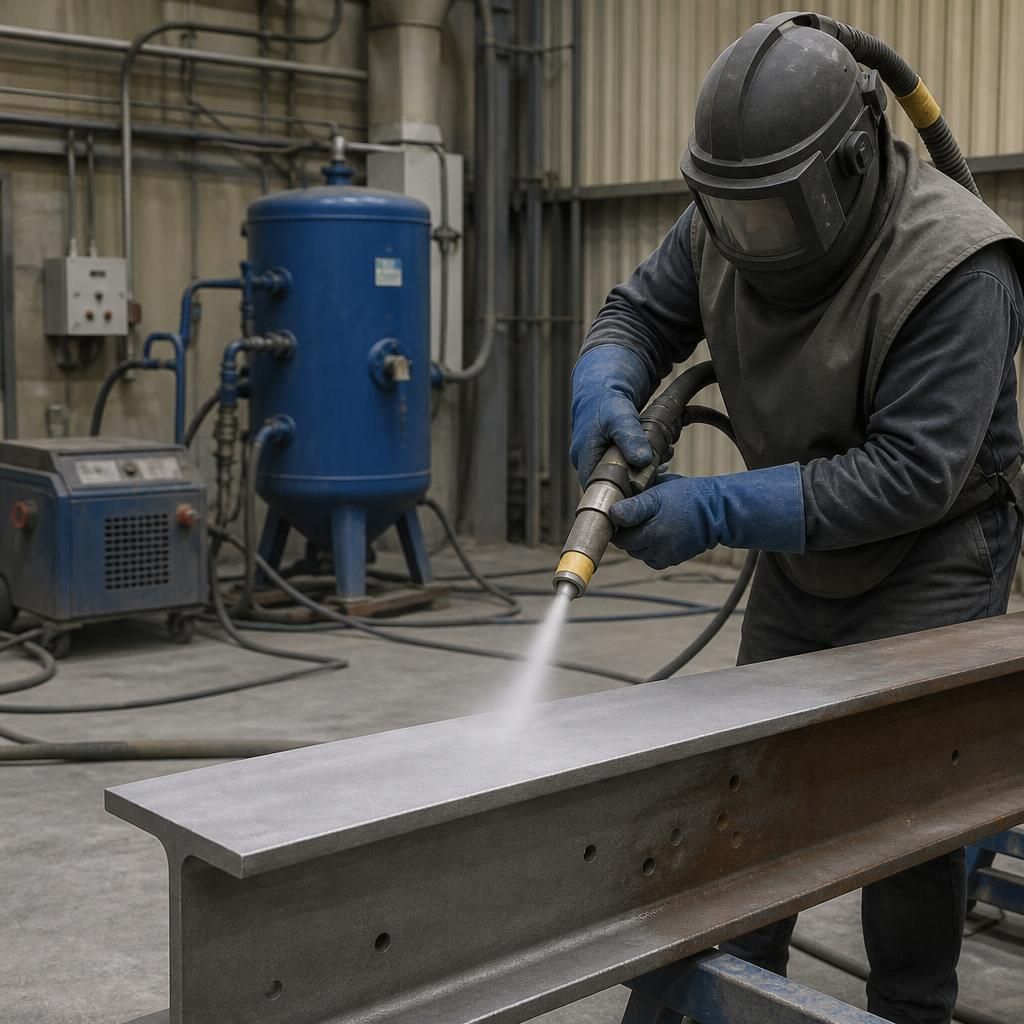
The equipment’s duty capacity affects whether blasting conditions remain stable throughout a batch. An undersized compressor or restricted air supply can cause pressure to fall during use, changing the abrasive impact and producing an inconsistent surface profile between components. Correctly matched equipment maintains more uniform working conditions and reduces interruptions for pressure recovery.
Blast-pot capacity, hose bore, coupling design and air-line layout also influence efficiency. Adequate media capacity reduces unnecessary refilling, while suitably sized hoses and unrestricted connections help deliver air and abrasive without avoidable losses. These details are particularly relevant when preparing multiple parts for a high-temperature coating, because fluctuating equipment performance can create variation that is difficult to correct at the coating stage.