

How does sand blasting enhance the longevity of high-temp coatings on metal surfaces?
Sand blasting extends the service life of high-temperature coatings by removing rust, scale, oils and other contaminants while creating a suitably rough surface for mechanical adhesion. This stronger bond helps the coating resist flaking, blistering and under-film corrosion when the metal is exposed to repeated heating and cooling.
Sand blasting enhances the longevity of high-temperature coatings by creating a controlled, uniform substrate for the complete coating system. Its value is not limited to initial adhesion: correctly prepared metal allows the coating to develop an even film, reduces local weaknesses and helps the finished component tolerate heat, oxidation and repeated changes in operating temperature.
High-temperature service places greater demands on a coating than ordinary atmospheric exposure. As the component heats and cools, the metal and coating expand and contract at different rates. Any variation in surface condition, coating thickness or bond strength can concentrate stress in a small area. These weak points may then develop into cracking, lifting or localised breakdown. A consistent blasted surface gives the coating a more predictable foundation, so thermal stress is distributed more evenly across the component.
The blasting process also supports uniform film formation. Welds, cast surfaces, rolled sections and fabricated parts can have different textures and levels of oxidation. If these variations are left untreated, the coating may be thinner over raised areas and heavier in recesses. Thin spots can reach their temperature and exposure limits sooner, while excessive thickness may retain stress or release vapours during heating. Preparing the surface consistently helps the applicator achieve a more even coating build across the whole part.
Control is essential. Excessive blast pressure, an unsuitable abrasive or prolonged treatment can damage sharp edges, distort thin sections or leave an unnecessarily aggressive profile. Conversely, insufficient preparation can leave unstable material that undermines the coating later. The correct approach depends on the metal, its condition, component geometry and the coating manufacturer’s requirements. Operators should control factors such as:
- abrasive type, size and cleanliness;
- air pressure and nozzle distance;
- the angle and movement of the blast stream;
- treatment time and coverage;
- the resulting surface profile; and
- the interval between blasting and coating.
These controls matter particularly around welds, corners, holes and joints. Geometry can make it easy to overblast one area while missing another. Careful technique produces a more consistent surface without creating sharp transitions that could become points of coating stress. Where necessary, edges may need suitable pre-treatment or design attention before coating, because an otherwise well-prepared broad surface cannot compensate for an exposed edge with inadequate film coverage.
Cleanliness after blasting is another factor in long-term performance. Abrasive dust, loose particles, moisture or handling marks can interfere with the coating process after the main preparation has been completed. The component should therefore be inspected and protected from recontamination before coating. If freshly prepared steel develops visible flash rust or other deterioration, the condition should be assessed rather than concealed beneath the coating.
Sand blasting can also reveal defects that would otherwise remain beneath the finish. Porosity, laminations, weld spatter, sharp burrs and poorly blended repairs may become more apparent after preparation. Identifying these issues before coating allows them to be corrected at the appropriate stage. Coating over such defects may preserve the appearance temporarily, but the defect can become a route for premature failure when the part is heated.
Longevity ultimately depends on the complete system, not blasting alone. The coating must be suitable for the actual operating temperature, atmosphere and substrate, and it must be applied and cured in accordance with its technical requirements. The service environment should also be considered: dry heat, combustion gases, chemicals, salt contamination and moisture can impose different failure mechanisms. Sand blasting provides the necessary preparation for a sound system, but it cannot compensate for an unsuitable coating or incorrect curing conditions.
For industrial components, useful quality checks include visual inspection under suitable lighting, confirmation that the specified surface profile has been achieved, checks for residual dust and verification that the prepared metal has not been damaged. Recording these checks creates a more repeatable process across batches. When surface preparation, coating selection, application thickness and curing are treated as connected stages, the finished high-temperature coating is better placed to retain its protective function throughout service.
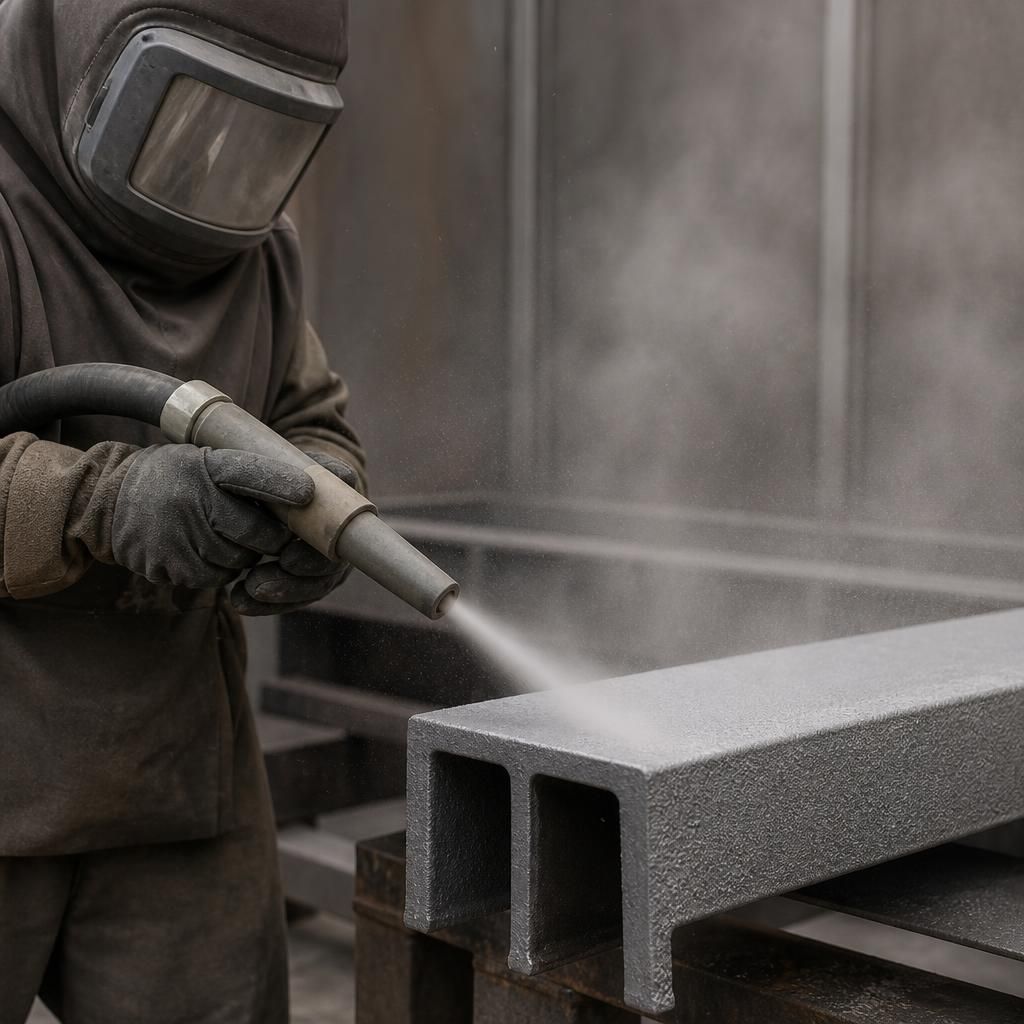
The blasted surface profile must be compatible with the coating film, because an overly deep or irregular texture can reduce long-term protection rather than improve it. If the coating does not fully cover the profile peaks and valleys, the peaks may have reduced film thickness while the recesses can trap air or contamination. These local weaknesses are more likely to deteriorate as the component experiences heat and cooling cycles.
For this reason, surface preparation should aim for a consistent profile within the coating system’s specified range, rather than the roughest possible finish. Matching the abrasive and blasting conditions to the metal and coating helps create a surface that the coating can wet and cover evenly, supporting more reliable protection throughout the component’s service life.
Discuss Your High-Temperature Coating Requirements
Discuss your component, substrate and operating temperature with the powder-coating specialists to determine whether sand blasting is suitable preparation for your high-temperature coating system. Share details of the part and its service environment so the required surface preparation can be considered alongside coating selection and application.