

How does sand blasting differ from other surface preparation methods for high-temperature coatings?
Sand blasting differs from methods such as chemical cleaning, wire brushing and abrasive sanding because it uses pressurised abrasive media to remove corrosion, mill scale, old coatings and contamination while creating a controlled surface profile. This textured, clean surface generally gives high-temperature coatings a more suitable key than cleaning methods that remove contaminants without significantly profiling the metal.
Sand blasting differs from other surface preparation methods because it combines contaminant removal with mechanical conditioning of the metal surface. For high-temperature coatings, this distinction matters: the substrate must be clean and sufficiently stable for the coating system to adhere before the component is exposed to repeated heating and cooling.
Compared with chemical cleaning, sand blasting provides a physical treatment rather than relying on solvents, detergents, acids or alkaline solutions. Chemical cleaning can be effective for oil, grease and certain oxides, but it does not usually remove firmly bonded scale or create a substantial mechanical key. It can also leave residues if rinsing or neutralisation is incomplete. Those residues may interfere with coating adhesion or become a source of blistering when the part reaches a high operating temperature.
Chemical processes can still form part of a preparation sequence, particularly where degreasing is needed before abrasive treatment. They are less suitable as the sole preparation method when the metal has corrosion, mill scale, an existing coating or other tightly adhered material that must be removed.
Compared with wire brushing and hand abrasion, sand blasting is generally better suited to larger areas, complex profiles and repeatable production work. A wire brush can remove loose rust and provide local preparation, while abrasive paper or discs can smooth or abrade accessible sections. These methods depend heavily on operator access and pressure, however. Recesses, weld contours, perforations and irregular edges may be difficult to prepare evenly by hand.
Hand tools remain useful for small repairs, localised areas or situations where surrounding surfaces must be protected. They may be less appropriate where the specification calls for a consistent preparation grade across a complete component. They can also polish some contaminants rather than removing them fully if the tool or technique is unsuitable.
Compared with shot blasting, the difference is mainly in the abrasive media and the resulting surface action. Sand or grit blasting typically uses angular particles that cut into contamination and produce a more pronounced, irregular profile. Shot blasting uses rounded metallic or mineral particles, which tend to impact and peen the surface. The choice between them depends on the substrate, the existing finish, the required profile and the geometry of the workpiece.
Shot blasting can be efficient for robust components and batch processing, but it may not be suitable for thin, delicate or easily distorted parts. The impact energy can also affect edges and dimensional features. Sand blasting, when correctly controlled, can offer more flexibility for targeted preparation, although excessive pressure or an unsuitable abrasive can still erode edges or damage softer metal.
Compared with wet blasting, dry sand blasting avoids introducing water into the preparation process. Wet blasting combines abrasive media with water to reduce airborne dust and can produce a different surface appearance. However, the component must then be thoroughly rinsed, dried and protected against flash rust. Trapped moisture in joints, pores or recesses is particularly undesirable before a high-temperature coating is applied.
Dry blasting therefore simplifies moisture control, but it requires effective management of airborne dust and spent abrasive. Neither method is automatically preferable for every component. The decision should consider the metal, the coating specification, the condition of the part and the ability to dry and inspect the surface properly.
Compared with water jetting, sand blasting applies abrasive impact rather than hydraulic force. Water jetting can remove loose coatings, salts and some corrosion without creating the same dust load, but it may leave the surface profile unchanged or less defined than abrasive blasting. It also introduces the need for controlled drying and protection from flash rust. For high-temperature coatings, any remaining moisture or soluble contamination must be addressed before coating.
Compared with laser cleaning, abrasive blasting usually covers prepared areas more practically where the objective is general coating removal and surface conditioning. Laser cleaning can be highly selective and can limit contact with the substrate, but its suitability depends on the material, contamination, component geometry and process control. It is not a universal replacement for abrasive preparation, particularly where a specified mechanical profile is required for the coating system.
The most important differences can be assessed against the following criteria:
- Contaminant removal: the method must remove oil, corrosion products, scale, old coating and other substances identified in the preparation specification.
- Surface profile: the resulting texture must be compatible with the high-temperature coating. A profile that is too shallow may reduce adhesion, while one that is too aggressive can increase coating demand or leave sharp peaks.
- Residue control: chemical residues, abrasive dust, salts and moisture must not remain on the substrate before coating.
- Access and geometry: recesses, welds, holes and intricate shapes may favour a process that can reach the full surface consistently.
- Substrate protection: thin sections, soft alloys and precision features require control of impact energy to avoid distortion, excessive roughening or dimensional change.
- Repeatability: production work benefits from a method that can be set and inspected consistently across batches.
For high-temperature applications, preparation should not be judged by visual cleanliness alone. The prepared surface also needs to be dry, free from loose residues and compatible with the coating manufacturer’s specified preparation grade and profile. Inspection may include visual assessment, checks for remaining contamination and measurement of surface roughness where the specification requires it.
In practice, sand blasting is often selected when the coating system requires both thorough removal of existing surface material and a controlled mechanical key. Chemical cleaning, hand tools, shot blasting, wet blasting, water jetting or laser cleaning may be more appropriate for particular contaminants, substrates or access limitations. The correct choice is therefore determined by the metal and coating requirements, not by the preparation method in isolation.
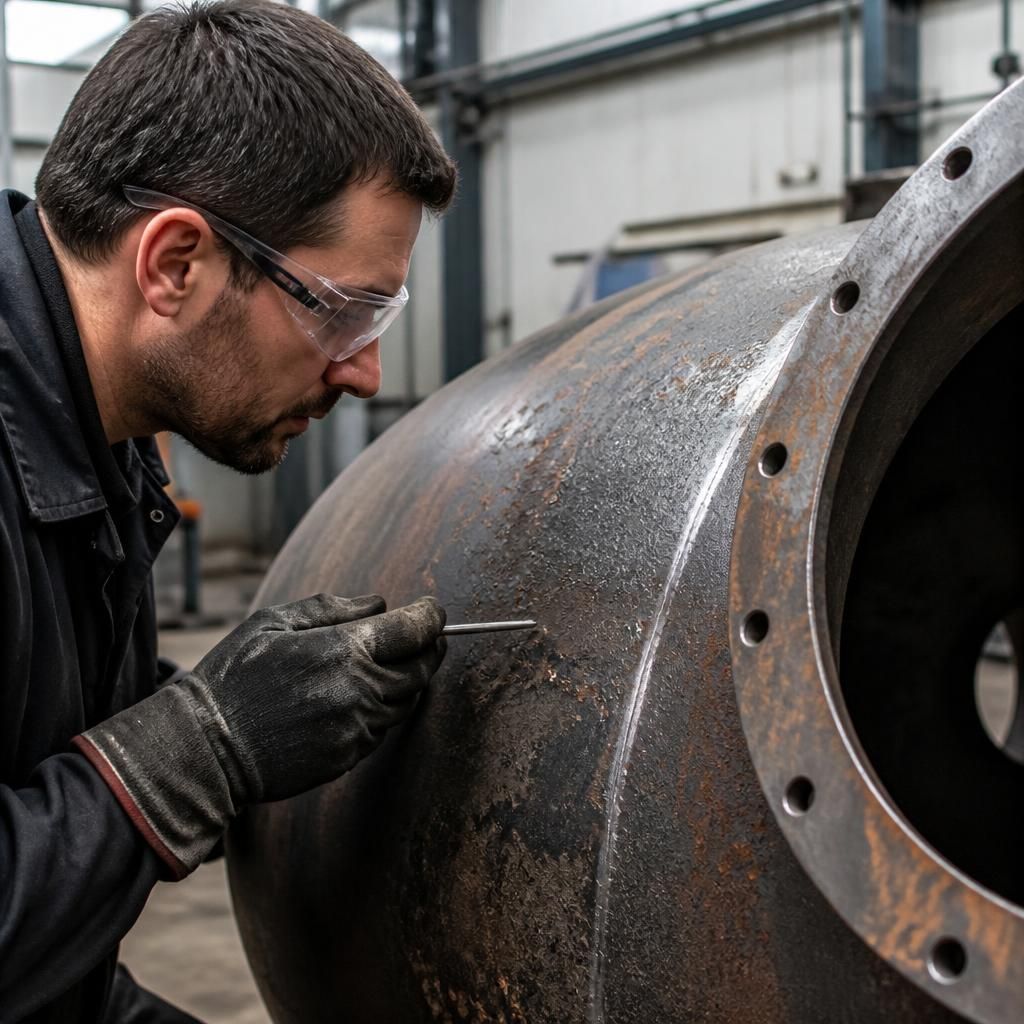
One practical difference between sand blasting and less aggressive preparation methods is that blasting can reveal the true condition of the metal before a high-temperature coating is applied. Once loose scale, corrosion products and failed coating layers have been removed, pits, weld spatter, sharp edges or previously concealed surface damage may become apparent.
This matters because a coating is not a substitute for repairing substrate defects. Newly exposed imperfections may need to be corrected, blended or accepted against the project specification before coating proceeds. Chemical cleaning or light manual preparation may leave some of these areas masked by firmly attached contamination, making the surface appear more suitable than it is.
For that reason, the preparation method should be treated as part of a staged assessment: prepare the metal, examine the exposed surface, complete any necessary remedial work and then confirm that the finish meets the coating requirements. This approach helps distinguish a genuinely prepared substrate from one that is merely cleaner on the surface.