

What types of finishes can be achieved with powder coating on steel and aluminium frames?
Powder coating can give steel and aluminium frames smooth, matt, satin, gloss, textured and metallic finishes in a wide range of colours. The selected powder, surface preparation and application settings determine the final appearance and texture.
Powder coating can produce decorative and functional finishes for steel and aluminium frames, with the final result determined by the coating chemistry, surface profile, curing conditions and the design of the frame. The finish may be selected primarily for appearance, for resistance to handling and weathering, or for a balance of both.
Beyond the basic level of sheen, finish selection can include:
- Solid colours: Suitable for consistent, uniform coverage across structural frames, brackets, enclosures and fabricated assemblies. Colours can be specified to match a project’s design scheme or an existing component.
- Fine-textured and rough-textured surfaces: These introduce a tactile surface that can help disguise minor visual irregularities in the underlying metal. The texture also changes how light is reflected, giving the frame a more industrial or architectural appearance.
- Wrinkle and hammered effects: These have a more pronounced surface pattern and may be chosen where a distinctive visual effect is required. They are particularly relevant to equipment, furniture components and specialist fabricated parts.
- Metallic and mica effects: These contain reflective or pearlescent elements that alter the appearance as the viewing angle changes. They require careful application because the distribution of the effect can influence colour consistency between components.
- Clear and translucent finishes: Where the appearance of the substrate is intended to remain visible, a clear or lightly tinted coating may be considered. The underlying metal must be prepared to a suitable standard because surface marks remain visible through a less opaque finish.
- Specialist nylon finishes: Nylon powder coatings can provide a hard-wearing surface for applications where resistance to abrasion, impact or particular chemicals is important. They are selected for performance requirements rather than appearance alone.
The same nominal colour can look different depending on the surface texture and gloss level. A smooth surface reflects light more evenly, while a textured surface scatters it and can therefore appear softer or darker. Metallic finishes are also more sensitive to viewing direction and application consistency than conventional solid colours. For this reason, a physical sample or approved reference panel is more reliable than judging a finish from a screen image.
Steel and aluminium frames can accept many of the same visual finish categories, but the substrates may require different preparation and coating systems. Steel commonly needs treatment that addresses mill scale, rust risk and weld areas. Aluminium may require a preparation process suited to its oxide layer and the intended service environment. If the substrate is not prepared correctly, an attractive powder selection will not compensate for poor adhesion, uneven coverage or premature coating failure.
Frame geometry also affects the finished appearance. Corners, welds, folded edges, recesses and internal faces can receive powder differently from broad, accessible surfaces. Deep sections may need an application approach that avoids uneven build-up, while sharp edges can require attention to achieve continuous coverage. Components designed to be seen from several angles should therefore be assessed as complete assemblies rather than judged only from the front face.
Coating chemistry is another important distinction. Polyester-based systems are commonly considered where the frame will face external weathering, whereas epoxy-based materials are generally more associated with environments where ultraviolet exposure is limited but chemical or mechanical performance is important. Hybrid systems can provide a balance of properties for suitable indoor uses. Nylon and other specialist powders may be selected where wear, impact or chemical resistance is a higher priority than a conventional decorative finish.
The intended use should guide the choice between appearance and performance. An internal machine frame may prioritise colour uniformity and resistance to workshop handling. An architectural frame may place greater emphasis on colour matching, sheen and texture. A component exposed to frequent contact or abrasion may need a tougher specialist system, even if that limits the available decorative options. Outdoor use also requires a coating system appropriate to ultraviolet exposure and the surrounding environment.
Consistency is especially important when a project contains multiple frame sections or repeat batches. The coater should be given the required colour reference, sheen, texture, approved sample and any masking instructions before production. Parts should be reviewed for compatibility where they will be assembled together, because differences in orientation, substrate, coating batch or texture can affect their visual match.
A suitable finish is therefore not chosen by colour alone. The specification should cover the substrate, location, expected handling, exposure conditions, required appearance, coating type and areas that must remain uncoated for assembly or electrical contact. A specialist powder coater can use this information to identify a finish that is practical to apply as well as appropriate for the frame’s final role.
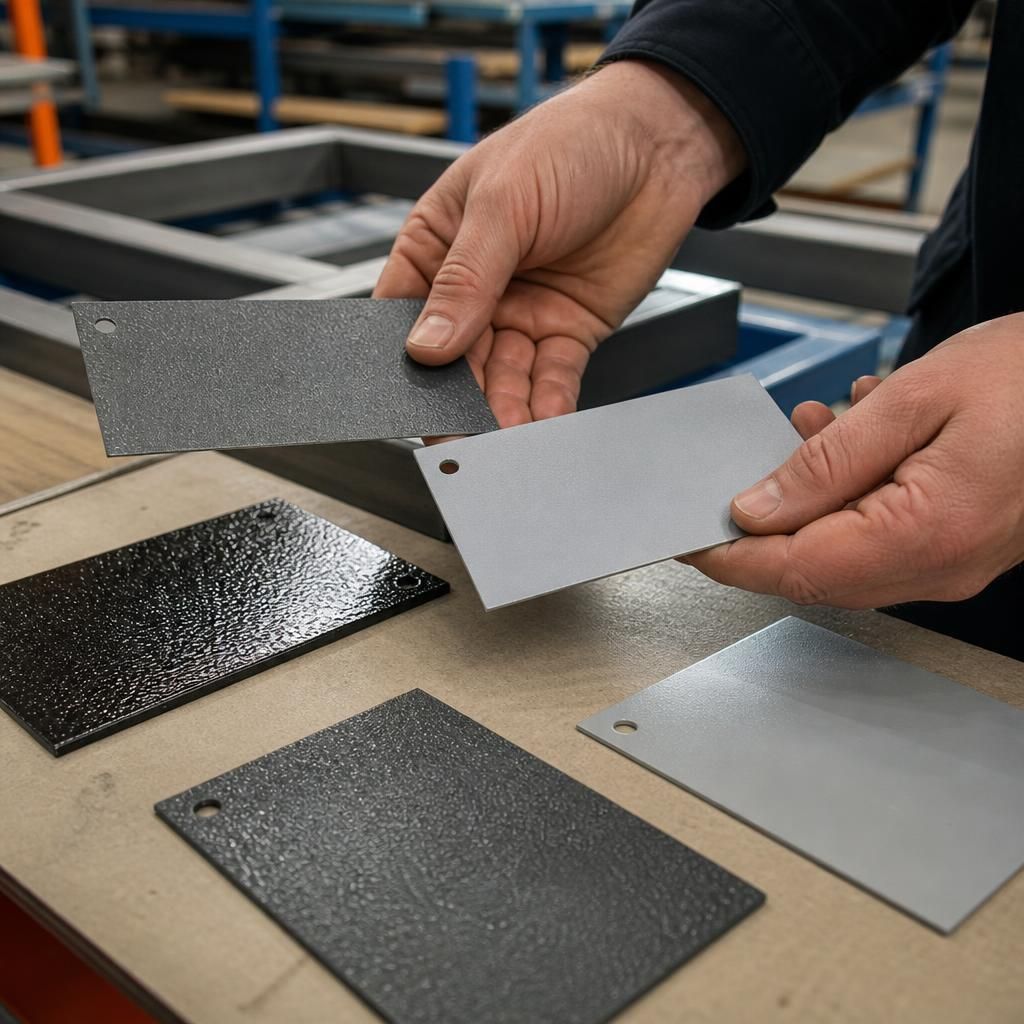
The surface texture of a powder-coated frame affects practical use as well as appearance. Smooth finishes are generally easier to wipe clean, while fine or heavier textures can help make minor marks less noticeable but may retain more dust in their surface pattern. Where a frame is frequently handled, installed in a visible location or exposed to workshop debris, the texture should be considered alongside colour and gloss.
A finish sample should therefore be assessed under the conditions in which the frame will be used. Compare its appearance, tactile feel and cleanability before approving the specification, particularly for frames that combine prominent external faces with areas subject to regular contact.
Discuss the Right Finish for Your Steel or Aluminium Frames
Discuss your required colour, gloss level, texture and service conditions with our powder-coating specialists to identify a suitable finish for your steel or aluminium frames. An approved sample or reference panel can then be used to confirm the appearance before production.