

How does powder coating enhance the corrosion resistance of steel and aluminium frames?
Powder coating enhances corrosion resistance by forming a continuous, tightly bonded barrier that separates steel or aluminium from moisture, oxygen and corrosive contaminants. When the metal is correctly prepared and the coating is applied and cured to specification, it helps reduce oxidation, rust and surface degradation, although protection depends on the substrate, pretreatment, coating system and service environment.
Powder coating enhances the corrosion resistance of steel and aluminium frames by combining suitable substrate preparation with a chemically resistant, fully cured coating system. The result is a hard, adherent finish that limits the conditions needed for corrosion to develop and helps protect the frame during handling, installation and service.
Steel corrodes when moisture and oxygen reach its surface, particularly where salts, pollutants or standing water are present. The corrosion products occupy more volume than the original steel and can cause blistering, flaking and progressive loss of section. A correctly specified powder coating separates the steel from these external influences. For applications where the steel is exposed to more aggressive conditions, the coating system may include a compatible anti-corrosion primer beneath the powder topcoat rather than relying on a single decorative layer.
Aluminium behaves differently. It naturally forms a thin oxide layer, but this does not make the frame immune to corrosion. Surface damage, persistent moisture, salts and contact with dissimilar metals can lead to localised attack, staining or pitting. Powder coating adds a controlled protective layer and reduces direct contact between the aluminium and its surroundings. The specification still needs to account for the environment, particularly on frames used externally or near sources of salt and industrial contamination.
- Substrate cleaning: Oil, grease, dirt, mill scale, oxides and other contaminants must be removed so that the coating can bond to sound metal.
- Chemical pretreatment: A suitable conversion treatment improves adhesion and helps limit corrosion beneath the coating if the surface is exposed through a small defect.
- Correct coating selection: The powder chemistry, film build and number of layers should be chosen for the metal, location and expected exposure rather than selected solely for colour or texture.
- Controlled curing: The powder must reach the required cure throughout the frame. Under-cured material may have reduced adhesion and chemical resistance, while excessive heat can affect the finish or substrate.
Frame design also has a direct effect on corrosion performance. Water can remain trapped in unsealed joints, folded sections, channels and fixing points, creating conditions that are more severe than those on an exposed flat surface. Drainage paths, suitable joint details and the avoidance of unnecessary crevices help the coating perform as intended. Welds and heat-affected areas require particular attention because residues, surface irregularities and differences in texture can affect preparation and coating continuity.
Edges are another important consideration. Sharp edges can receive less powder than broad faces, leaving a thinner area that is more vulnerable to early breakdown. Radiused edges, appropriate preparation and a coating specification that recognises edge coverage can improve protection. Recesses and internal corners may also require process checks because electrostatic application can make it harder to achieve an even deposit in areas affected by the Faraday cage effect.
Powder coating does not repair corroded or poorly prepared metal. Rust, aluminium corrosion products, weld contamination or chemical residues left beneath the finish can continue to affect adhesion and may cause underfilm corrosion. Where a frame has previously been coated, the existing material must also be assessed for compatibility and removed or treated where necessary. Preparation should be agreed according to the frame’s condition and the required level of protection.
Mechanical damage is the main way a finished frame can lose its protective continuity. Cutting, drilling, grinding and careless installation can expose the underlying metal. Fasteners, brackets and other attachments should be selected and installed to minimise damage and avoid creating galvanic corrosion between dissimilar metals. Any exposed areas should be assessed and repaired with a compatible system rather than covered with an unrelated paint or sealant.
Corrosion resistance is therefore a system property, not a feature of the powder alone. A suitable assessment considers:
- the base metal and its surface condition;
- indoor or outdoor exposure, including moisture, condensation, salt and industrial pollutants;
- the frame’s geometry, drainage and joint design;
- the likelihood of impact, abrasion, chemical contact or installation damage;
- the required appearance and expected maintenance arrangements; and
- the preparation, coating and curing controls used by the applicator.
Laboratory tests and project specifications can help compare coating systems, but test results should not be treated as a direct prediction of service life. Actual performance depends on the complete process and the environment in which the frame is installed. For a demanding application, the coating specification should define the preparation method, primer or topcoat arrangement where applicable, curing requirements, inspection criteria and repair procedure before production begins.
In practice, powder coating offers effective corrosion protection when the steel or aluminium is properly prepared, the coating system matches the exposure and the finished frames are designed, handled and maintained to avoid water traps and physical damage. It should be viewed as part of an engineered protection system rather than as a substitute for sound metalwork design or suitable ongoing care.
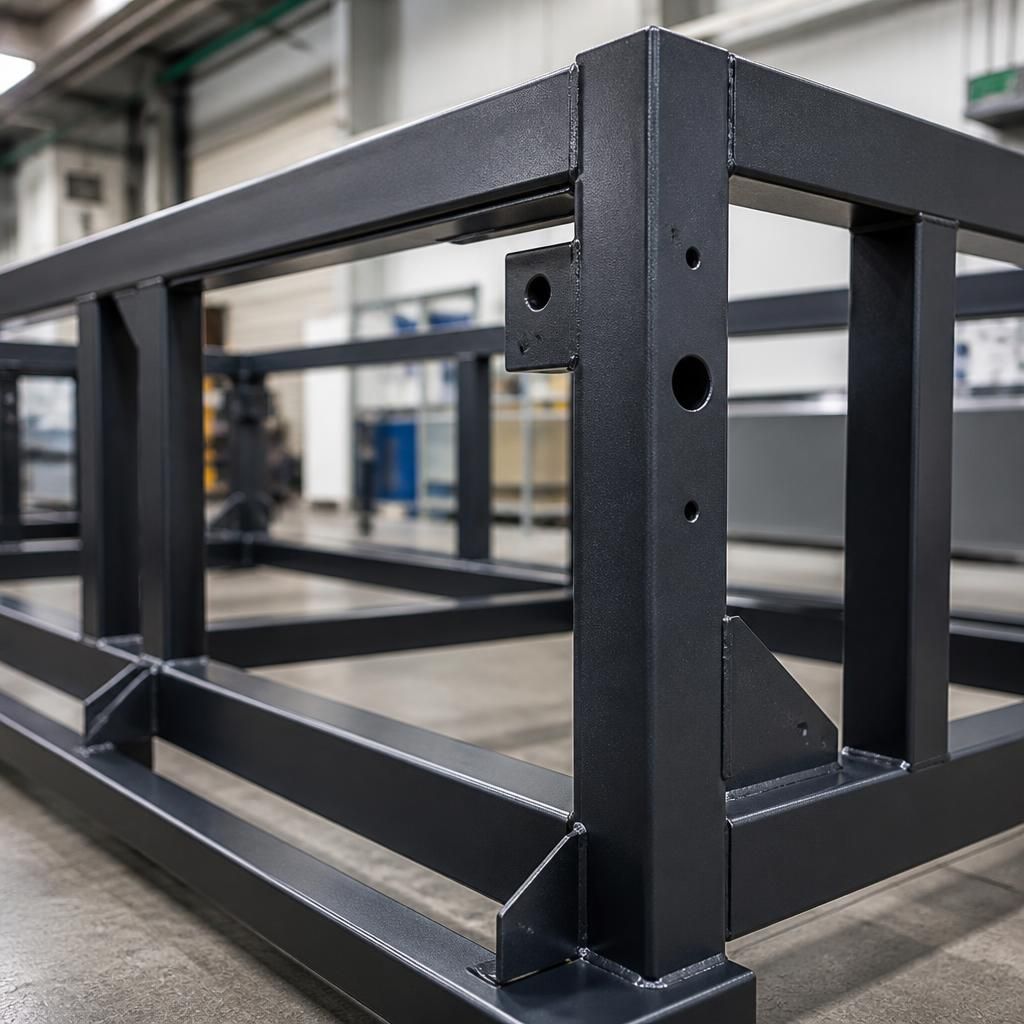
Powder coating protects steel and aluminium as an organic barrier rather than through sacrificial protection. Unlike a zinc coating, it does not preferentially corrode to protect exposed steel. This means the coating must remain intact and well bonded: once metal is exposed by impact, drilling or abrasion, corrosion can begin at that localised point and spread beneath a damaged edge if it is not dealt with.
This distinction is important when assessing a frame for service. A powder-coated surface may look sound while concealed faces, cut ends and contact areas around fittings require closer inspection. The coating specification should therefore be considered alongside the frame’s construction, handling method and repair arrangements. Keeping the finish continuous, limiting damage during installation and using compatible repairs are central to retaining the corrosion resistance provided by the coating system.