

How does the curing process impact the final finish and longevity of powder-coated galvanised steel?
Curing determines how fully the powder coating melts, flows and cross-links on galvanised steel, directly affecting the finish’s smoothness, hardness and consistency. Correctly controlled curing produces a durable coating with better resistance to wear, corrosion and service conditions, while insufficient or excessive heat can reduce performance and impair the final appearance.
Curing has a direct effect on the performance and service life of powder-coated galvanised steel because it determines whether the deposited powder develops its intended chemical and physical properties. A correctly cured coating forms a stable film that can withstand handling and use; a coating that receives too little, too much or uneven heat may show defects and reach failure sooner.
The curing schedule is based on the powder manufacturer’s requirements and the temperature of the steel itself, not simply the temperature displayed by the oven. Galvanised sections can vary considerably in mass and shape, so a thin bracket may reach the required metal temperature sooner than a heavy fabricated frame. If the oven setting is judged without checking the workpiece, different parts of the same batch may receive different curing exposure.
Several stages of the process influence the result:
- Heating: The steel must absorb enough heat for the powder to react throughout the coating film. Heavy sections, boxed fabrications and assemblies with limited airflow require particular attention because their internal areas may heat more slowly.
- Film development: Once the coating reaches its specified curing range, the resin system develops its intended structure. This affects properties such as flexibility, impact resistance, adhesion and resistance to chemicals and moisture.
- Temperature uniformity: A consistent temperature across the component helps prevent differences in colour, texture, gloss or mechanical performance between edges, faces and recessed areas.
- Cooling: After leaving the oven, the part must be handled in a way that avoids marking, distortion or contamination while the coating is still settling and gaining practical handling strength.
Under-curing is a common concern. It can leave the film less developed than intended, which may reduce adhesion and resistance to scratching, impact, chemicals and outdoor exposure. The surface may look acceptable immediately after coating but perform poorly once subjected to fabrication, transport, assembly or service conditions. Under-cured areas can also be more vulnerable where water or contaminants remain against the galvanised substrate.
Over-curing can be equally problematic. Excessive heat exposure may alter colour or gloss, cause yellowing in some systems, embrittle the film or reduce flexibility. This matters when coated steel will be moved, fastened or exposed to vibration. Repeated heating of a component, or a prolonged dwell caused by an unsuitable production setting, therefore needs to be considered rather than assuming that more heat will improve durability.
Galvanised steel introduces additional variables during curing. Zinc coatings can retain moisture, treatment residues or gases within surface irregularities. As the workpiece heats, these may be released through the powder film and create pinholes, blisters or local loss of adhesion. Thorough preparation, suitable pre-treatment and an appropriate powder system reduce this risk, but the curing stage remains important because rapid or uneven heating can make trapped-gas defects more visible.
The geometry and condition of the galvanised item also affect the final result. Sharp edges, welds, overlaps, drainage holes and sheltered recesses may receive heat differently from broad exposed faces. Differences in zinc texture or thickness can influence how the powder lays and how the coating responds during heating. These factors should be assessed when establishing the coating specification and loading the oven.
Professional coating work uses process control rather than visual inspection alone. Oven temperature records, checks on the metal temperature and suitable film-thickness inspections help identify whether the coating has received the required treatment. Where performance is critical, testing may also assess adhesion, flexibility, impact resistance or exposure behaviour. These checks help distinguish a coating that merely looks sound from one that is suitable for its intended service.
For manufacturers, fabricators and construction or automotive businesses, the coating specification should therefore state the required powder type, preparation standard, target film thickness and curing requirements. The coater should also be told about heavy sections, mixed-size batches, enclosed fabrications and any post-coating forming or assembly. Powder coating specialists serving the Midlands can use this information to plan collection, processing and delivery around the component’s material and geometry, rather than applying one generic oven setting to every galvanised-steel item.
In practical terms, correct curing does not compensate for poor preparation or an unsuitable powder system, but it is essential to turn a properly prepared galvanised surface and correctly applied powder into a dependable finished component. It affects not only the initial appearance but also how well the coating remains attached, flexible and protective throughout its working life.
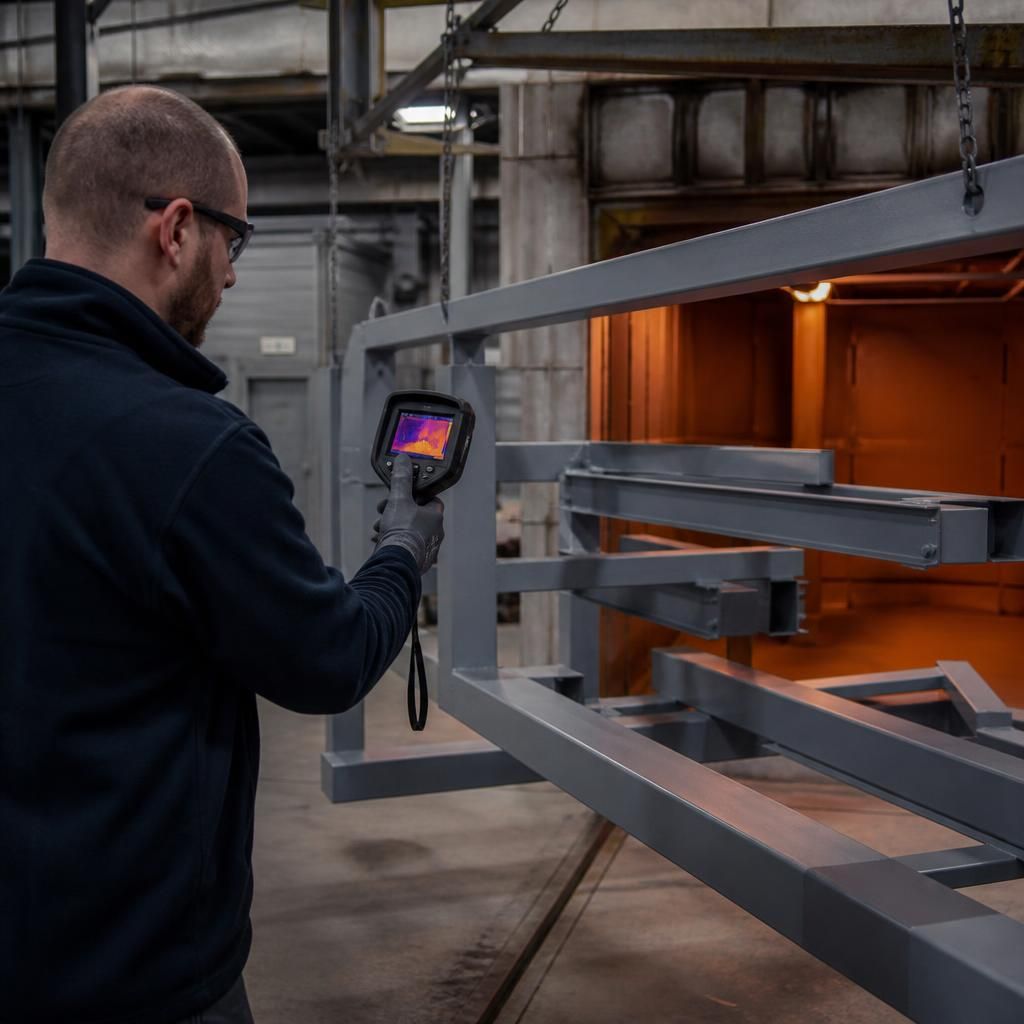
The final finish depends on achieving an even cure across the complete galvanised component, including areas that are difficult to expose to heat. If one section cures differently from another, the result may show inconsistent gloss, colour or surface texture even when the overall coating appears acceptable. This is particularly relevant to fabricated parts with varied section thicknesses, enclosed areas or complex profiles.
For this reason, curing should be considered alongside the component’s design and intended use. A controlled, uniform cure helps the powder coating form a continuous protective film over the zinc surface, supporting consistent appearance and dependable resistance during handling, assembly and service. The correct approach is to assess the complete component rather than judge curing by the visible finish on its largest face.
Discuss curing requirements for your powder-coated galvanised steel
Share the galvanised component’s dimensions, section thicknesses, intended service conditions and any post-coating assembly requirements with a powder coating specialist. This allows the curing requirements and inspection approach to be assessed before processing.