

What safety measures should be implemented during the powder coating process to protect workers and ensure compliance with industry standards?
Powder coating safety requires documented risk assessments, suitable personal protective equipment, effective extraction and ventilation, controlled handling of powders and heated components, and appropriate training. Employers should also maintain equipment, control ignition and electrical risks, and keep procedures aligned with applicable UK health and safety requirements.
Effective powder coating safety combines process-specific controls with compliance management for the coating line, pretreatment area, curing oven, storage areas and finished components. In practice, this means controlling exposure to coating powders and chemicals, preventing contact with moving or hot equipment, managing combustible-dust and fire risks, and keeping evidence that safeguards are inspected and procedures are followed.
Control access to the process. Powder coating areas should be clearly defined, with access limited to trained employees and authorised contractors. Signs should identify restricted areas, hot surfaces, chemical hazards, required protective measures and emergency equipment. Visitors should receive a site briefing and remain under suitable supervision rather than entering an operating booth, pretreatment area or oven-loading zone without permission.
Manage coating powders under COSHH principles. Safety data sheets should be available for every powder, pretreatment chemical, cleaning product and other substance used. They should be checked before a product is introduced, with attention to hazardous ingredients, storage conditions, spill response, first aid and disposal requirements. Containers should remain labelled and closed when not in use. Powder should not be swept or blown into the air with compressed air; approved industrial vacuum equipment or controlled wet-cleaning methods are generally more appropriate, provided the equipment is suitable for the material.
Where a powder or chemical presents a significant health risk, the employer should assess the route of exposure and consider whether a less hazardous product or process is practicable. Skin contamination, eye contact and accidental ingestion should be addressed through suitable washing facilities, hygiene rules and clear separation between work areas and eating or drinking areas. Health surveillance may be appropriate where the completed assessment identifies a relevant risk that cannot be adequately controlled by other means.
Control combustible-dust and ignition hazards. Fine powder deposits can contribute to fire or explosion risks when dispersed in air. The workplace should therefore prevent unnecessary powder accumulation on floors, ledges, ducting, filters and equipment. Cleaning arrangements should specify who is responsible, which equipment is permitted and how collected material is contained. Ignition sources must be controlled around powder-handling and spray areas, including unsuitable electrical equipment, hot work, static discharge and unauthorised smoking or vaping.
Where dangerous substances could create a fire or explosion risk, the requirements of the Dangerous Substances and Explosive Atmospheres Regulations may be relevant. A DSEAR assessment should identify hazardous areas, possible release points, ignition sources and required protective measures. Electrical and extraction equipment selected for those areas should be appropriate to the assessed risk, and bonding or earthing arrangements should be checked rather than assumed to be effective.
Safeguard machinery and moving parts. Spray guns, conveyors, reclaim systems, reciprocators, fans and associated machinery should have suitable guards and interlocks. Operators should not bypass an interlock to keep production running. Isolation procedures should be used before clearing blockages, entering guarded areas, cleaning machinery or carrying out maintenance. Under the Provision and Use of Work Equipment Regulations, equipment should be suitable for its intended use, maintained in safe condition and operated only by people with the necessary competence.
Particular care is needed where automatic equipment can start without warning. Controls should be arranged so that an operator can identify the emergency stop and isolate the relevant energy source. Maintenance staff should consider electrical, pneumatic, hydraulic, mechanical and stored thermal energy before work begins. After maintenance, guards and interlocks should be reinstated and checked before the equipment returns to service.
Protect people from curing-oven hazards. Ovens and recently cured components can cause serious burns, while combustion systems may introduce additional fuel, flame and exhaust risks. Hot surfaces should be identified and protected where practicable. Loading arrangements should prevent components from falling or obstructing access, and operators should use suitable tools or handling aids where direct contact is unsafe. Oven doors, access panels, temperature controls and alarms should be maintained and tested in line with the equipment manufacturer’s instructions.
Safe operating procedures should cover abnormal conditions such as a failed fan, temperature excursion, conveyor stoppage, loss of gas supply or suspected fire. Employees should know how to stop the process, raise an alarm and summon assistance without exposing themselves to unnecessary heat, fumes or moving equipment. Any combustion appliance or fuel system should receive competent inspection and servicing, with records retained.
Address pretreatment and wastewater risks. Degreasing, phosphating, rinsing and other preparation stages can introduce corrosive, irritant or environmentally harmful substances. Chemical transfer should use suitable containers and controlled methods, with incompatible substances kept apart. Bunding or equivalent containment can reduce the consequences of a leak. Emergency eyewash and washing facilities should be positioned so they can be reached quickly without passing through the hazard, and spill arrangements should state how contaminated absorbent and rinse water are handled.
Include manual handling and ergonomic controls. Metal parts, racks and jigs may be awkward or heavy even when the coating itself is lightweight. The handling assessment should consider lifting, pushing, pulling, repetitive loading and work at height. Trolleys, hoists, adjustable workstations and redesigned racks can reduce strain where they are suitable for the component and process. Routes should be kept clear, and loads should be secured during movement between preparation, coating, curing and inspection.
Maintain compliance records. A defensible system should retain current procedures, training and competence records, equipment examinations, oven and extraction checks, electrical inspections, cleaning records, incident reports, spill records and corrective actions. Records are most useful when they identify the asset or area inspected, the date, the person completing the check, any defect found and how it was closed out. Procedures should be reviewed after an incident, equipment modification, formulation change or significant change in the work method.
Relevant UK duties can involve the Health and Safety at Work etc. Act, COSHH, DSEAR, PUWER, the Regulatory Reform (Fire Safety) Order and workplace welfare requirements. The precise obligations depend on the installation, substances, workforce and premises. A competent review should therefore map the actual powder coating process against the applicable legislation, manufacturer instructions and recognised industry guidance rather than relying on a generic checklist.
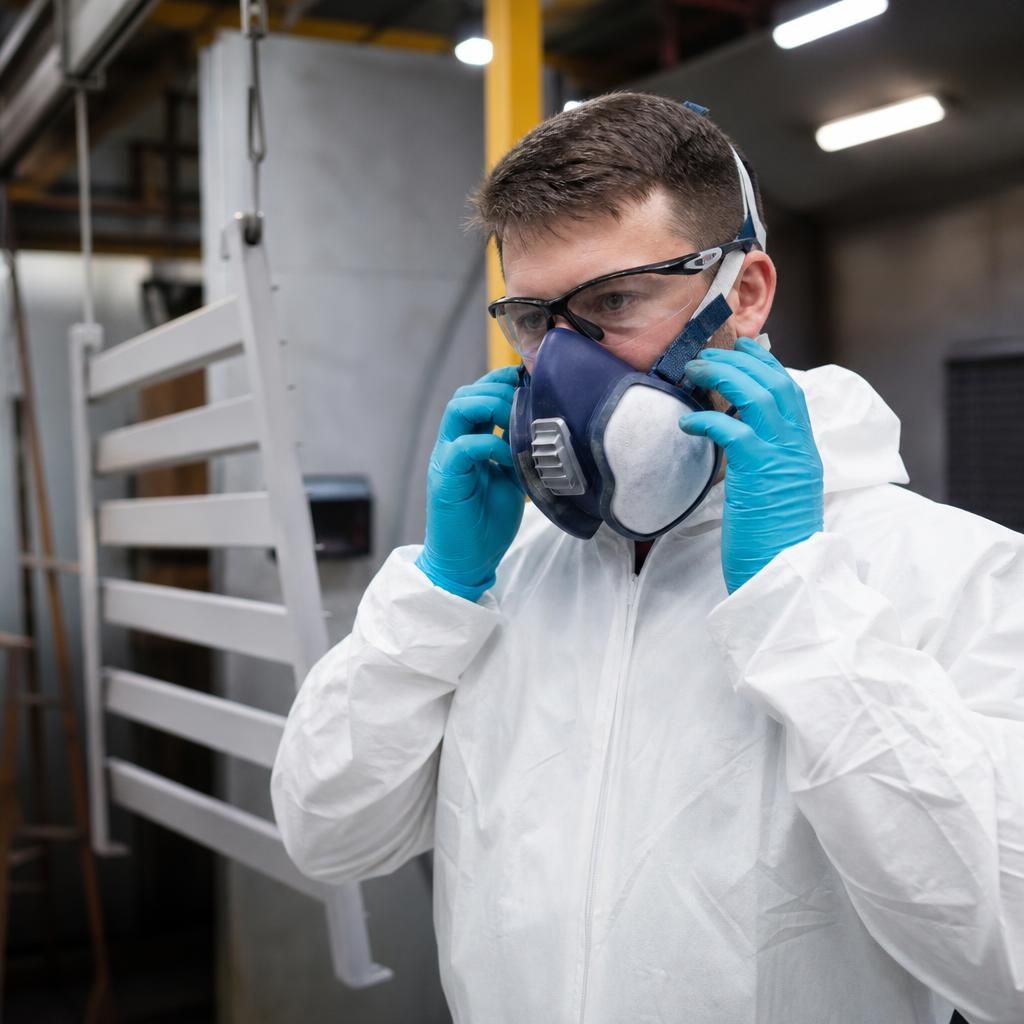
Respiratory protection should be selected from the exposure assessment rather than treated as a substitute for effective extraction and enclosure. Where powder cannot be adequately controlled at source, the chosen respirator must be suitable for the substance and task, correctly fitted to the individual, and maintained in accordance with its instructions.
Workers should be trained to check the equipment before use, recognise damage or loss of seal, and store it away from contamination. Face-fit testing is important for tight-fitting masks, particularly where facial hair, spectacles or other equipment could affect the seal. Reusable respirators also require defined cleaning, filter-change and inspection arrangements so that protection remains reliable throughout the coating process.