

What chemical properties should I look for in a high temperature powder coating to ensure it provides both heat resistance and surface protection for my specific application?
Look for a powder coating whose resin chemistry and additives provide the required thermal stability, resistance to oxidation and degradation, and reliable adhesion at the component’s operating temperature. For surface protection, also assess chemical resistance, moisture and corrosion protection, flexibility, and compatibility with the metal substrate and service environment.
The most important chemical properties are thermal stability, controlled cross-linking, resistance to oxidation and chemical attack, and adhesion that remains reliable through repeated heating and cooling. These properties must be assessed against the actual metal substrate, operating temperature, exposure conditions and required service life; a coating described simply as “high temperature” is not necessarily suitable for every heated component.
Resin chemistry and decomposition behaviour
The resin is the coating’s primary chemical structure, so its resistance to softening, embrittlement, oxidation and decomposition is fundamental. High-temperature formulations commonly use resin systems selected for their ability to retain a stable film when exposed to elevated temperatures. The key information is not only the maximum temperature claimed in a product specification, but also how the resin behaves during prolonged exposure and during temperature cycling.
Ask for data covering continuous operating temperature, intermittent peak temperature and the expected duration of each exposure. A coating may tolerate a short-term peak but degrade more quickly if held at that temperature continuously. Degradation can appear as discolouration, loss of gloss, chalking, cracking, blistering or loss of adhesion. If the component is exposed to flames or direct combustion gases, a conventional high-temperature powder coating may not be the correct system, because heat resistance does not automatically mean fire resistance or flame-retardant performance.
Cross-link density and film stability
During curing, reactive groups in the powder resin and hardener form a cross-linked network. This network gives the coating its hardness, chemical resistance and dimensional stability. A formulation with insufficient cure may remain chemically vulnerable, while excessive or unsuitable cross-linking can make the film brittle and less tolerant of thermal expansion and contraction.
For a heated metal part, look for a formulation that maintains its film integrity after the specified cure and subsequent thermal exposure. The technical data should identify the required metal temperature and cure schedule rather than relying only on oven air temperature. Incomplete cure can be mistaken for poor resin chemistry when the real issue is that the coating did not reach the required substrate temperature.
Resistance to oxidation and thermal ageing
At elevated temperature, oxygen can accelerate chemical changes in the binder and promote surface oxidation. A suitable formulation should resist chain breakdown and maintain a coherent film when exposed to the combination of heat and air found in the application. This is especially relevant for components operating near furnaces, engines, exhaust systems, ovens or other heated plant.
Review evidence from heat-ageing or thermal-cycling tests where available. A single oven exposure does not fully represent service conditions. Repeated transitions between ambient and operating temperature can create stresses within the coating and at the coating-to-metal interface, particularly where the metal and film expand at different rates.
Pigments, fillers and stabilising additives
Every ingredient must remain stable at the intended temperature. Pigments can change shade or lose opacity, while fillers may affect thermal expansion, hardness and flexibility. Additives may improve flow, corrosion resistance or surface performance, but they can also influence the cure reaction and long-term stability.
For components where appearance is important, request information about colour retention and gloss retention after heat exposure. A coating can continue to protect the substrate even after its appearance changes, but that may not be acceptable for visible equipment or coded components. Where electrical insulation, low smoke or specific friction characteristics are required, those properties should be confirmed separately rather than inferred from the coating’s temperature rating.
Resistance to the chemicals present in service
Heat often makes chemical attack more aggressive. Oils, fuels, hydraulic fluids, cleaning agents, solvents, acids, alkalis, salts and process chemicals should therefore be considered at their actual use temperature. Check whether the coating has been tested against the specific substances, concentration, contact time and temperature involved.
Pay particular attention to immersion, condensation and repeated splashing. A coating that withstands brief contact may not be suitable for continuous immersion or trapped residues. If chemicals can penetrate microscopic defects, the underlying metal may corrode even though the visible coating initially appears intact.
Adhesion and interfacial chemistry
Long-term performance depends on the bond between the cured film and the prepared metal, not just on the strength of the film itself. The formulation should be compatible with the substrate and any conversion coating or primer used beneath it. Steel, galvanised steel, aluminium and other alloys can present different surface chemistries and thermal expansion characteristics.
Ask whether the system has been evaluated after heat exposure, humidity and thermal cycling, rather than only immediately after application. This helps identify loss of adhesion caused by corrosion at the interface, absorbed moisture or repeated expansion and contraction. Surface preparation remains essential: contamination, oxide layers, residues and unsuitable pretreatment can prevent the coating’s chemical adhesion mechanisms from working properly.
Moisture and corrosion protection
For a coating to protect metal, the cured film should have low permeability to water and corrosive ions, while maintaining adequate edge coverage and resistance to pinholes. Chemical corrosion resistance may come from the barrier properties of the film, corrosion-inhibiting pigments or a compatible primer and topcoat arrangement. These features must remain effective after heat ageing, because thermal degradation can increase permeability and create routes for corrosion.
Where the part will face humidity, salt contamination or condensation, examine test information for moisture resistance and corrosion creep from damaged areas. The correct choice may be a complete coating system rather than a single high-temperature topcoat.
Questions to put to the coating supplier or applicator
- What are the continuous and intermittent service-temperature limits?
- How does the coating perform after prolonged heat exposure and repeated thermal cycling?
- What chemical exposures have been tested, and at what temperature and contact duration?
- Is the formulation suitable for the exact metal substrate and specified pretreatment?
- What cure schedule is required at the component’s actual metal temperature?
- How are colour, gloss, adhesion and corrosion resistance affected by heat ageing?
- Does the application require a primer, multilayer system or additional protection at edges and joints?
The best selection is therefore based on the complete chemical and service profile, not on the highest temperature stated in a catalogue. Match the resin and additive package to the heat pattern, atmosphere, chemicals, substrate and required appearance, then confirm performance through relevant technical data or application-specific testing before specifying the system for production components.
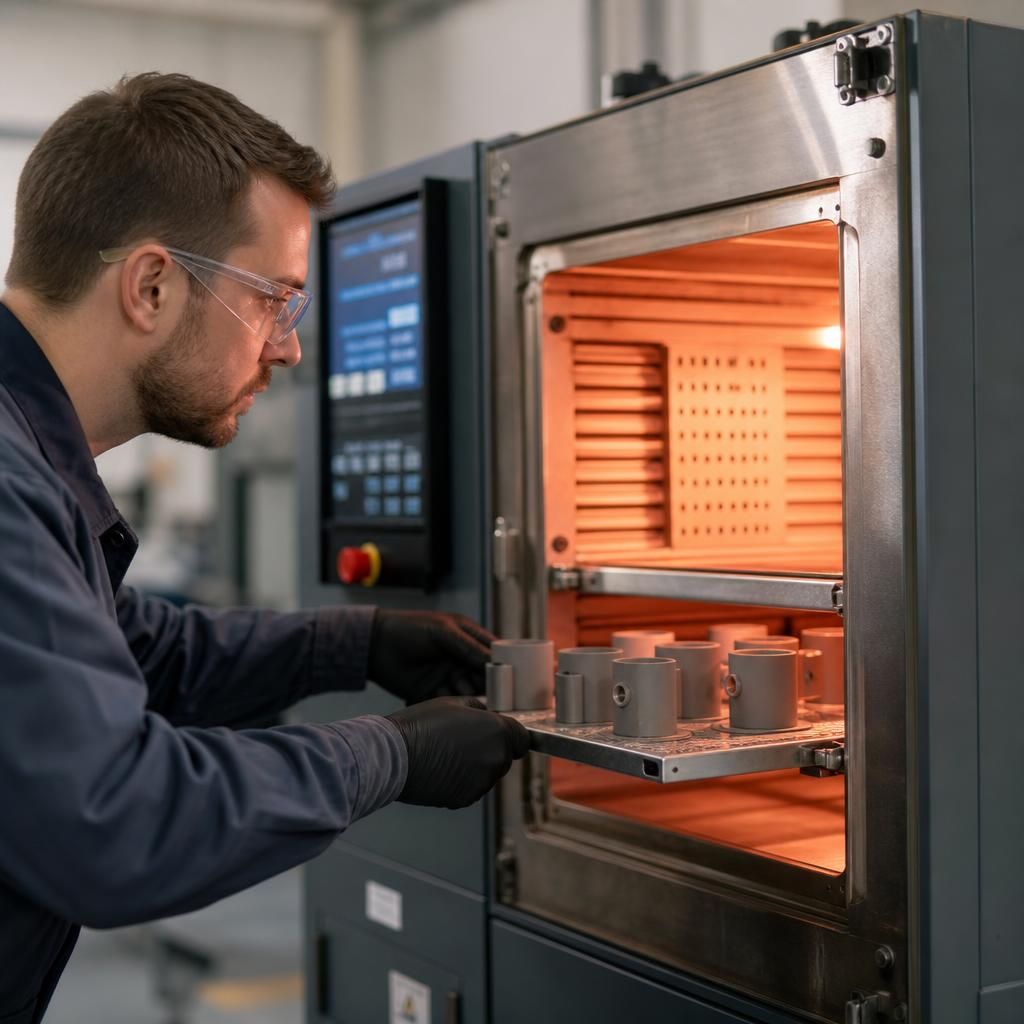
Interpret a high-temperature coating’s technical data by its test conditions rather than by the headline temperature rating alone. A meaningful result should state the coating thickness, cure condition, exposure atmosphere and duration, together with the failure criteria used. This shows whether the test measured colour change, softening, adhesion loss, cracking, blistering or a reduction in corrosion protection.
When comparing formulations, give greater weight to evidence that reflects the component’s actual duty cycle. Results from a dry-air heat test may not represent performance where the coating encounters condensation, process vapours or chemical residues. A formulation should therefore be judged on the properties that matter most to the application, rather than on a single maximum-temperature claim.
Discuss Your High Temperature Powder Coating Requirements
Discuss your component’s operating conditions, substrate and required chemical resistance with a powder-coating specialist before selecting a high-temperature formulation. This allows the proposed system to be reviewed against the relevant technical data and application requirements.