

What are the potential challenges when applying high temperature powder coatings to different metal substrates?
Applying high temperature powder coatings to different metal substrates can be challenging because each material has distinct thermal expansion, surface chemistry, conductivity and curing behaviour. Common risks include inadequate adhesion, uneven film formation, outgassing, distortion or discoloration, so the coating system, preparation method and curing cycle must be matched to the specific substrate and component design.
The main challenge is maintaining a consistent coating interface and controlled cure across metals that react differently to heat, preparation and handling. A high temperature powder system must therefore be assessed against the actual substrate, component geometry, service temperature and preparation route rather than selected as a universal coating for every metal part.
Carbon and mild steel are generally straightforward substrates, but surface condition remains critical. Mill scale, welding residue, cutting fluids, oil and flash rust can prevent the coating from forming a sound bond. Welds and heat-affected zones may also behave differently from the surrounding steel because their surface profile and metallurgy have been altered during fabrication. Abrasive preparation should produce a uniform, suitably clean profile without embedding contaminants, and fabricated parts should be checked for residues trapped in joints, folds or partially closed sections.
Stainless steel presents a different interface. Its passive chromium-rich surface is chemically stable, which can make mechanical preparation and cleaning more important than on ordinary carbon steel. Overly aggressive blasting can damage the desired surface condition, while insufficient preparation may leave a smooth or contaminated surface to which the powder cannot bond reliably. Stainless components can also contain weld discolouration or fabrication residues that need to be removed using a process compatible with the intended finish and service environment.
Aluminium and its alloys require careful control because their oxide layer reforms rapidly after cleaning. The alloy, temper and previous treatment can affect the preparation method, and thin sections can be more vulnerable to handling marks or dimensional change during heating. Entrapped air or residues in cast or porous aluminium can emerge during the bake, making trial work and suitable pre-treatment particularly important. Masking and racking must also avoid contact marks on softer surfaces.
Galvanised and zinc-coated steel can be challenging because the coating beneath the powder may contain moisture, treatment residues or gases that are released when heated. The zinc layer can also be damaged by aggressive preparation or unsuitable handling. A compatible cleaning and surface-treatment sequence is needed, with attention to the condition of edges, weld repairs and areas where the protective zinc coating has been disturbed. If the underlying zinc surface is not stable, the powder finish may conceal a substrate problem rather than correct it.
Cast iron and other porous materials can retain oil, moisture and processing residues below the visible surface. These contaminants may only become apparent during heating, particularly around cast features, drilled holes and deep recesses. Degassing or preheating procedures may be considered where appropriate, but they need to be validated because excessive heat can affect the component or create additional surface changes. A small representative sample is more informative than relying solely on a flat test panel.
Mixed-metal assemblies create an additional set of problems. Aluminium joined to steel, stainless steel joined to carbon steel, or components containing zinc-coated sections may require different preparation methods within the same job. The assembly may also contain dissimilar contact points, trapped air spaces and concealed surfaces that are difficult to clean, coat or inspect. Where practical, coating parts separately before assembly can give better process control. If the assembly must remain intact, the design should allow effective access for cleaning, powder application, grounding and inspection.
Component design can be as important as the metal itself. Sharp edges may receive less powder than broad faces, while deep recesses, narrow gaps and internal corners can affect electrostatic deposition and visual uniformity. Drainage and venting holes should be positioned to prevent cleaning fluids or gases being trapped. Threads, bearing seats, electrical contact areas and precision fits may need temporary masking, and the masking material must tolerate the selected cure conditions without leaving residue or altering the coating edge.
The curing stage must be judged against the metal part’s actual temperature, not simply the oven air setting or the time the component spends inside the oven. Mass, wall thickness, shape, loading pattern and racking all affect how quickly the substrate reaches the required condition. A heavy steel bracket and a thin aluminium cover may enter the same oven together but follow different heating profiles. Temperature recording on representative parts or test pieces helps establish whether the coating has received the intended cure without exposing the substrate to unnecessary heat.
High temperature service can expose weaknesses that are not obvious during initial inspection. Repeated heating and cooling may place stress on the coating-to-metal interface, especially on complex parts or assemblies containing dissimilar metals. Coating selection should therefore consider the complete temperature cycle, including dwell periods, thermal gradients, contact with hot gases or chemicals, and any cooling or cleaning method used in service. A system suitable for a continuously hot enclosure may not be suitable for a component subject to rapid cycling or localised heat.
Practical controls for reducing substrate-related problems include:
- Identify every metal type, alloy, treatment and repaired area before defining the preparation sequence.
- Remove oil, grease, corrosion products, weld residues and treatment chemicals using methods compatible with the substrate.
- Use representative test pieces when the job includes cast, porous, galvanised, thin-gauge or mixed-metal components.
- Confirm that masking, racking and grounding arrangements suit the component geometry and do not obstruct critical surfaces.
- Record the part-temperature profile during cure and compare it with the coating system’s technical requirements.
- Inspect film coverage, edge protection, masked areas, surface defects and coating adhesion after processing.
- Check critical dimensions and functional interfaces after coating, particularly threads, bores, mating faces and moving clearances.
When a component combines several substrates or has an unusual service duty, a controlled trial is preferable to treating it as a standard steel job. The trial should use the same preparation, racking, application and cure conditions as production, then be assessed for appearance, coverage, adhesion, dimensional impact and resistance to the intended environment. This approach identifies whether the limitation lies in the powder formulation, the substrate preparation, the component design or the curing schedule before larger batches are processed.
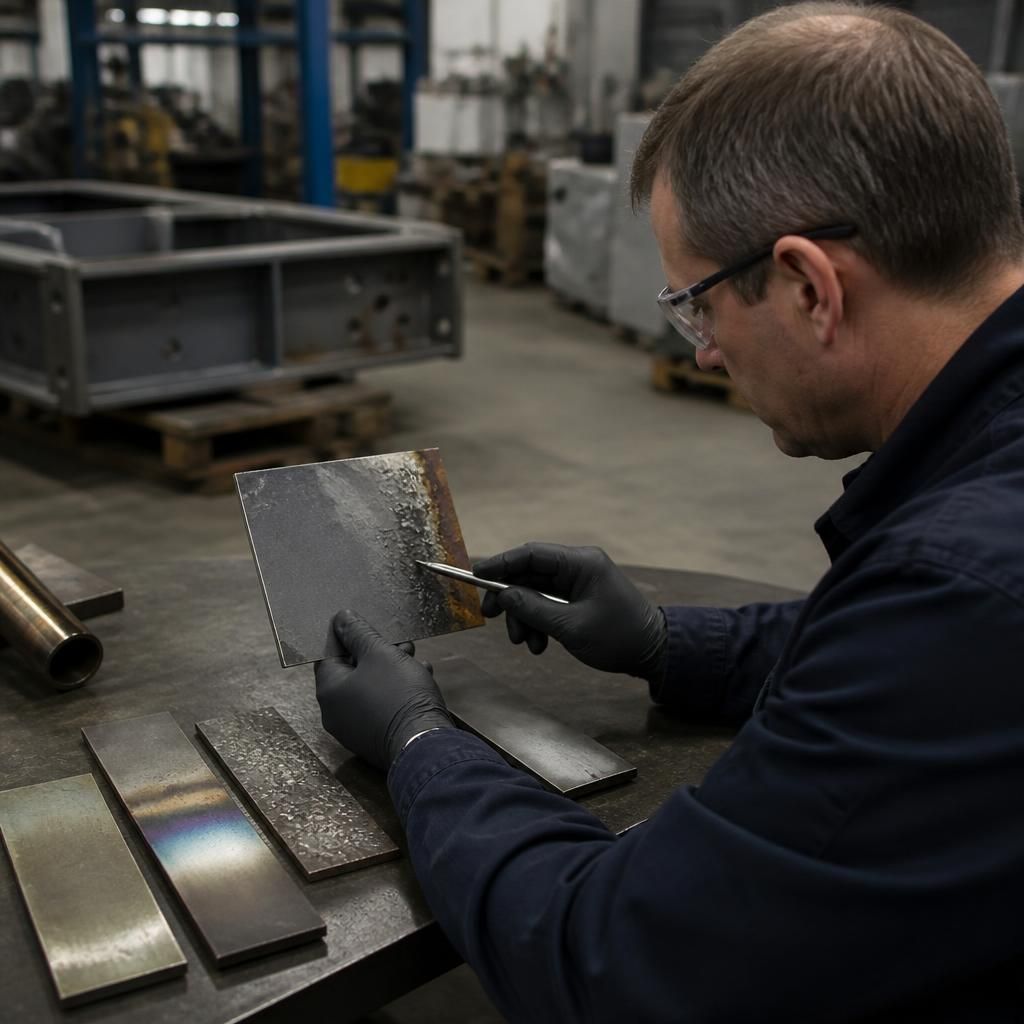
Failure assessment should distinguish a coating problem from a substrate problem. Blistering or delamination may indicate contamination or inadequate bonding, while cracking can result from repeated expansion and contraction, excessive film build or movement in the component. Discolouration may reflect thermal degradation of the coating, oxidation of exposed metal or a reaction at a repaired area rather than a simple application defect.
For this reason, evaluation should include representative coated parts exposed to the intended temperature cycle, followed by inspection of edges, welds, joints and high-stress features. Where damage occurs, examine the coating fracture and the underlying metal separately. This helps identify whether the corrective action should involve different preparation, a revised coating system, altered film thickness or a change to the component design.
Discuss Your High Temperature Powder Coating Requirements
Discuss your high temperature powder coating requirements with the team, providing details of the substrates, component design and operating conditions. This allows the preparation, coating system and curing approach to be considered against the specific application.