

How does the high temperature powder coating process impact the durability and performance of metal components in industrial applications?
High temperature powder coating improves the durability and performance of metal components by forming a cured protective film that resists heat, thermal cycling, corrosion, chemicals and mechanical wear. Its effectiveness depends on selecting a formulation suited to the operating temperature and achieving correct substrate preparation, application and curing, which help maintain adhesion and finish integrity in industrial service.
High temperature powder coating affects industrial component durability by creating a thermally stable surface layer that helps the metal retain its required function during repeated exposure to elevated operating temperatures. The result depends not only on the powder chemistry, but also on the component’s temperature profile, substrate, coating thickness, joint design and the accuracy of the application process.
At operating temperature, a suitable coating should remain sufficiently stable to protect the surface without softening, blistering, losing adhesion or developing excessive discolouration. This is particularly important for housings, brackets, guards, frames, exhaust-related parts, heating equipment and other components positioned near heat sources. The relevant specification should distinguish between continuous service temperature and short-term peak exposure, because a coating that tolerates an occasional temperature spike may not be appropriate for uninterrupted heat.
Thermal cycling places a different demand on the finish. As the metal heats and cools, both the substrate and coating expand and contract. If their movement is not well matched, repeated cycles can create stress at the interface, around edges or near welds. A correctly selected system reduces the risk of cracking, lifting and loss of protective continuity. Component geometry therefore matters: sharp corners, deep recesses, overlapping joints and areas that retain heat can experience more severe local stresses than broad, evenly exposed surfaces.
The coating also influences how a component performs mechanically. A sound, uniformly applied film helps protect the base metal from abrasion, handling damage and contact with contaminants that could initiate surface deterioration. However, excessive film build can affect edge definition, clearances, threaded features and the fit of mating parts. In precision assemblies, coating thickness must be considered during design and controlled during production rather than treated as an incidental cosmetic layer.
High temperature performance can be reduced by factors outside the nominal temperature rating. Oil, fuel, cleaning chemicals, salt-laden moisture and process deposits may become more aggressive when heated. Contamination trapped beneath the coating can also expand or react during service. This is why the intended atmosphere, contact media and cleaning regime should be assessed alongside the maximum surface temperature. A formulation suitable for dry heat may not be suitable where heat is combined with chemicals or persistent moisture.
The curing stage has a direct effect on long-term performance. The metal must reach the specified part temperature for the required cure schedule; oven air temperature alone does not confirm that the component has cured correctly. Under-cured film may have inadequate hardness and adhesion, while excessive heat exposure can damage the finish, distort sensitive parts or alter the properties of the substrate. Large, thick or complex components require particular attention because their temperature rises less evenly than that of small, simple parts.
Preparation and application quality determine whether the coating can deliver its designed performance. Residual oil, oxides, weld residue and salts can create local defects, while poor grounding or unsuitable spray technique can produce uneven coverage. Particular checks are useful on:
- welds, folded edges and corners, where coverage can be less consistent;
- recesses and internal faces, where cleaning and powder penetration may be difficult;
- masked areas, threaded holes and mating surfaces, where unwanted build can affect assembly;
- areas subject to direct heat, where the actual metal temperature may differ from the surrounding air temperature; and
- interfaces between coated and uncoated sections, where moisture or deposits can accumulate.
Coating selection should therefore begin with the complete service environment rather than a temperature figure alone. Record the normal operating range, peak excursions, heating and cooling frequency, exposure duration, surrounding chemicals, expected mechanical contact and the consequences of coating failure. The required appearance may also influence the choice, since some high temperature systems prioritise functional stability over colour retention, gloss or decorative consistency at elevated temperatures.
For critical industrial parts, performance should be verified against representative conditions. Evaluation may include visual inspection after thermal exposure, adhesion checks, film-thickness measurement, examination for cracking or blistering, and assessment of dimensional or assembly changes. Testing should use the actual substrate, coating build and cure method where possible, because laboratory results from a different metal or process may not predict field behaviour accurately.
In practice, a high temperature powder coating improves component reliability when the coating’s thermal limits match the application and the complete process is controlled from preparation through curing. It should be treated as one part of the component design: operating conditions, metal grade, geometry, tolerances and maintenance requirements all influence whether the finished part continues to perform effectively in service.
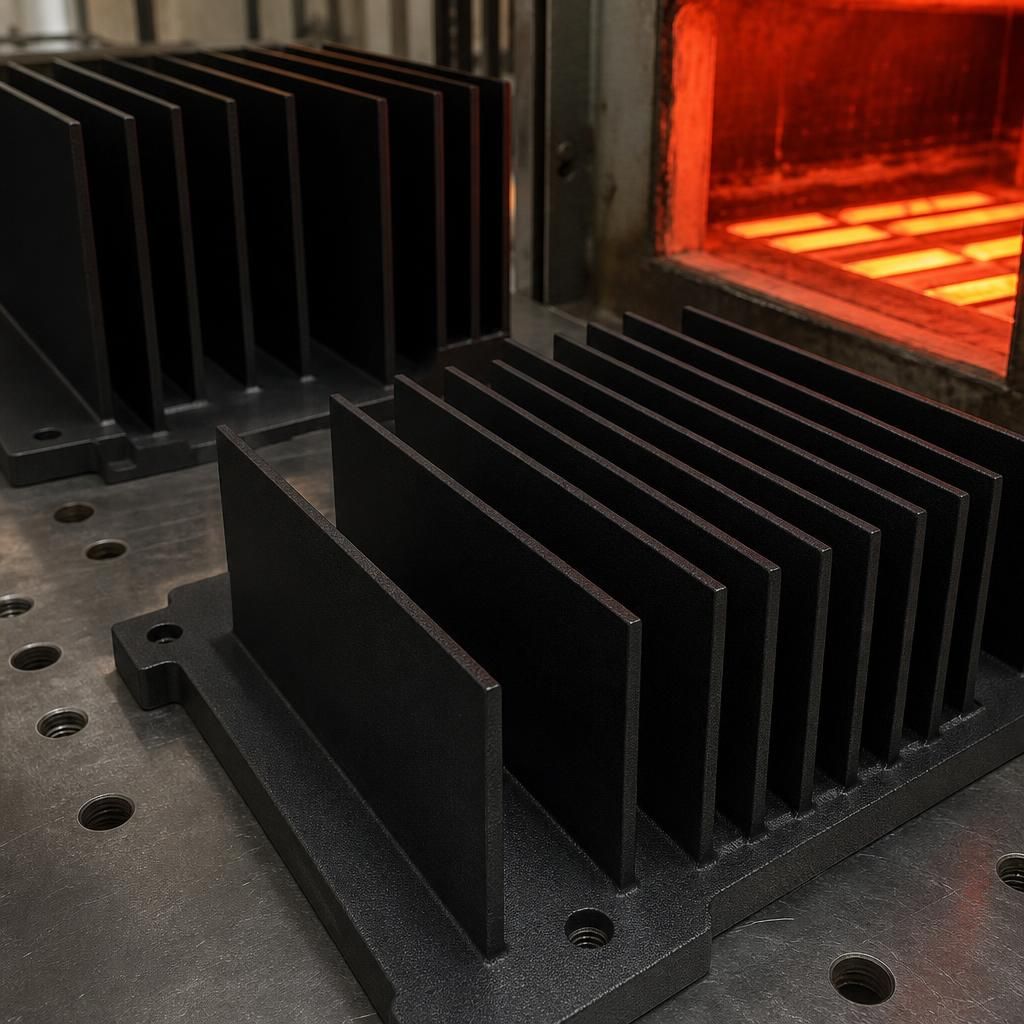
High temperature powder coating can also influence how a component transfers heat. On heat-dissipating surfaces, film thickness, coating formulation and surface emissivity may affect the balance between conducted, convected and radiated heat. A finish selected for corrosion or wear resistance is therefore not automatically suitable for a heat-transfer surface.
Where thermal output or heat dissipation is part of the component’s function, assess the coated part under representative operating conditions. Confirm that the coating does not create an unacceptable change in surface temperature, thermal response or contact performance, particularly around mounted interfaces and other areas where heat must move efficiently.