

Why is it important to follow the manufacturer's specifications for powder coat curing temperatures and times?
Following the manufacturer’s specified powder coat curing temperature and time ensures the coating reaches the required chemical cure, rather than simply appearing dry. Deviating from the schedule can leave the finish under-cured and weak, or over-cured and discoloured, reducing its intended performance and consistency.
Manufacturer’s curing specifications provide the process conditions needed for a particular powder formulation to develop its designed properties. They define more than a nominal oven temperature: the specification normally relates to the metal part’s actual temperature, the time held at that temperature, the permitted tolerance and, where relevant, the heating method. Following those conditions makes the coating process repeatable and allows the finished component to be assessed against the powder manufacturer’s technical data.
Powder coatings are formulated from different resin systems, curing agents, pigments and additives. These ingredients determine how the material reacts to heat and how long that reaction must continue. Two powders may appear similar but require different schedules because their chemistry and intended performance differ. Applying one product’s curing profile to another can alter the coating’s hardness, flexibility, adhesion, chemical resistance or appearance, even where the oven display shows the expected setting.
The temperature stated on a technical data sheet usually refers to the temperature reached by the coated metal, not simply the air temperature inside the oven. This distinction is important because a heavy steel assembly, a thin pressed component and a multi-layered part will absorb heat at different rates. The oven may reach its setpoint before the coldest area of the component does. Cure timing should therefore be based on a verified part-temperature profile, with the hold period beginning when the relevant metal has reached the specified temperature.
Following the specification also helps identify the correct curing window. Some products allow a range of time and temperature combinations, while others have a narrower process tolerance. The schedule should be selected with reference to the full component, including its thickest sections, recesses, folded areas and areas shielded from circulating air. A setting that suits a small test panel may not represent the conditions experienced by a large or complex fabrication.
Accurate control is particularly important where the coated part contains materials or features that are sensitive to heat. Excessive thermal exposure can affect substrates, seals, assembled components, adhesives, masking materials or pre-treated surfaces. The powder manufacturer’s instructions should be considered alongside the component manufacturer’s limits, with the process adjusted only where the required coating performance and the part’s construction can both be accommodated.
A reliable curing process involves more than entering a number into the oven controller. Good practice includes:
- checking the powder’s current technical data sheet and any application instructions before processing;
- confirming whether the stated schedule is based on object temperature or oven air temperature;
- allowing for the heating characteristics of the actual component, rather than relying only on a previous job;
- checking oven temperature uniformity, air circulation and controller accuracy;
- using suitable temperature probes or data-logging equipment to confirm the part’s thermal profile; and
- recording the powder identification, batch information, process settings and verification results for repeat work.
Temperature profiling is useful because it shows the range of conditions across a component and through a production load. Probe placement should represent areas likely to heat slowly, such as thick sections, internal corners and densely loaded positions. If the profile does not reach the specified conditions consistently, the cause may be incorrect loading, restricted airflow, inaccurate sensors, poor oven performance or an unsuitable line speed. Correcting that cause is more reliable than simply increasing the displayed temperature or extending the programmed cycle.
Consistent adherence to the specification also supports quality control between batches and coating operators. When a finish is questioned, documented curing parameters and a verified profile help distinguish a curing issue from problems associated with preparation, contamination, film thickness, application equipment or the substrate. This is especially relevant for fabricated parts supplied into applications where coating performance and process traceability need to be demonstrated.
For repeat production, the approved curing profile should be treated as part of the job specification. Any change to powder type, film thickness, component design, load arrangement, oven settings or line speed should prompt a review of the profile. Powder coating specialists can use the manufacturer’s data together with component size, metal thickness and oven characteristics to establish a practical process that remains within the product’s specified conditions.
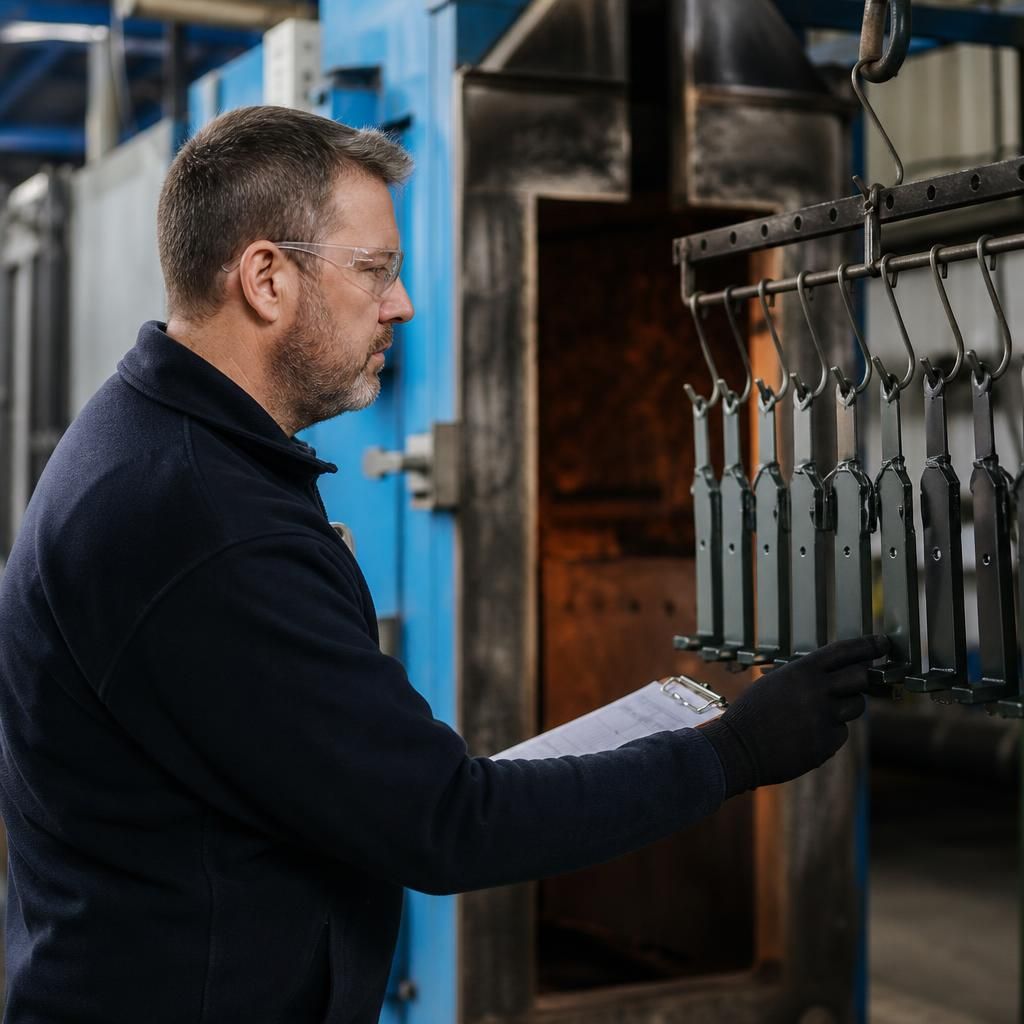
Manufacturer’s curing instructions are also important when a component needs recoating or a second bake. Further heat exposure can alter the existing film’s colour, gloss and surface condition, while the substrate or assembled features may have already experienced part of their allowable thermal load. A rework cycle should therefore not be treated as an ordinary first cure.
Before recoating, establish whether the powder supplier permits the proposed preparation and curing sequence, then check the part’s complete heat history. This prevents an apparently acceptable finish from being exposed to an unsuitable combination of stripping, recoating and baking conditions.
Discuss Your Powder Coat Curing Requirements
If you need to confirm that a proposed coating cycle is suitable, discuss the powder specification, component design and available process information with our coating specialists. This provides a practical basis for identifying the relevant curing requirements before production begins.