

What should be considered when determining appropriate bake and curing times for specific powder coating materials?
Appropriate bake and curing times depend on the powder coating material’s specified cure schedule, the required metal temperature, component thickness and the oven’s ability to deliver consistent heat. Use the coating supplier’s technical data alongside measured part temperature, rather than relying solely on the oven’s air-temperature setting.
The appropriate bake and curing time is determined by the powder’s chemistry and specified cure window, together with how the coating behaves on the actual component. The schedule should therefore be selected from the product’s technical data and then validated against the coating result, rather than applied as a universal time for every powder material.
Consider the type of powder coating
Different powder chemistries require different treatment. Thermosetting powders, including polyester, epoxy and hybrid systems, need sufficient heat at the coated metal to complete their cross-linking reaction. A coating that reaches its required temperature but is removed too soon may remain under-cured, while excessive heat or dwell time can cause over-cure, colour change, loss of gloss or deterioration of other performance characteristics.
Thermoplastic powders, such as nylon-based materials, behave differently. They melt and form a continuous film rather than curing through the same cross-linking mechanism as a thermosetting powder. Their requirements may focus on melting, flow, bonding and controlled cooling. The material’s technical documentation should make clear whether the stated schedule relates to curing, melting, gelation or another stage of film formation.
Review the complete technical data
A product data sheet may specify more than one acceptable cure schedule. Check whether the stated time is:
- the time the metal must remain at the target temperature;
- the total time inside the oven; or
- a recommended range linked to a particular film thickness or application method.
This distinction is important because oven air can reach its set point before the component does. The dwell period normally starts when the coated metal has reached the required temperature, unless the powder supplier specifies a different basis. Where a schedule gives a range, select a point within that range that suits the component, production process and required finish, then confirm the result through testing.
Account for film build and coating design
Applied film thickness can influence flow, appearance and heat transfer through the coating. A heavier film may need particular attention to heating and curing behaviour, while an excessively thin or uneven film can produce poor coverage even if the nominal bake schedule is followed. Multiple coats, primer-and-topcoat systems and powders designed for textured finishes should be assessed as a complete system, because the first layer can affect the way the subsequent layer flows and cures.
Material formulations may also contain additives, metallic effects, matting agents or pigments that alter appearance when exposed to heat. A schedule that produces an acceptable result on a standard colour should not automatically be assumed suitable for every colour or finish in the same product family. Confirm the specific grade and finish before setting a production process.
Check the component’s thermal response
Parts with different sections, folds, enclosed areas or substantial welded features may heat at different rates. Thin edges can reach the required temperature before heavier sections, creating a risk of uneven cure across one component. Assemblies may also shield surfaces from air movement or make it difficult for heat to reach internal faces. The schedule should be based on the slowest or most difficult-to-heat relevant area, not only on an easily accessible surface.
Joints, crevices and boxed sections deserve particular attention. Trapped air, residual moisture or outgassing from the substrate can create pinholes and blisters that may be mistaken for a curing problem. Appropriate cleaning, drying, venting and preparation should be established alongside the bake schedule.
Evaluate the oven and loading arrangement
The same powder can behave differently when the load, racking arrangement or component orientation changes. A densely loaded oven can alter air circulation and heating behaviour, while close spacing can shield surfaces from the effective heat flow. Racks should support the parts without creating cold spots or uncoated contact areas, and the loading pattern used for validation should represent normal production.
Oven control should be checked at the component rather than inferred only from the controller display. A temperature recorder or suitable profiling equipment can show the time taken for representative parts to reach the required temperature and reveal differences between heavy, light, exposed and sheltered sections. Profiling should be repeated when there are meaningful changes to the load, racking, oven settings or component design.
Allow for the powder’s cure tolerance
Some materials have a relatively broad cure window, whereas others are less tolerant of deviation. If the process repeatedly approaches the lower or upper limit, investigate the cause rather than compensating by adding arbitrary oven time. Excessive curing can be as damaging as insufficient curing, particularly where colour, gloss, flexibility or impact performance matters.
When a coating appears defective, consider the full process before changing the bake time. Poor adhesion, inconsistent gloss, pinholes, orange peel or colour variation can also result from surface contamination, incorrect application, unsuitable film thickness, moisture, outgassing or powder storage conditions. Extending the bake may not correct these faults and can make some of them more pronounced.
Validate the selected schedule
Validation should combine a measured thermal profile with checks on the finished coating. Depending on the specification, this may include visual appearance, film thickness, adhesion, hardness, flexibility, impact resistance, solvent-resistance testing or other agreed performance tests. The chosen test method must be suitable for the coating type; for example, a thermoplastic material should not automatically be judged using a test intended for a chemically cross-linked system.
Record the powder grade, application conditions, film build, component configuration, oven settings and measured part temperature. Retaining this information creates a repeatable process and helps identify whether a future defect is caused by the material, application or heat cycle. For a new powder, unusual component or specialist finish, a trial load and supplier-supported technical review are prudent before full production.
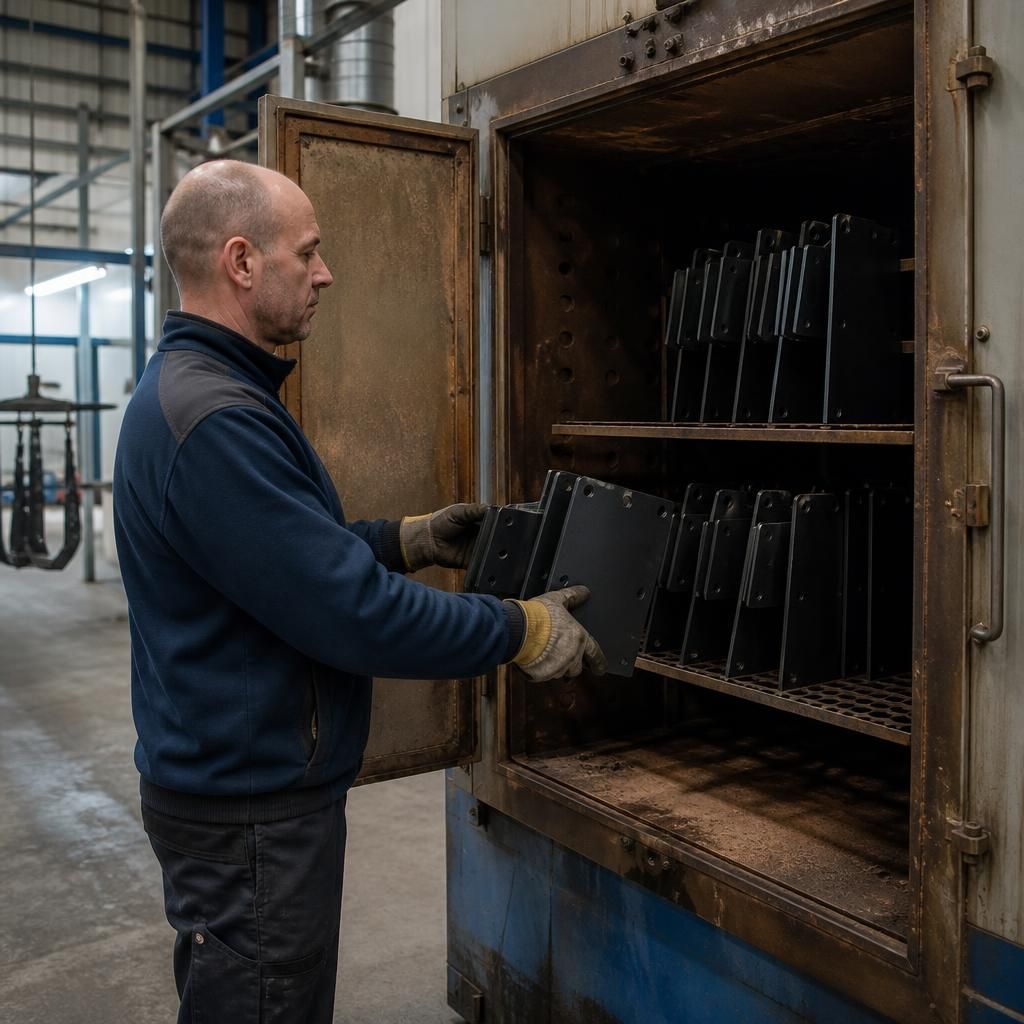
Interruptions to the bake cycle must be treated as a process change, not as a simple loss of oven time. If parts are removed, the oven door is opened or the load cools before the specified thermal exposure is complete, the time already elapsed may not be directly interchangeable with a later heating period. Reassess the part-temperature profile and follow the powder supplier’s guidance before returning the components to the oven. This is particularly important where a second cycle could expose the coating to excessive heat or alter its appearance.
Discuss Your Powder Coating Bake and Cure Requirements
Discuss your powder coating bake and cure requirements with our team, providing the powder data sheet and component details so the process can be assessed accurately. We can advise on suitable coating considerations for your metal parts and production requirements.