

What role does ambient temperature play in setting the curing and bake times for powder coatings?
Ambient temperature mainly affects how quickly the coated metal reaches the required curing temperature, so colder parts may need a longer heat-up period before the cure timer starts. Set bake times according to the component’s actual metal temperature and the powder manufacturer’s specification, rather than adjusting the cure time solely because the surrounding air is warmer or cooler.
Ambient temperature influences powder coating cure times mainly by changing the starting condition of the metal, the heat required to bring it to cure temperature and the amount of heat lost from the oven system. It should therefore be treated as a factor in establishing a repeatable bake schedule, rather than as a reason to alter the coating manufacturer’s specified cure requirements arbitrarily.
A component entering the process from a cold workshop begins with a greater temperature difference between its surface and the oven environment. It will absorb heat during the initial part of the cycle, which can affect how soon the coating reaches the conditions needed for flow, chemical reaction and final film development. A component that starts warmer may reach those conditions sooner, but this does not automatically mean that its total cure requirement is reduced. The coating still needs the specified combination of metal temperature and time.
The effect is more noticeable with heavy fabrications, thick plate, enclosed sections and assemblies containing different metal thicknesses. These parts can develop temperature differences internally, even when the surrounding air appears stable. A cold or substantial section may continue drawing heat away from the coated surface, while a thin edge heats more quickly. If the schedule is based only on the oven air reading, parts of the component may be under-cured or exposed to unnecessary heat.
Ambient conditions around the oven can also affect how consistently the equipment maintains its process temperature. A colder surrounding area may increase heat loss through doors, openings, walls and loading points. A warmer area can reduce that heat loss, although it does not remove the need to control the actual coating cycle. Frequent door opening, variable loading and changes in the temperature of incoming work can create greater variation than the room temperature alone.
For this reason, the appropriate response to seasonal or workshop temperature changes is normally better process control rather than a simple increase or decrease in bake time. A reliable assessment should consider:
- the temperature of the metal before it enters the oven;
- the mass, thickness and shape of the component;
- the number of parts loaded and their spacing;
- the oven’s recovery behaviour after loading or door opening;
- air circulation and the position of the component within the oven; and
- the coating system’s specified metal-temperature and time profile.
Thermal profiling is the most dependable way to assess these effects. Temperature probes attached to representative heavy, light and shielded areas show how the component heats through the cycle. The recorded profile can then be compared with the powder system’s requirements to establish whether the selected bake schedule provides sufficient exposure across the whole part. This is more informative than relying on a fixed oven setpoint or an assumed room temperature.
Ambient temperature also matters before curing takes place. Powder should be stored and handled in conditions that preserve its intended flow and application characteristics. If material or components are unusually cold, condensation and changes in powder behaviour may introduce defects that cannot be corrected by extending the oven cycle. The coating surface, substrate condition and application environment should therefore be checked as part of the wider process, while keeping curing decisions based on the approved technical data.
When ambient conditions change, the process should be reviewed whenever there is a noticeable difference in preheat conditions, loading behaviour or measured component temperature. Adjustments should be validated with a representative test load and documented thermal profile. The objective is not to make the coating hotter for longer, but to ensure that every relevant area of the metal receives the required cure without over-baking thin sections or heat-sensitive assemblies.
In production work, consistent results come from controlling the full thermal history: starting temperature, heat-up pattern, time at the required metal temperature and cooling conditions. Ambient temperature is an important influence on that history, but it should be managed alongside component design, oven performance and the coating’s technical specification rather than used as a standalone basis for changing bake times.
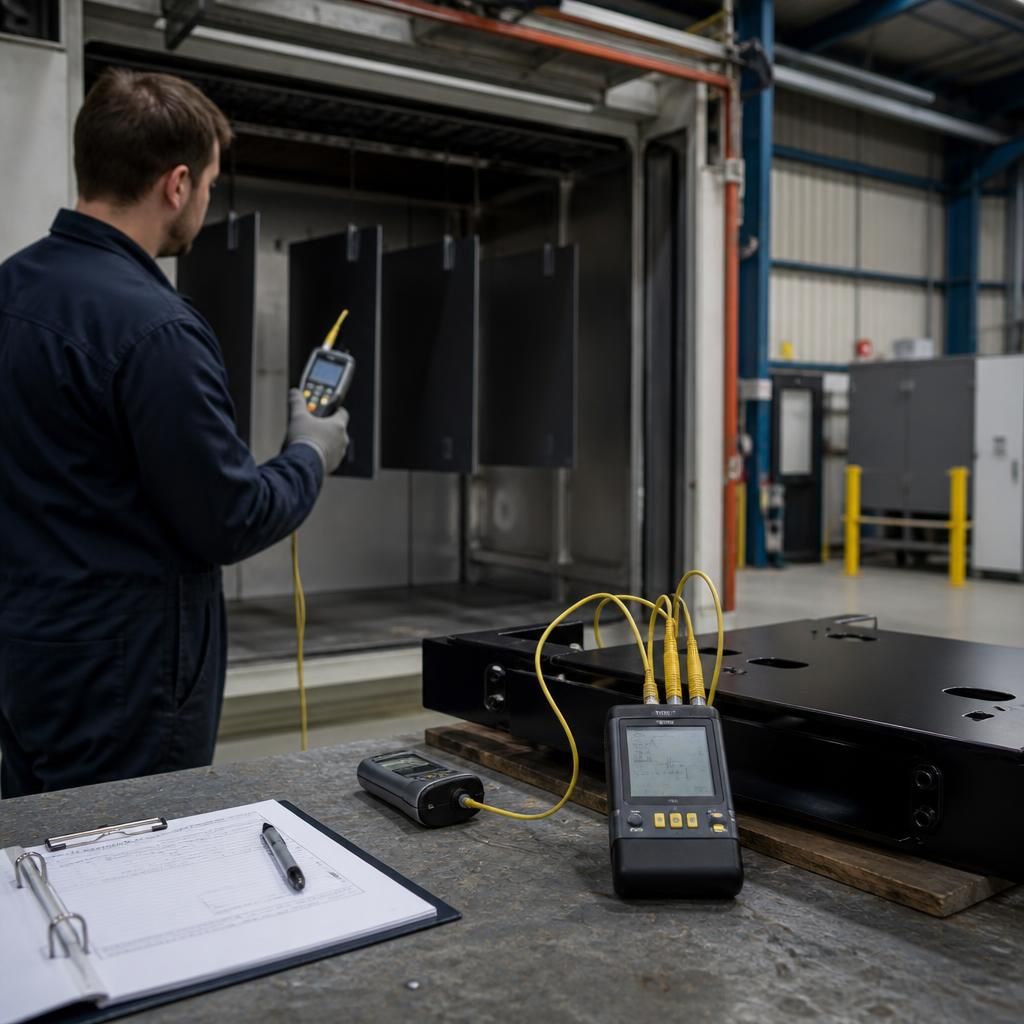
Ambient temperature can change how quickly a coated part appears to flow, level or cool, but visual appearance is not a reliable indication that curing is complete. A smooth film may still require further exposure at the specified metal temperature for the resin and cross-linking reaction to develop fully.
For this reason, operators should not use surface appearance, touch or the surrounding room temperature as the cure endpoint. The relevant comparison is the component’s measured temperature against the powder system’s approved time-and-temperature profile. This distinction helps prevent a part from being removed too early simply because it looks finished, or kept in the oven unnecessarily because a cooler environment has changed its apparent handling condition.