

What are the typical temperature ranges for curing powder coatings in a convection oven?
Most conventional powder coatings cure at a component metal temperature of approximately 160–200°C, although the precise range depends on the powder chemistry and specified cure schedule. In a convection oven, the air setting may need to be higher or maintained longer so the coated component reaches its required temperature; always follow the powder manufacturer’s specification.
In practice, powder coating is cured within a product-specific temperature window measured at the metal component, rather than by setting every convection oven to one universal temperature. The commonly used cure range for conventional powders is approximately 160–200°C at the component, but the required oven setting and dwell time depend on the powder chemistry, component mass and loading arrangement.
Component temperature versus oven-air temperature is the most important distinction. An oven display may show the air temperature, while the powder specification normally refers to the temperature reached by the coated metal. The component must absorb enough heat to reach the required cure temperature and remain there for the specified period. A heavy steel fabrication may therefore need a different oven programme from a thin pressed panel, even when both use the same powder.
Powder systems are available with different cure requirements. Some are formulated to cure at relatively lower temperatures, while others require a higher component temperature or a longer dwell period. The powder manufacturer’s technical data sheet should identify the approved cure schedule, usually by showing one or more combinations of component temperature and time. These combinations describe the cure window: a shorter dwell may be suitable at a higher metal temperature, while a longer dwell may be needed at a lower temperature.
The stated dwell time should generally be treated as beginning when the metal—not when the part enters the oven—has reached the specified temperature. This is particularly relevant for:
- thick or high-mass components, which absorb heat more slowly;
- assemblies with enclosed sections, boxed areas or substantial welds;
- thin components, which can heat rapidly and may be more vulnerable to overcuring;
- mixed batches containing parts with significantly different sizes or thicknesses; and
- heavily loaded ovens, where airflow and heat recovery can affect the heating rate.
Convection ovens transfer heat through circulating air, so the air temperature must be high enough, stable enough and evenly distributed for the parts to achieve their specified profile. An oven can show the correct average air setting while local cold spots, restricted airflow or poor loading prevent some components from curing fully. Parts should not be packed so closely that heated air cannot circulate around coated surfaces.
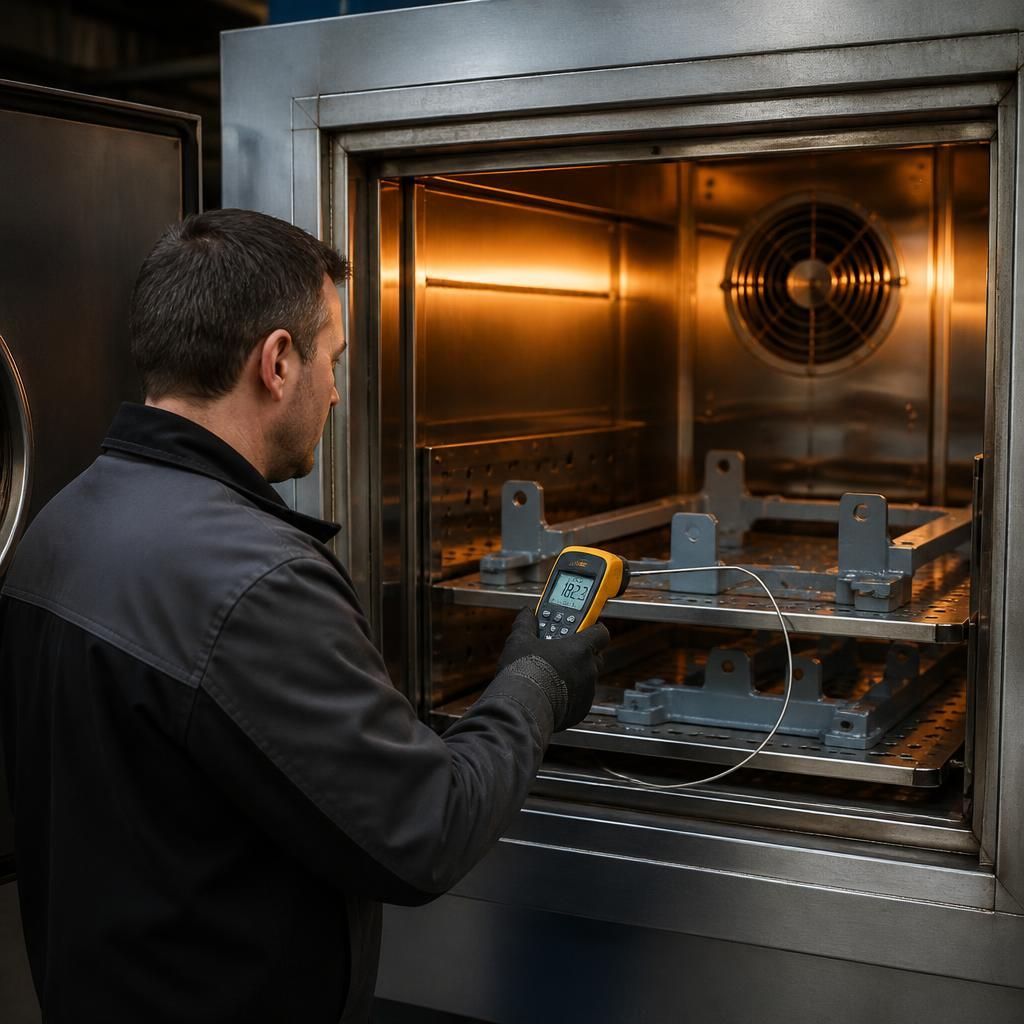
Measurement is more reliable than appearance alone. A cured coating may look smooth and glossy even when it has not reached the required metal temperature. For production validation, temperature probes or a suitable data-logging system can be attached to representative parts to record the actual metal-temperature profile. Measurements should include the areas most likely to heat slowly, such as thick sections, corners and thermally isolated features.
Insufficient heat exposure can leave the coating below its intended cure level, potentially affecting hardness, adhesion, chemical resistance and long-term performance. Excessive heat exposure can also be undesirable, causing changes such as gloss variation, colour shift or degradation, depending on the powder formulation. The correct objective is therefore not simply to use the highest available oven setting, but to achieve the specified component temperature and dwell profile consistently.
For a new powder, component design or batch arrangement, the practical process is to review the technical data sheet, select representative parts, attach temperature sensors where heating is likely to be slowest, and compare the recorded profile with the specified cure schedule. If the measured metal temperature does not reach the required range, changing the oven-air setting, dwell time, loading pattern or airflow may be necessary. Any adjustment should be verified on the component rather than judged solely from the oven controller.
Typical convection-oven curing temperatures are reference points rather than universal settings. The correct range is determined by the powder formulation and the temperature profile specified for the finished coating, so changing the powder can require a different process even when the same metal components and oven are used.
For production work, treat the technical data sheet as the controlling document. It should indicate the required metal temperature and permitted dwell combinations, including whether the coating is suitable for a lower-temperature cure or needs a higher-temperature cycle. This prevents a familiar oven setting from being applied incorrectly to a different powder system.
Discuss Your Powder Coating Curing Requirements
If you need to confirm the suitable curing process for a metal component or production batch, discuss the powder specification, component details and required finish with our powder coating team. We can help assess the coating requirements before you proceed with manufacture or finishing.