

How does the type of metal component being coated influence the curing and bake times?
The component’s material, thickness, mass and geometry affect how quickly it reaches the powder coating’s required curing temperature. Thin sections heat rapidly, while heavy or complex parts with deep recesses and varying wall thicknesses may need a longer bake so the coldest areas achieve the specified metal temperature without over-curing exposed surfaces.
The type of metal influences powder coating cure time mainly through its thermal behaviour, surface condition and construction. The curing schedule is based on the temperature reached by the metal substrate, not simply the temperature shown by the oven controller. Consequently, two components placed in the same oven can require different dwell times to achieve the same cure, even when they have been coated with the same powder.
Common substrate differences
- Mild or carbon steel: This is a common powder coating substrate and usually gives predictable heat transfer when the component is clean and prepared correctly. Its coating schedule still needs to be checked against the actual part temperature, particularly where the steel has been fabricated into an assembly.
- Stainless steel: Stainless grades transfer heat differently from ordinary carbon steel. The difference may affect the time taken for the substrate to reach the required curing temperature, while the surface condition and preparation method can also influence coating performance.
- Aluminium: Aluminium conducts heat efficiently, so it can respond differently to the oven environment from steel components. Its high thermal conductivity can move heat away from the coated surface, especially through connected sections or areas fixed to larger aluminium structures. The selected curing schedule should therefore be validated on the finished component rather than assumed from a steel equivalent.
- Galvanised or zinc-coated steel: Zinc-coated surfaces can release gases or moisture when heated. If the substrate, coating and preparation process are not suitable, this can lead to pinholes, bubbling or other surface defects. Bake conditions may need to account for outgassing, but extending the cure alone will not correct an unsuitable preparation or powder system.
- Cast metals: Cast iron and cast aluminium may contain pores, residues or absorbed moisture that become significant during heating. A staged preparation and controlled preheating process may be needed to reduce the risk of gases escaping through the powder film. The appropriate process depends on the casting, its history and the coating specification.
Surface condition can alter the practical schedule
Metal type is only one part of the assessment. Mill scale, oil, corrosion products, blasting residue, conversion coatings and previous finishes can change how the surface accepts powder and how it behaves during heating. A component that has been heavily blasted, chemically treated or preheated may need different handling from a clean, untreated part. Preparation must also be compatible with the substrate: an aggressive process suitable for carbon steel may damage or contaminate aluminium, zinc-coated steel or stainless steel.
Some metals and castings can retain moisture or contaminants in pores, seams and joints. Heating these areas can produce vapour or gas beneath the powder film. This is a process issue rather than a simple question of adding minutes to the bake. Cleaning, drying, degassing and selecting a suitable coating system are often more important than increasing the oven dwell.
Assemblies and mixed-metal components
A fabricated item made from different metals can have several thermal responses within one coating cycle. For example, a steel frame with aluminium panels, zinc-coated brackets or stainless fixings may not bring every section to the target metal temperature at the same time. Heat can also pass between joined components, creating local areas that cure at a different rate from exposed surfaces.
Welds, folded joints, overlaps, boxed sections and bolted interfaces can create additional variation. Enclosed sections may trap air or moisture, while narrow gaps can restrict cleaning and powder access. Components should be designed or presented for coating so that air can circulate, drainage is possible and the coating is not deposited excessively in corners. Where different metals are permanently joined, the coating provider needs to know the full construction rather than treating the item as a single uniform substrate.
Fixtures, contact points and masking
Hanging points and racks can draw heat from a component or shield small areas from oven air. Contact marks may also expose bare metal, making it important to position the part so that critical surfaces receive an even coating and the item is supported without creating substantial cold spots. Masking materials, plugs and protective caps must tolerate the curing conditions and should not interfere with heat transfer or release contaminants.
Threaded holes, machined faces, bearing seats and electrical contact areas may need masking or a controlled coating thickness. These details do not necessarily change the nominal cure schedule, but they can affect how the part is loaded, supported and monitored. They should be considered before the curing cycle is selected.
How the correct time is established
- Identify the substrate or combination of substrates, including any plating, galvanising, casting or previous treatment.
- Review the powder coating’s specified metal-temperature profile and confirm whether it is suitable for the component and its intended use.
- Assess the complete part, including joints, enclosed sections, contact points and areas connected to larger masses.
- Use temperature measurement on representative locations to establish when the slowest-heating critical area reaches the required temperature.
- Set the dwell period from that verified point, rather than starting the timer as soon as the oven air reaches its set temperature.
- Inspect the finish and, where necessary, verify cure using an appropriate process-control method.
The aim is not to bake every metal component for as long as possible. Insufficient heat or dwell can leave the film under-cured, reducing its intended hardness, adhesion and resistance to service conditions. Excessive heat can discolour some finishes, damage heat-sensitive substrates or create defects in the coating system. The suitable process is therefore the shortest validated cycle that brings the relevant metal areas through the powder’s specified cure profile.
For mixed batches, components should be grouped by substrate, construction and thermal response where practical. If that is not possible, the cycle should be checked against the part most likely to heat slowly, while ensuring that sensitive finishes and substrates are not exposed to unnecessary heat. For complex industrial components, trial loading and temperature profiling provide more reliable information than relying on oven air temperature alone.
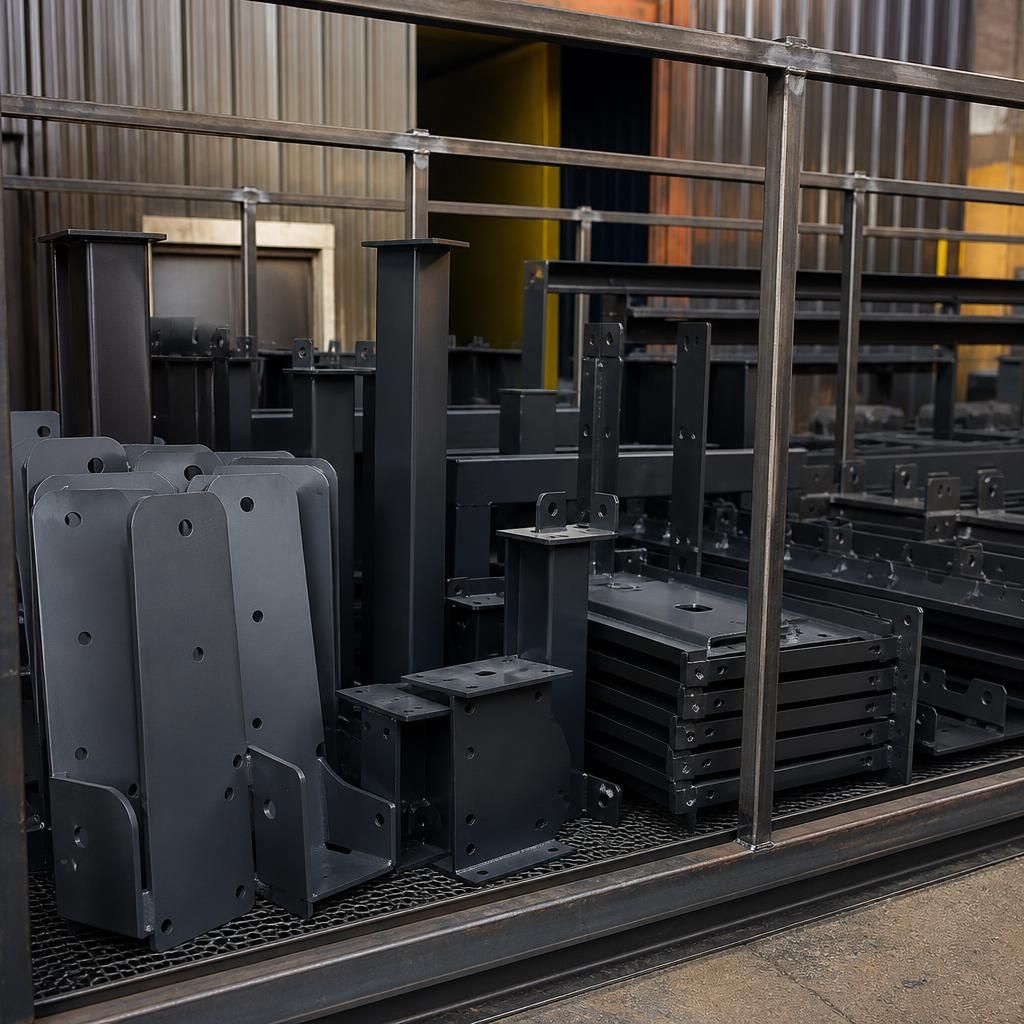
The oven load can influence a component’s effective cure time as much as its material. When parts are densely packed, closely nested or positioned beside substantially heavier items, the available heat transfer to individual surfaces may change. This is particularly relevant when a batch contains a mixture of thin brackets, large fabrications and enclosed assemblies.
For consistent results, load components with sufficient separation for heated air to reach their coated surfaces and avoid treating a heavily loaded batch as equivalent to a lightly loaded one. Temperature profiling should represent the most thermally demanding position and part in the load, so the selected dwell time reflects the actual batch rather than an idealised oven condition.