

How does convection oven air circulation impact the curing process of powder coatings?
Convection oven air circulation transfers heat evenly around coated components, helping the powder reach its specified curing temperature consistently. Poor or uneven airflow can create hot and cold spots, causing under-curing, over-curing or inconsistent finish quality and durability across a batch.
Convection oven air circulation affects powder coating curing by controlling how efficiently heat moves from the oven atmosphere into the metal component. The powder does not cure simply because the oven reaches its set temperature; the coated part must absorb sufficient heat for the required time. Air movement therefore influences heat transfer, temperature recovery and the consistency of the cure throughout a component or batch.
Airflow and heat transfer
Moving air continually replaces the cooler layer of air next to the metal surface with warmer oven air. This improves convective heat transfer compared with still air and helps the component progress through powder melting, flow and crosslinking. The effectiveness of that transfer depends on the part’s shape, mass, surface area and position in relation to the oven’s supply and return air paths.
Air velocity is not the only consideration. The direction of the airflow, the distance from circulating fans or ducts, and the way air is distributed within the chamber all affect how energy reaches the load. A strong stream directed at one area does not necessarily produce better curing than a controlled, well-distributed circulation pattern. Excessive turbulence can also disturb loose powder on inadequately grounded or poorly prepared components before the coating has fused.
The relationship between oven temperature and part temperature
The oven’s displayed temperature describes the surrounding air, not necessarily the temperature of the metal. A heavy steel component, a hollow fabrication and a thin pressed part can respond differently to the same air conditions. Air circulation helps reduce the delay in heating, but it cannot remove the effect of component thickness or thermal mass.
For this reason, a curing schedule should be assessed against the coating manufacturer’s specified metal-temperature profile. The relevant sequence normally includes:
- the time required for the component to reach the coating’s curing temperature;
- the period for which the metal remains at that temperature; and
- the cooling behaviour after the required cure has been completed.
Relying only on the oven setpoint can result in a component being removed before the coating has received its full cure, particularly where the load contains thick sections or densely packed parts.
How the load changes circulation
The arrangement of parts inside the oven has a direct effect on airflow. Closely spaced components can shield one another and restrict the movement of heated air around internal faces. Large panels, boxed sections and fabrications with cavities can create stagnant areas, while a heavily loaded rack can obstruct the intended return-air path. Parts should therefore be positioned to allow air to reach all relevant coated surfaces without unnecessarily blocking circulation around the load.
Hanging orientation also matters. A component suspended in one position may expose its broad face to the airflow, whereas rotating or rearranging it may improve access to recessed or sheltered areas. Racks, hooks and fixtures should be considered part of the thermal load because they absorb heat and can affect the way air moves around the work.
Effects on the finished coating
Appropriate circulation supports more consistent melting and flow, allowing the film to level before it completes its crosslinking reaction. If airflow or heat transfer differs substantially around a part, the coating may show variation in gloss, texture, flow, hardness or resistance to service conditions. These symptoms should not automatically be attributed to airflow alone: film thickness, pretreatment, powder storage, contamination and the selected cure schedule can also influence the result.
Overly aggressive or poorly directed circulation may contribute to visible surface disturbance while the powder is still loose. Conversely, insufficient movement can make the oven slow to transfer heat into heavy loads and can increase the difference between air temperature and metal temperature. The objective is controlled circulation that supports heat transfer without disrupting the coating or creating unnecessary thermal stress.
Oven checks and process control
Reliable curing requires the oven’s circulation system to be assessed under representative operating conditions rather than with an empty chamber only. Useful checks include:
- confirming that fans, ducts, dampers and return paths are functioning as intended;
- checking that the load does not obstruct supply or return air routes;
- comparing conditions at different positions within the working zone;
- monitoring the temperature of representative parts with suitable probes or data-logging equipment; and
- repeating the assessment after significant changes to load size, component geometry or hanging arrangement.
Part-temperature monitoring is particularly valuable for thick, complex or high-mass components. It shows when the metal actually enters the specified curing range and whether sheltered surfaces follow the same thermal profile as exposed surfaces. The findings can then be used to adjust loading, airflow settings or the oven programme in accordance with the coating supplier’s technical information.
In practice, convection airflow should be treated as one element of a controlled curing system. Correct circulation, suitable loading, accurate temperature measurement and adherence to the specified cure profile work together to produce a properly fused coating. Air movement can improve the transfer of heat, but it cannot compensate for an unsuitable powder, inadequate preparation, excessive film thickness or a curing schedule that does not match the component.
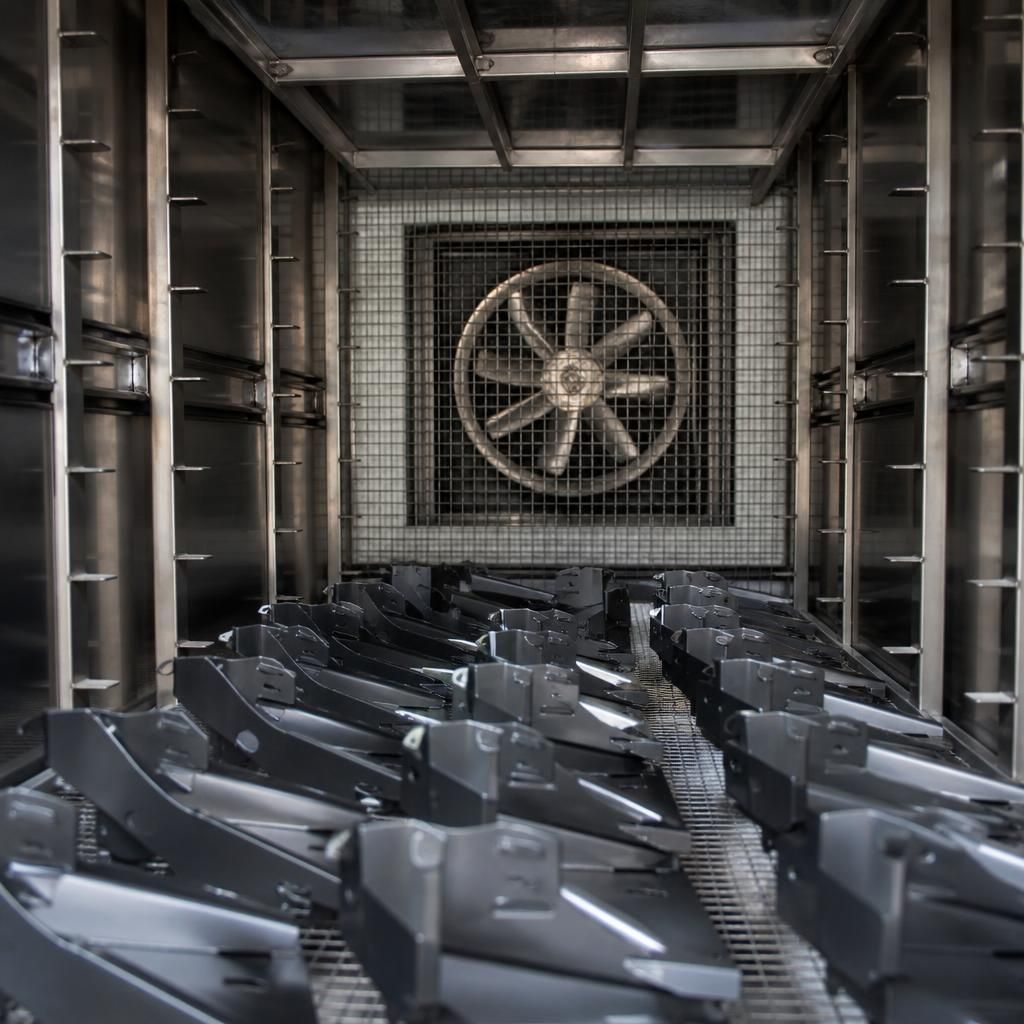
Convection oven air circulation also helps control the atmosphere around the coating as the powder melts and cures. The process releases vapours, which need to be managed through the oven’s recirculation and exhaust arrangement. If extraction is excessive, heated air can be removed too quickly and the oven may struggle to maintain its intended curing conditions. If ventilation is insufficient, released vapours may remain around the load and contribute to surface imperfections.
The aim is a balanced system in which heated air is recirculated consistently while the necessary exhaust is maintained. Airflow performance should therefore be considered alongside damper settings, fan operation and the oven’s temperature controls when investigating inconsistent curing or finish defects.
Discuss your convection oven curing requirements
Discuss your convection oven curing requirements with Powder-coatings.co.uk, providing component dimensions, material details, batch arrangement and the powder’s specified cure profile. This information can help the coating team assess the process requirements before production.