

How do bake times affect the durability of high-temperature powder coatings?
Bake time directly affects the durability of high-temperature powder coatings because the coating must reach and remain at its specified cure temperature to develop full hardness, adhesion and resistance to heat, chemicals and wear. Under-baking can leave the finish soft or poorly bonded, while excessive baking may damage the coating, so the specified time at the metal’s actual temperature—not simply the oven’s set temperature—must be followed.
Bake time affects the durability of a high-temperature powder coating by controlling how completely and uniformly the coating develops its final chemical structure. The relevant measure is the time the metal and coating film remain within the specified curing range, rather than the time shown on the oven timer. A component can therefore receive a different cure from another component in the same load if its thickness, shape or starting temperature differs.
A coating that has not received a sufficient thermal cycle may appear acceptable immediately after removal from the oven but perform poorly in service. Its resistance to impact, abrasion, solvents and repeated heating can be reduced, and the finish may be more vulnerable to damage at edges, corners and fixing points. These weaknesses are not always visible during a visual inspection, which is why bake time must be controlled as a process variable rather than judged by appearance alone.
Excessive baking can also reduce long-term performance. Prolonged or unnecessarily intense heating may cause changes in colour, gloss or surface texture and can make some films less flexible. Repeated over-baking of the same coating system can also affect its ability to tolerate thermal cycling. The correct cure is therefore a defined balance: enough heat exposure to complete the formulation’s reaction, without adding avoidable thermal stress.
Time at part temperature is the critical measurement. The oven’s air may reach its set point before the workpiece does. This is especially important for:
- thick steel sections, castings and components with substantial thermal mass;
- closely packed loads that restrict heated air around the parts;
- assemblies with enclosed areas, deep recesses or overlapping sections;
- large components entering the oven at different starting temperatures; and
- parts suspended on heavy hooks, racks or fixtures that absorb heat.
In these situations, the timer may begin before the coating itself has reached the required curing conditions. Treating the oven dwell period as the curing period can consequently produce inconsistent results between small and large components. A smaller item may be exposed for longer than necessary while a heavier item is still approaching the required temperature.
Component design and load arrangement also influence heat transfer. Flat, lightly constructed parts generally respond differently from fabricated frames, boxed sections and multi-layer assemblies. Contact points between parts can shield areas from circulating air, while tightly arranged loads can create cooler zones. Coated surfaces should be positioned so that heated air can circulate around them, with sufficient separation to avoid shadowing and uneven heating.
Film thickness is another consideration. A thicker deposited film may require the same specified schedule to be achieved throughout the coating rather than just at its surface. If powder accumulates at corners, welds or recessed areas, those locations can behave differently during heating and may show variations in finish or performance. Consistent preparation, application and film-thickness control help make the specified bake schedule repeatable.
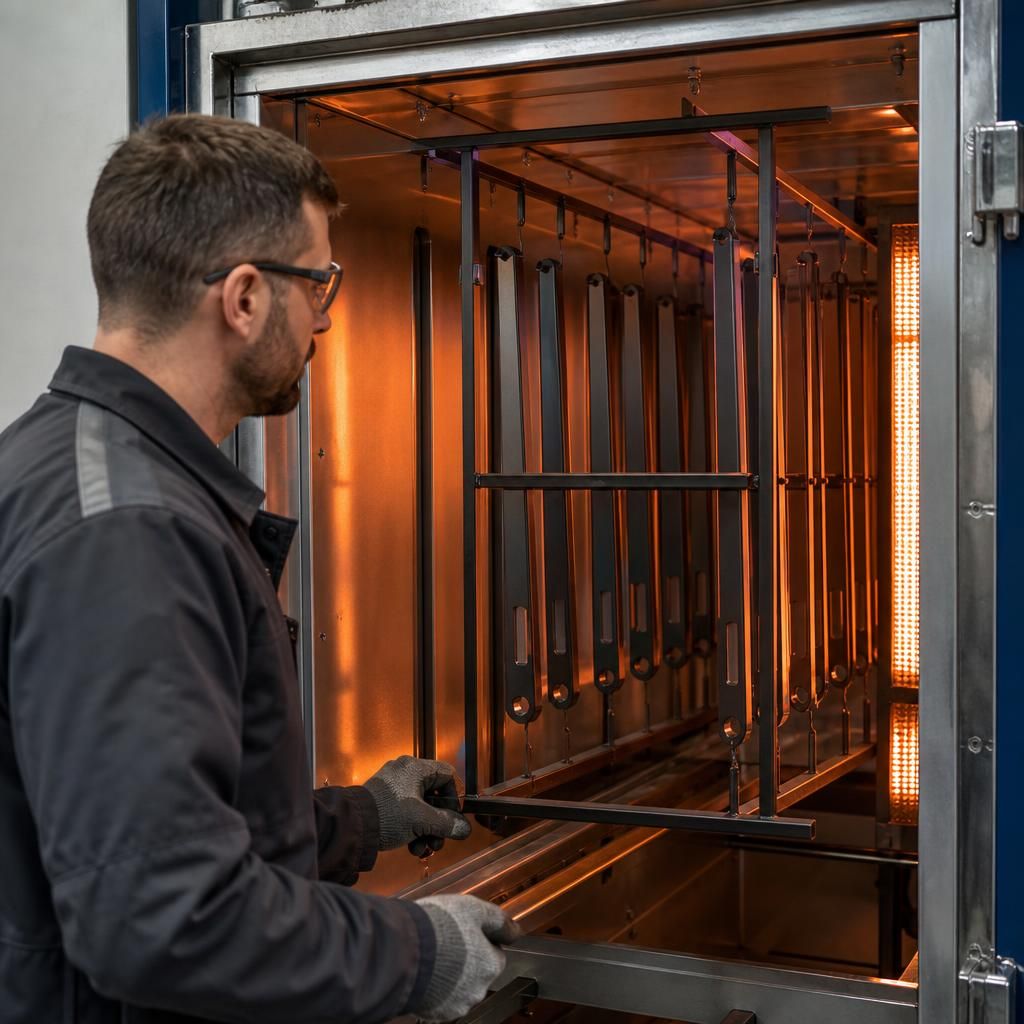
For production work, the curing profile should be checked on representative parts rather than inferred from the oven display. Temperature-recording equipment can be attached to or positioned against the workpiece to show when the metal enters the curing range and how long it remains there. This helps identify slow-heating areas, temperature differences between load positions and any excessive dwell after the required cycle has been completed.
Oven control should be reviewed alongside the bake time. Relevant checks include the accuracy of temperature sensors, the condition of heating elements, air circulation, door seals and the consistency of airflow between different oven zones. A correctly entered timer cannot compensate for poor temperature distribution. Calibration and profiling are particularly valuable when changing from small components to heavy fabrications or when introducing a different high-temperature coating system.
When assessing durability, curing should be considered together with surface preparation, substrate cleanliness, application thickness and handling after coating. A suitable bake schedule cannot correct contamination, inadequate preparation or mechanical damage introduced during cooling and assembly. Conversely, a well-prepared part can still develop inconsistent performance if its thermal profile varies substantially across the load.
For this reason, the coating product’s technical documentation should define the required temperature and time relationship, and that schedule should be applied to the actual component rather than copied from a previous job without review. Where parts vary significantly in size or construction, separate profiles or adjusted loading arrangements may be necessary. This approach gives high-temperature powder coatings a more consistent foundation for resisting the heat, handling and service conditions for which they were selected.
Bake time determines whether a high-temperature powder coating cures correctly; it does not define the coating’s maximum service temperature. A coating may require a particular oven schedule to develop its properties, while its technical documentation separately states the temperatures it can withstand during use. These two temperature ranges should not be treated as interchangeable.
Durability therefore depends on matching the coating system to the component’s actual operating conditions, including continuous heat, intermittent temperature peaks and exposure to chemicals or abrasion. If the service temperature exceeds the coating’s stated capability, extending the bake time will not compensate for that mismatch. The correct approach is to verify the product’s cure schedule and service limits before coating, then assess both against the component’s intended application.