

How does the curing process in high temp powder coating affect the overall performance and durability of metal components?
During curing, high temp powder coating melts, flows and chemically cross-links to form a continuous protective film on the metal component. Correct control of the curing temperature and time improves coating adhesion, hardness, chemical resistance and long-term durability, while under-curing or over-curing can weaken the finish and reduce its performance.
The curing process determines whether a high temperature powder coating develops the properties required for the component’s working environment. The coating must receive the correct thermal exposure throughout its film and across the whole part, so that the finished surface can withstand heat, thermal cycling, handling and contact with other materials without premature breakdown.
It is important to distinguish the coating’s curing temperature from its service temperature. The curing temperature is the oven condition needed to develop the coating, whereas the service temperature is the heat the finished component can tolerate in use. A coating designed for elevated-temperature service may still require a controlled cure in a conventional industrial oven. Selecting a product solely because it has a high stated service temperature can therefore produce poor results if the curing requirements are not compatible with the substrate, component size or available process.
Correct curing affects performance in several practical ways:
- Thermal cycling: Components that repeatedly heat and cool place stress on the coating and the metal beneath it. A properly developed film is better able to accommodate expansion and contraction without cracking, flaking or losing continuity.
- Resistance to service conditions: The cured film must retain its protective function when exposed to the operating temperature, moisture, chemicals, oils or industrial contaminants relevant to the application. The exact result depends on the powder formulation as well as the cure.
- Mechanical performance: Handling, assembly, vibration and contact with adjacent parts can expose weaknesses in the coating. Cure quality influences whether the surface remains intact during these activities, particularly on edges, corners and areas subject to repeated contact.
- Appearance retention: Incorrect thermal exposure can affect the uniformity of colour, gloss and texture. Heat-sensitive pigments or specialist finishes may show visible variation if different parts of a component experience different oven conditions.
- Protection of the substrate: A continuous, well-developed film limits pathways through which moisture and contaminants can reach the metal. This is especially relevant where components are exposed to outdoor conditions or corrosive industrial environments.
The oven temperature alone does not define the cure. The metal must reach the required temperature, and the coating must remain at that condition for the specified period. Large, dense or complex components may heat more slowly than thin sections, while recessed areas and assemblies with different material thicknesses can experience uneven heat transfer. Measuring or validating the part temperature is therefore more meaningful than relying only on the oven’s displayed air temperature.
Component design also affects the final result. Sharp edges, folded sections, welds, blind recesses and areas where components touch can collect powder or receive less consistent heat. Excessive film build may alter the way the coating responds to heating, while insufficient coverage can leave weak points in the protective system. These issues are addressed through suitable application control, rack positioning and a cure schedule matched to the component rather than applied as a fixed assumption.
The metal itself must also be considered. Steel, galvanised steel, aluminium and previously treated surfaces can absorb and transfer heat differently. Residual oil, moisture, fabrication contamination or trapped gases may become visible during heating and cause pinholes, blisters or other surface defects. Proper preparation and suitable pre-treatment reduce these risks, but the curing stage can reveal them if they have not been dealt with earlier in the process.
For parts that will operate near their thermal limit, performance should be assessed across the full duty cycle rather than at a single peak temperature. Relevant questions include:
- How frequently will the component heat and cool?
- Will it be exposed to direct heat, radiant heat or a combination of heat and chemicals?
- Are dimensional tolerances, moving interfaces or electrical insulation properties important?
- Will the finish be subjected to abrasion, impact, outdoor weathering or cleaning agents?
- Does the powder specification suit the substrate and the available curing equipment?
In industrial production, a reliable process links the powder specification, preparation method, application thickness, part temperature and oven profile. Checking representative components is particularly useful where geometry varies between batches. This helps identify cold spots, excessive heat exposure and visual or functional changes before a larger production run is coated.
High temperature powder coating can therefore improve the working life of metal components, but the result depends on a controlled and application-specific cure rather than the coating label alone. For manufacturers and fabricators, confirming the required service conditions and matching them to the coating data and component design is essential when durability, appearance and consistent batch performance are important.
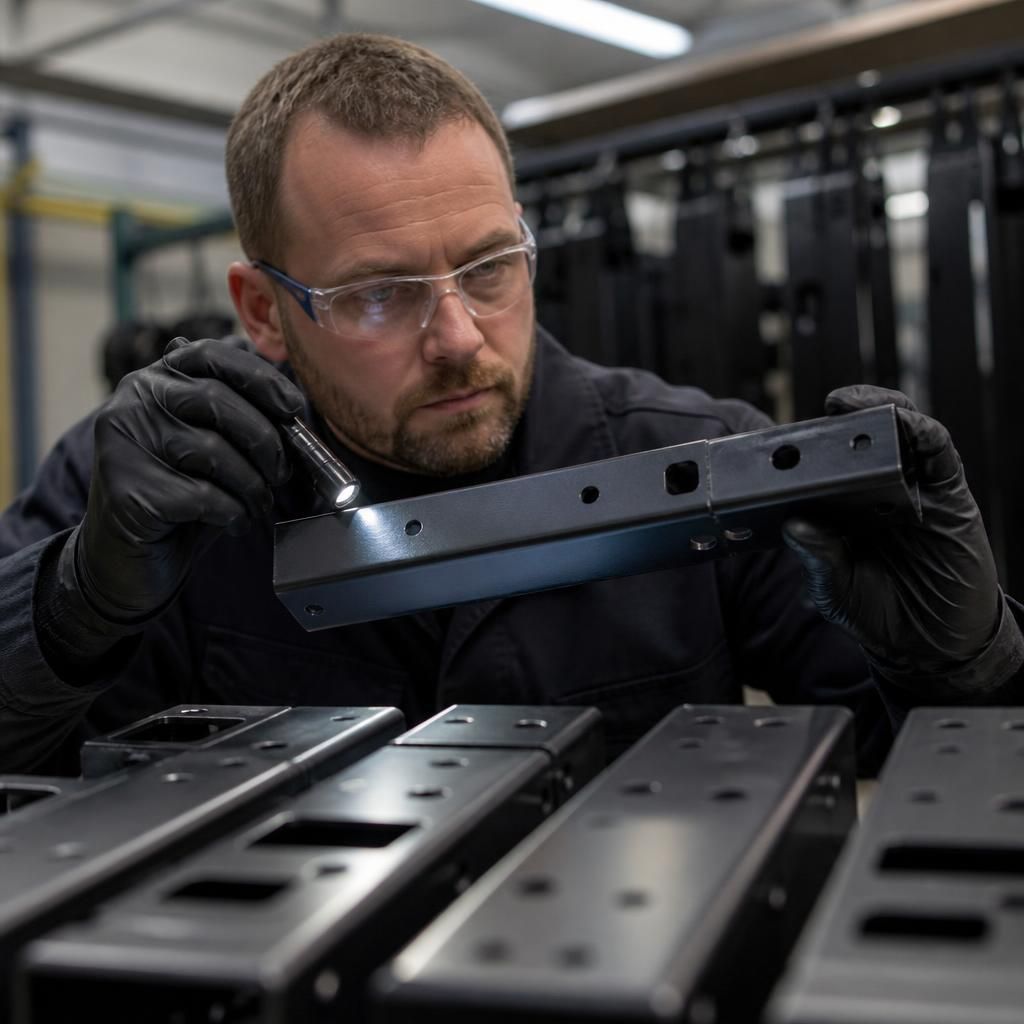
Curing performance is best confirmed by checking the finished film, not by relying on the oven display alone. A coating may appear smooth while remaining insufficiently cross-linked, or it may show colour and gloss changes after excessive thermal exposure. Production checks should therefore compare the cured finish with the coating specification and the component’s intended use.
- Inspect the surface for pinholes, blisters, craters, uneven gloss and colour variation.
- Check adhesion and hardness using test methods appropriate to the coating system and substrate.
- Where required, assess resistance to the chemicals, abrasion or cleaning agents encountered in service.
- Record results for representative parts when component geometry or film thickness changes between batches.
These checks help distinguish a genuine curing problem from defects caused by preparation, contamination, excessive film build or uneven application. Any test method should follow the powder supplier’s technical guidance, as a result that is suitable for one formulation may not accurately assess another.
Discuss your high temp powder coating curing requirements
Discuss your component’s substrate, dimensions, operating conditions and required finish with a powder-coating specialist to establish suitable curing requirements. Powder-coatings.co.uk can help assess the coating specification and process considerations for your industrial parts.